Turning experts into journalists: Two years of The Conversation

Stephen Khan
is editor of The Conversation.
Two years ago we invited Stephen Khan, editor of a new journalistic enterprise called The Conversation, to write about his project. Here’s an update on how the work of bringing academia and journalism together is going:
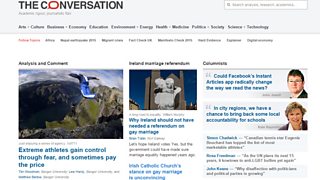
Our newest political correspondent is based in Bangor, north Wales. We have a health columnist in Surrey. Experts in Aberdeen provide analysis of earthquakes around the world. And a science team in Hull regularly sheds light on important breakthroughs.
The Conversation launched in the UK from an office on top of City University in London. Since then we have commissioned thousands of new writers - all experts in their field. The Conversation is a collaboration that brings professional editors and academics together to provide trustworthy, rapid news analysis and comment.
A year ago we were attracting around two million views a month. Now that figure has leapt to more than 10 million. And our team of full-time editors has grown from seven at launch to 16 now. We have been joined by sister publications in the United States and Africa.
The idea for The Conversation was born in Australia in 2011. The thinking was that in a world of shrinking newsrooms, and in particular a decline in the number of specialist journalists on regional and national news titles, there was scope for new ways to convey complex but important information. Rapid technological advances mean that the public are besieged by a relentless onslaught of news, comment and analysis. But how do readers know what to believe and who to trust? By seeking out authoritative experts The Conversation offers to provide an answer.
In some respects we operate like a traditional newsroom. We meet for morning conference, editors discuss key events taking place in their areas, and we commission content. But the articles, which are typically around 700 to 800 words, are written by unpaid academics. Some become regular writers, but every week we bring to publication many who have never before written for a general readership.
It’s an interesting process. There is the occasional dispute over jargon. One editor was told she was stupid if she didn't understand a fairly complex technical term. With admirable professionalism she talked our expert around, persuading him that a different approach would bring in more readers and ultimately be of benefit to him.
These sometimes delicate negotiations often play out in the arena of our content management system which allows editors and academics to work on the pieces together. Headlines can present difficulties. But our whole team has learned to operate diplomatically in this new environment and in general academics respect our editors' sense of what will ‘sell’ a story.
The result is content that can be dynamic and agenda-setting. As I’ve written elsewhere, those pondering the future of journalism often focus on technology - wondering how Periscope, Facebook and Apple will change the delivery of news. The question of what content will be delivered is equally important. We are pioneering a different kind of journalism by channeling and sharing news writing skills with people who have access to great stories and expertise through their research.
Our content is free to read and republish, bringing our writers to a large and broad readership. Most weeks see a mix of republications: from traditional big media sites such as CNN, the Guardian and Washington Post to start-ups such as Quartz and Scroll.
So how is this model sustainable in the torrid economic environment for news media? The Conversation UK is set up as a charity with all its funding supporting the editorial team and support staff. The bulk of our money comes from the academic sector - central bodies such as the Higher Education Funding Council for England (HEFCE) as well as universities that take out membership.
We began with 13 universities backing us and we now have 40, with four more pledged to join, including the universities of Oxford and Glasgow. Membership gives them access to metrics about readership and a training programme run by our editors to help academics write for a general audience.
We originally launched The Conversation in the UK as a six-month pilot project, hoping to prove its viability in the northern hemisphere. Two years on it is a vibrant community of thousands of academics with a strong base of regular readers, most of whom, our surveys suggest, are educated but not academics. And it is allowing our expanding team of paid editors to deliver news analysis and comment that is rooted in expertise.
Amid concern over clickbait and the sidebar of shame, The Conversation proves it’s not all bad news for news.
