Competing interpretations of Ukraine: Journalism v propaganda
Stephen Ennis
is Russian media analyst for BBC Monitoring.
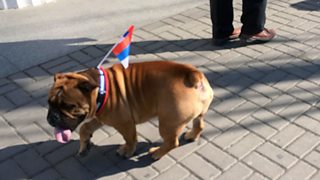
Russian-supporting dog in Sevastopol, April 2014
Russian media saw things differently. "The Donetsk self-defence force dispersed a march of neo-Nazis," reported the pro-Kremlin news channel LifeNews.
Reporting of the current crisis in Ukraine has raised several issues of journalistic rights and ethics, including the difference between a journalist and a propagandist and how governments should deal with reporters from an unfriendly state in conditions of "information warfare".
A few days earlier various pro-Kremlin media had shown footage of bound, blindfolded and bloodstained captives being interviewed, or rather interrogated, in the pro-Russian stronghold of Slovyansk. The men were said to be Ukrainian security service officers. According to freelance journalist Leonid Ragozin, the people who produced these reports were not journalists as such but "propaganda workers".
The Ukrainian authorities view Russian media reports like this as acts of "information warfare" and have responded by ordering cable operators to drop state-owned Russian TV channels from their packages. They have also deported several Russian journalists and stopped others from entering the country.
Among those targeted have been not only employees of Russian state TV and pro-Kremlin media, such as LifeNews, but journalists from other Russian media organisations that do not necessarily toe the Kremlin line. They include Roman Super of REN TV, Andrey Kolesnikov of the business daily Kommersant and Vsevolod Boyko of editorially independent Ekho Moskvy radio.
This indiscriminate approach has been criticised by leading journalists and media industry figures including the Guardian's Shaun Walker, Aleksandr Vinokurov, co-owner of independent Russian TV station Dozhd, and Ekho Moskvy's editor-in-chief Aleksey Venediktov. Writing on Ekho's website, Venediktov said that if you "stop journalists from entering your country on invented and laughable pretexts (lack of funds for an assignment by an Ekho journalist), then the suspicion arises that you are covering up events that are unpleasant for the Ukrainian authorities”.
He continued: "You are restricting the ability of our listeners and the readers of our website to be informed - let them make up their own minds about the Ukrainian government and its aspirations for democratic transparency."
Venediktov's intervention appeared to do the trick. Boyko was allowed to enter Ukraine shortly afterwards.
Others have been more understanding of the Ukrainian authorities.
"If I were a [banned] journalist, I would not be offended at the Ukrainian authorities, but would thank our colleagues who have drowned everything in lies. We are suffering because of our own swine," tweeted Pavel Sheremet, a Belarusian journalist who has worked for several of Russia's top media organisations.
Similarly, Igor Yakovenko, former secretary of the Russian Union of Journalists (RUJ), suggested it was unreasonable to expect Ukrainian border officials to distinguish between "journalists and provocateurs when an information war is being waged".
The issue of deciding whether or not someone is a proper journalist has also arisen in connection with the EU's inclusion of TV anchor Dmitriy Kiselev in its list of Russian public figures targeted by sanctions in response to Moscow's annexation of Crimea. Fronting official channel Rossiya 1's weekly current affairs programme Vesti Nedeli, Kiselev has arguably been the chief cheerleader of President Putin's policy on Ukraine. He was also recently appointed to head the new state news agency Rossiya Segodnya (Russia Today).
The EU did not specify why Kiselev had been included on the sanctions list, but the general assumption appears to be it is because it sees him not as a journalist but a propagandist - or the Kremlin's "chief propagandist", as the Financial Times recently put it. Kiselev does not seem to particularly balk at the label. He recently said his show "promotes or rather propagandises - I'm not afraid to use the term - healthy values and patriotism". In the Guardian, he dismissed the idea that "sanctions can restrict freedom of speech in this day and age, even if you call it propaganda".
The Guardian described Kiselev as a "journalist". But popular US blogger and activist John Aravosis has his doubts - arguing that Kiselev as well as the US Fox News fail a crucial test because they do not genuinely seek the truth.
Aravosis also quoted a definition of ‘journalist’ from New York University's Journal of Legislation and Public Policy as "someone employed to regularly engage in gathering, processing and disseminating (activities) news and information (output) to serve the public interest (social role)".
The reference to "public interest" may provide a clue as to why many Russians have a rather different conception of journalism from how the term is generally understood in the West. Whereas in the USA and UK, with their multitude of independent institutions, there is a clear distinction between the public interest and the interest of the state, in Russia, with its long history of autocracy, the two are much more likely to be conflated.
A recent poll by the Public Opinion Foundation (FOM) suggested that more than 70 per cent of Russians think it acceptable to "suppress information" in the interests of the state, and more than 50 per cent think it acceptable to "distort information" to this end.
The College of Journalism’s Russian website
