What price polling day? Here’s what we know

David Cowling
is editor, BBC Political Research
May 2015, the likely next general election date, may seem a long way off. But by the time we broadcast our election results programme a massive operation that completely dwarfs anything we plan to do will have been in preparation for many months, and will be launched 15 hours ahead of our transmission.
The precise details of how elections are delivered are fragmentary. Hansard (27 April 2011) records Labour MP John Spellar asking what was “the cost to the public purse” of the 2010 general election.
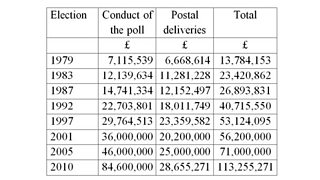
Cabinet Office minister Mark Harper had the figures: £113,255,271 was his estimate - £28,655,271 for the cost of distributing candidates’ mailings and another £84.6m for “the conduct of the poll”.
British Electoral Facts 1832-2012 records the following total costs (see page 21) for election administration and postal deliveries:
We know that the 2010 general election was contested by 4,150 candidates, representing 135 political parties; that UK electoral registers contained 45.6 million entries (an increase of 1.3 million since the 2005 general election); that just over 82% of all votes were cast in polling stations, and the remaining 12% by post.
And that, as they say, is about it as far as our information goes.
(I was fascinated though to read this footnote in British Electoral Facts: “Returning officers’ expenses include the administrative costs of the election, printing etc. Prior to 1918 these charges were paid by the candidates… in addition to their own election expenses.” If that were still the case today, every candidate in the 2010 election would have been handed a bill for £27,290.)
So what about the 2011 alternative vote referendum? Given that the AV poll was a UK-wide event, it is the closest we are likely to come to the scale of organisation that will be required at the next general election. I think the detail of how such an event is delivered is worth a closer look.
The Electoral Commission published its report on the costs of the referendum last December - “the first time that a full report has been published on the costs of running a national poll”, it pointed out.
As with the 2010 election, the 2011 referendum polling day was shared with a number of other elections - those for the Scottish Parliament, Welsh and Northern Ireland Assemblies, as well as local elections across most of England and all of Northern Ireland.
Costs were also shared and the total bill for administering the referendum was £58.2m. However, the Electoral Commission estimates that the AV poll would have cost around £90m if it been held on a ‘standalone’ basis - around £5m more than the bill for the 2010 general election.
Nearly 45.7 million people were registered to vote in 2011 and almost 19.3 million (42.2%) did so. Here is a snapshot of the sheer scale of organisation involved:
Polling station costs(£27.2m)
There were 42,781 polling stations used throughout the UK and hired at a cost of £4.3m. The average cost of hiring a polling station was £637 (£486 in Wales, £1,323 in London).
Polling stations were staffed by 119,500 people throughout the day, at a cost of £15.6m. Some 45.7 million ballot papers were printed, costing £2.7m; ballot boxes, polling booths etc cost £1.5m.
Postal vote costs (£10.6m)
Almost 7.2 million postal votes were printed and despatched, and 5.2 million were returned in pre-paid envelopes.
Poll card costs (£6.3m)
Some 45.7 million poll cards were printed and delivered to every elector.
Count costs (£6.8m)
About 19.3 million votes cast in 42,781 polling stations across the UK were transported to 400 count venues where 80,500 people were employed to count them.
Campaign broadcasts
The report notes that the cost of referendums or party political campaign broadcasts had not been estimated before. Undaunted, the Commission asked “the commercial broadcasters” to estimate the total value of the ‘Yes’ and ‘No’ campaign broadcasts if they had had to pay for the space. The estimate they came up with was £420,000 for TV broadcasts and £30,000 for radio.
Public awareness
In addition to the total of £58.2m spent on administering the referendum, the Electoral Commission spent £7.5m on its public awareness campaigning, including the delivery of an information booklet to 27.8 million households.
It paid a further £8.8m to Royal Mail, including £1.5m for delivering 8.5 million items of campaign literature from Yes to Fairer Votes and £6.7m for delivering 40 million items from the No to AV campaign.
This summary presents a picture that is likely to be very similar to what will be in place for May 2015.
Prior to polling day in 2015, around 7 million postal votes will have been despatched and about 6 million returned and processed. More than 45 million ballot papers will have been printed to reflect 650 separate candidate lists for the election, and the same number of poll cards delivered to electors.
On polling day there will be around 43,000 polling stations staffed for 15 hours by 120,000 people. On election night, thousands of ballot boxes will be transported to centres where more than 80,000 people will sort and count their contents.
Like most people, I take all this for granted - barely give it a second thought. Yet it is a massive, extraordinary and complex operation: the biggest manifestation of civic society that any of us are ever likely to see.
