Handling complaints effectively

Keith Jones
Head of Communications & Complaints
Audiences and being accountable to them are at the heart of what the BBC does. Handling complaints effectively is key to both. BBC producers and managers regularly read audience comments and complaints submitted to the BBC's audience feedback service and find the information provided invaluable. In this post, Head of Communication & Complaints at BBC Audience Services Keith Jones, reflects on the conclusions of a recent BBC Trust report that investigated the service.
Today the BBC Trust has published its conclusions to the results of an ICM report which investigated how the BBC's complaints service has been performing since changes were implemented in 2012.
In 2005 the BBC launched its three-stage complaints process. This was reviewed in 2012 by the BBC Trust which represents the interests of licence-fee payers. Changes made included centralising the initial handling of complaints - 'Stage 1'. This meant that people should complain through BBC Audience Services (online, or by letter or telephone) to ensure complaints could be tracked, acknowledged and dealt with effectively.
Complaints are first dealt with by the BBC’s Executive side (not the BBC Trust itself). A complaint may then escalate to a second stage, at which point the Editorial Complaints Unit - independent of programme makers - normally investigates those which suggest there may have been a breach of standards as outlined in the BBC's Editorial Guidelines. In certain cases complaints can later be escalated to the BBC Trust on appeal - 'Stage 3'. Full details of the complaints service are on our complaints website.
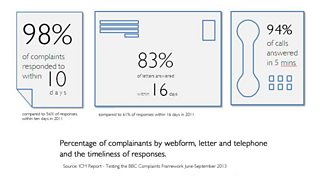
ICM’s 'mystery shopping' report, commissioned by the BBC Trust, tested the first stage of the process using a team of researchers who submitted their own complaints to the system. The research was carried out between June and September 2013, details of which can be found in the report's appendix.
The Trust concluded that since the last test in 2011 there had been improvements in the timeliness of responses to written complaints, which were mostly replied to within 3-6 working days, compared to between 9-11 working days when the report was carried out in 2011.
Researchers also said they were largely satisfied, but more so when they contacted the BBC by phone or letter than if they complained online. Perhaps this is because engaging online with an organisation can often feel a more impersonal way to make contact. But some 75% of all complaints to the BBC are now made online, and although we know we can’t expect to please everyone all the time, clearly we need to see what we can do to try and improve the content of our some of our email replies.
The research has still shown significant improvements to the way in which 'Stage 1' complaints are handled. And although we're not complacent, we are pleased to see the new system working more effectively.
Keith Jones is Head of Communication & Complaints, BBC Audience Services
