From in the room to on the air: new theatre, arts and museums programmes as part of Culture in Quarantine

Mohit Bakaya
Controller, BBC Radio 4
Tagged with:
From the many Shakespeare plays that this blog highlighted last week as part of BBC Arts’ Culture in Quarantine, I’m delighted this week to announce that we’ll be broadcasting more contemporary plays as part of our virtual repertory theatre giving audiences contemporary plays that they aren’t able to see as a result of the pandemic.
Like other parts of the BBC, BBC Radio 4 is finding new ways to team up with cultural institutions and bring artistic experiences into people’s homes as part of Culture in Quarantine. We, along with our colleagues at BBC Radio 3 and BBC Arts, are particularly pleased to be bringing listeners broadcasts of great stage plays that had runs cut short as part of Lockdown Theatre Festival.
The project was created by actor Bertie Carvel and we’ll be broadcasting the plays on Radio 4 and Radio 3 on Saturday 13 and Sunday 14 June.It’s wonderful to be able to provide a new or different lease of life to these works whilst they can’t be on stage and bring them to a wide audience. The plays are: The Mikvah Project by Josh Azouz and originally showing at the Orange Tree Theatre in Richmond, Love Love Love by Mike Bartlett recently revived for Lyric, Hammersmith Theatre, Rockets And Blue Lights by Winsome Pinnock - sadly suspended before its world premiere planned at Manchester’s Royal Exchange, and Shoe Lady by E.V. Crowe - cut short into its run at the Royal Court Theatre.
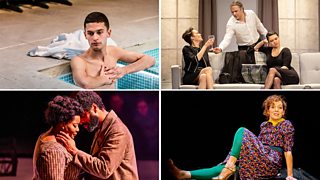
Josh Zaré in The Mikvah Project, Rachael Stirling, Nicholas Burns, Isabella Laughland in Love Love Love, Rochelle Rose and Karl Collins in Rockets & Blue Lights, Katherine Parkinson in Shoe Lady.
On the project, Bertie Carvel told us: “All this work was going to waste! I wanted to create a cultural snapshot for posterity, because who knows what the future holds? Theatres up and down the country are facing an existential crisis. I hope Lockdown Theatre Festival will demonstrate our community’s positivity and resilience - but also shine a light on the challenges we face.”
Those involved in these plays, such as cast including Katherine Parkinson, Nicholas Burns, Karl Collins, Rachael Stirling and more, are rising to the challenge of doing something different. We are not simply broadcasting an existing audio recording taken from rehearsals or performances. Instead actors will record ‘down the line’ from isolation, drawing on the muscle memory of fully realised stage productions to reimagine their performances for the radio. Whilst it will be a different experience to going to a theatre, we hope they will be a reminder of the magic of live theatre and how precious it is, as well as a wonderful piece of audio in their own right. Produced by Jeremy Mortimer, a Reduced Listening production for Radio 3 and Radio 4.
Another programme I’m really pleased to be bringing to Radio 4 as part of this drive to ensure culture remains in the nation’s homes during lockdown is a special series with eminent historian Simon Schama. Following his project for BBC Four as part of Museum in Quarantine, he will take Radio 4 listeners on The Great Gallery Tours of four world class galleries, explaining their unique significance and why they draw him back time and again. Through the series Simon will share works which have moved him, such as Manet’s glorious A Bar at the Folies-Bergère from the Courtauld Gallery, London.
He’ll virtually visit the Rijksmuseum in the Netherlands, home to many paintings by Rembrandt, an artist much revered (and studied by Simon) who will look at both the artist’s grand and intimate works. In Madrid’s Prado Museum, we encounter Velazquez and Goya, and Edward Hopper’s A Woman in the Sun at the Whitney, New York. At each stage we also hear from the directors and curators of these museums as they reflect upon the current circumstances. Simon Schama: The Great Gallery Tours will begin 16:00 on Monday 13 July and is produced by Susan Marling, at Just Radio Productions for Radio 4.
At a time when galleries around the globe have closed their doors, Simon Schama will remind us of some of the stories and treasures they hold. This will sit alongside The Way I See It, a radiophonic art exhibition of the Museum of Modern Art in New York, featuring leading creatives including Roxane Gay, John Walters, Margaret Cho and Fiona Shaw; which first aired on Radio 3 and - with museums closed - we’re broadcasting on Radio 4 bringing it to our audience as well.
We asked Simon why he was so keen to be involved in the project he said: "Like many of you I'm badly missing the joy of museums and galleries during the lockdown. So I'm really delighted to be able to talk about four of my favourite treasure-houses of great art - the Prado, the Courtauld Collection; the Rijksmuseum and the Whitney in New York, and to convey in full-colour radio the transforming power of some of their greatest paintings.”
As Simon says, we know how much culture means to our audience. Our regular programmes such as Front Row are doing a brilliant job at continuing to bring the arts into people’s home. The team has risen to the challenge presented by lockdown, employing technical wizardry to connect with creatives, where ever they may be in the world. In the coming week, Front Row features music from Nicola Benedetti and Artist in Residence during lockdown, Víkingur Ólafsson performing Philip Glass from the Harpa Concert Hall in Rejkyavik. The programme also welcomes actor Emma Thompson, writer Frank Cottrell-Boyce, director Damien Chazelle, and we look ahead to a special extended edition on Friday 8 May with Turner Prize-winning artist Jeremy Deller.
We have wanted to look at other ways too that we could support institutions in getting to the public. As part of the Culture in Quarantine initiative, the BBC has a special role at the moment in giving the audience access to artistic treasures, working with theatre productions and museums to bring listeners some joy and delight, and enabling institutions to give us all a reminder of the nourishment that arts and culture can give us now, during the pandemic, and in the future when the world starts to return to something that approximates to normal…whatever that will be.
