BBC Writersroom TV Drama Writers' Festival 2017

Hannah Khalil
Digital Content Producer, About The BBC Blog
Tagged with:
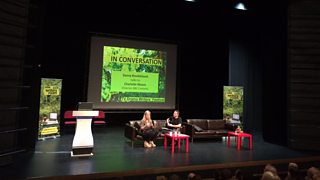
Danny Brocklehurst in conversation with Charlotte Moore
The joyous annual event that is the BBC Writersroom TV Drama Writers' Festival took place on Thursday 8 June 2017 at Stratford Circus in East London. I had the pleasure of attending again this year, along with many other writers - the only criteria being they have to have a television broadcast credit.
The mood of these festivals is always upbeat which surprised me the first time I went to one: surely these writers are in competition with one another for a small amount of working opportunities? Well there’s no sense of that at all. This year there were lots of smiling faces, and I overheard more than one person say that this was 'my favourite writers' event and that there was ‘nothing else like it’. That high profile established writers generously give up their time to talk to emerging writers in an open and honest way is certainly a lovely thing.
As ever, this blog is a round-up of the sessions I attended – and the fact the good folk at the Writersroom lay on such a vast array of session is a double-edged sword in that I can’t be in two places at once. As ever, Chatham House Rules apply as the event is intended to be a safe space for writers to share thoughts, so particular comments may not be attributed to specific people.
The day kicked off with a welcome to this the 7th annual BBC Writersroom TV Writers’ Festival from Anne Edyvean the Head of the BBC Writersroom. She also highlighted the recent festivals in Scotland and Wales to mark the establishment of BBC Writersroom hubs in those regions. Then she handed over to writer Danny Brocklehurst who was chatting to Charlotte Moore, Director, BBC Content who explained she oversees all genres for TV and iPlayer.
The question of what the BBC was looking for in new writing terms came up. Moore asserted that: “It’s not about my particular taste… there’s an extraordinary range across the networks, that’s the joy of the BBC”. She went on to say: “We want a diversity of the broadest voices in the truest sense” and reassured writers that “as long as it’s good it isn’t even about viewing figures.”
For the next session I was torn between ‘Meet the Commissioners’ and ‘Children’s Drama: Writing for drama’s most changeable audience'. I eventually opted for the latter.
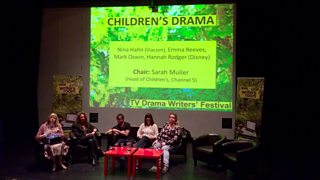
Sarah Muller the Head of Children's at Channel 5 chaired a panel that featured Nina Hahn from Nickelodeon, Hannah Rodger from Disney and writers Mark Oswin and Emma Reeves. The panel all agreed that there is no difference between adult and children’s drama – the requirements are the same in both for high quality and values. Then the question was raised: ‘What sort of stories can be told in Children’s drama?’ It was agreed that nothing’s really off limits, but there should be hope at the end of any story.
The subject of research came up again and again with would-be Children’s writers being encouraged to research their audience carefully and also the network they are approaching as each one has its own tone. It was also agreed that a driving storyline is vital, as is a watertight structure and comedic elements.
Panelists agreed that writing for Children’s is "not a good way to get into writing adult telly, it’s a good way to get into writing for Children’s" – it shouldn’t be a means to an end. But both writers said they never felt restricted or limited in this genre and that they could do everything they would in an adult drama (bar sex and violence) and that it was very satisfying work and a kind, nurturing environment for writers. That said, the panel ended with a warning – "children will turn off quicker than any other audience" so you’ll always get an honest response to your work.
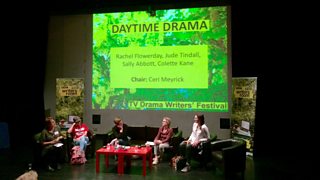
Another tough decision followed: the 'Daytime Drama' or 'Comedy Drama' session? I chose Daytime and was delighted to see an all-female panel. The chair was producer Ceri Meyrick who was joined by writers Rachel Flowerday (The Moonstone), Jude Tindall (Father Brown), Sally Abbott (The Coroner) and Collette Kane (Moving On).
A conversation about the under-the-radar nature of Daytime drama ensued, with panelists asserting that you can do more in that ‘while the kids are at school’ slot than you might think. The audience were painted a picture of a simpler commissioning process thanks to a smaller chain of command. Although the budgets are smaller one panelist asserted that "it’s valuable having limitations" and all agreed that with less money you have to rely more on scripts being excellent so it is a very creative environment for writers. Daytime slots also free writers from an hour-long slot, but they said a 45-minute programme time offers its own challenges, demanding rigourous and tight pieces of storytelling.
Three spectacular panels were scheduled next making my decision making even more impossible: The choice was between: ‘How to pitch your show!’, ‘Continuing Drama’ and ‘Changing how our industry looks’. I reasoned that as I’d been to a talk on writing for medical drama a couple of years ago and blogged about it I could justify not going to that one, and the whole topic of last year’s festival was Unheard voices, so I went for ‘How to pitch your show!’
Writer Toby Whithouse chaired the session with writers Jed Mercurio and Danny Brocklehurst and Kudos’ Head of Development Sarah Stack. All agreed the key to a good verbal pitch is knowing what you want to say and saying it in a concise manner. But all warned that saying an idea out loud can expose an its weaknesses, so practice is the key – that way you should get a sense where you are being vague or over-complicating things. They said if you can sum up your show in three sentences then you know it’s a strong pitch.
One panelist thought that a big problem for writers starting out is the fact that they are ‘pitching by proxy’ – so to a producer who would in turn pitch on their behalf to the decision-maker. That way an idea could be compromised. Hence the need for a clear, concise, three sentence pitch that is easy to get a handle on. The question of whether comparisons to other shows should be made in a pitch was raised. The panel agreed this can be useful to give a sense of tone, which is such an intangible thing. But the downfall is that you could be asked how your show is different from any shows you reference. The advice? Reference other art forms like novels and films instead of other telly shows.
After your pitch meeting you should supply a short pitch document with a fuller sense of what you’ve talked about. Panelists urged writers to avoid the tendency to make this too long. And when asked whether pictures could be included they agreed if it was helpful in getting a sense of the show then it would be fine but not to consider this too much – better to concentrate on the words.
A question was asked about how many pitches to have ready in case your main one falls flat. Not too many seemed the consensus – perhaps one but if you have too many it might look like you aren’t sure about which projects you are most interested in.
Toby’s final piece of advice was to go into any meeting prepared – even if you think it’s an informal chat.
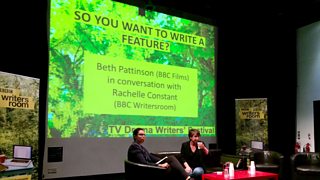
My last session choice was ‘Film: So you want to write a feature?’ where BBC Writersroom’s Rachelle Constant talked to BBC Films’ Beth Pattinson. Beth introduced BBC Films as the film-making arm of the BBC – all the films go to the cinema first before later making their way to a BBC channel. Making 8-10 features a year the very small team develops up to 70 a year. They don’t fully finance any one film but work in collaboration with other companies to get films made. They have a remit to support the British Film industry. Rose Garnett has recently joined as the new head of BBC Films after the departure of Christine Langham.
Projects should be submitted by agents or producers, and sent to the Development Coordinator in the first instance. Then submissions are read, discussed internally and people can expect a response in a couple of months. Ideally the form of the approach will be a script, and writers were warned that very few projects are taken on by the small team, so many great projects are rejected. They always have to ask the question ‘will audiences go out to see this film at the cinema?’ As that is the unique challenge of film. Beth said BBC Films tries to promote British filmmakers and often the team will have a first time director or writer, but that person will always have a track-record in another medium.
In terms of themes being sought, a British focus seems key, and a lot of this is about the filmmakers and what they want to say. In addition, contemporary material is of interest and occasionally the team produce children’s films.
The final session was the Keynote: ‘The Scandi Invasion’ with Tony Wood from Buccaneer Media talking to writer and creator of The Bridge and Marcella Hans Rosenfeldt.
It was agreed that key elements of Scandi Drama are violence and/ or a dark tone, though Hans said “I don’t even know what Scand Noir is,” claiming most shows from Scandinavia are labelled as such without any set criteria.
Hans started out in continuing drama in Sweden before working on dark crime dramas, perhaps a natural progression because, as Tony pointed out many Soap lines involve crime stories.
Hans talked about the way shows are written in Sweden – he didn’t find too many differences between the Swedish and the British process. For The Bridge he did not have a writers' room in the American sense but all the writers who would be writing on the show were involved in a very collaborative and detailed storylining process at the show’s inception. Writers penned three drafts of an episode and then Hans took over honing all the scripts across the series.
How did this translate when working in England on Marcella? Tony who was Hans’ producer on the project said the water-tight plotting led to extremely compelling scripts. Tony also noticed there were less words on the pages of Hans’ scripts than a traditional English one, and felt this elicited heighted, engaging performances on-screen.
Hans talked again and again about how he aimed to make scripts as readable as possible. For him this means less discursive staging directions on the page and getting straight to the tightly-plotting story. This is surely good advice for any writer and a good note to end the festival on.
As I couldn’t get to everything so please do feel free to share your experiences of particular sessions in the comment section below.
