BBC Writersroom’s TV Drama Writers Festival 2014

Hannah Khalil
Digital Content Producer, About The BBC Blog
Tagged with:
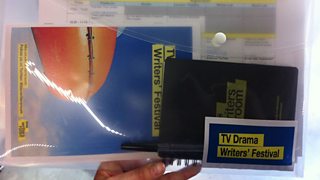
BBC Writersroom TV Drama Writers Festival pack
Once again, this year, I was happily able to attend the BBC Writersroom’s TV Drama Writers Festival. The day of sessions, held this year in London at the impressive University of the Arts in King’s Cross,and with the support of Drama Centre London and Central Saint Martins, is open to writers with a TV broadcast credit. The aim, to create a safe environment for writers – who all too often are working in isolation - to talk to their peers about what’s going on in the industry.
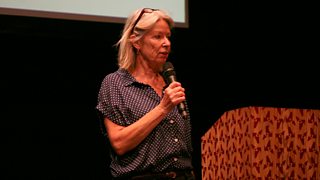
BBC Creative Director of New Writing and Head of Writersroom, Kate Rowland (Credit: Michelle Brooks)
Scanning the schedule for the day I realised my main problem would be choosing which sessions to attend – there were 22 over the one day and all of them sounded fascinating. But choose I must and my own day panned out like this:
Session 1: Keynote, Tony Jordan; Chair Kate
Rowland (pictured above)
Session 2: From Fresh Meat to Babylon, Sam Bain and Jesse Armstrong; Chair
Toby Whithouse
Session 3: Staying Relevant: Feeding the Beasts of the Schedules, Simon
Ashdown, Jane Hudson, Debbie Oates, Ben Stephenson; Chair Henry Swindell
Session 4: Drama on YouTube: Rosie Allimonos
Session 5: The Two Tones: Tony Hall and
Tony Jordan
Session 6: Dealing with Rejection: Barbara Machin, Levi David Addai and Danny
Brocklehurst, Chair: Tony Jordan
Session 7: In conversation with Jane Featherstone and Tony Jordan
Session 8: Keynote, Unstorifiable by Adam Curtis; Chair Jed Mercurio
Exciting no? But making those choices wasn’t easy – I missed out on Do we need Treatments? from the brilliant Brian Elsley, The Politics of Drama care of Peter Moffat, Face to Face with Abi Morgan and New Markets: Do we still need broadcasters with Cameron Roach, Jed Mercurio, Liam Keelan and Barbara Machin chairing, to name a few. See, I told you it was tough to choose.
As the keynote started my pulse began to race (and it wasn’t just because Jed Mercurio – who penned Line of Duty – was sat in front of me), Tony Jordan laid out his stall (metaphorically, though I later learnt he was a market trader in Liverpool before landing his first job writing on EastEnders), "Content is King", "You can’t stream fresh air," "Networks are defined by their drama output". It was a rallying cry to put writers at the heart of everything. He also talked about a delicate balance between the creative and commercial, and how he believes writers have to "take their own crown" by being "brave, innovative, ground breaking and genre shaking." Writers have to lead this digital revolution, was his message.
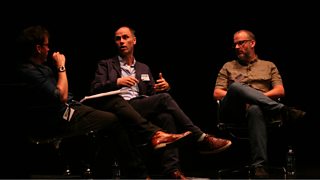
Toby Whithouse, Sam Bain, Jesse Armstrong (Credit: Michelle Brooks)
Suitably inspired I moved on to From Fresh Meat to Babylon, with Sam Bain and Jesse Armstrong plus Toby Whithouse asking the questions. This was a kind of ‘in conversation’ with the two writers who often work together. They talked about how they do that – starting with a long chat in which they define every detail of their idea, then taking a different episode each to pen, and finally editing each other’s work. They also considered why comedy writing partnerships are common while drama writers tend to work alone, and concluded it’s something about the making of a joke, needing someone to bounce it off, banter with, and that there is a certain amount of healthy one-upmanship in the process.
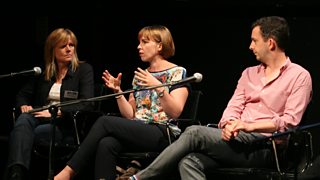
Debbie Oates, Jane Hudson, Ben Stephenson (Credit: Michelle Brooks)
Session 3 was Staying Relevant:Feeding the Beasts of the Schedules, with Simon Ashdown (a long term EastEnders writer), Jane Hudson (ITV's Head of Drama), Debbie Oates (a key Coronation Street writer) and Ben Stephenson (BBC controller, Drama Commissioning); Writersroom’s own Henry Swindell acted as chair. The panel asserted that continuing dramas or soaps are a vital part of the television drama ecosystem, delivering hundreds of hours of television a year. "The industry owes a lot to soaps" they said, because it is a vital training ground for, not only writers, but all the other production team members – an environment where the turn around is so quick and continuous that you have the opportunity to make something and watch it on air very quickly, learning from your successes and failures.
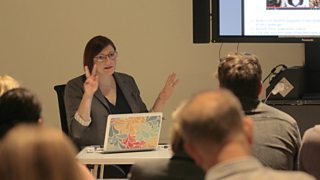
Rosie Allimonos (Credit: Michelle Brooks)
My next session was Drama on YouTube given by Rosie Allimonos the Head of content partnerships there (former Multiplatform Executive and Senior Online Producer at the BBC). I was particularly interested in this session as I’ve never heard anyone from YouTube talk about the platform (which is now owned by Google). Rosie outlined that YouTube has over a billion global visits a month making it a key platform for writers (or indeed any other artist wanting to promote their work to a wide audience). She explained that they’ve introduced 'channelisation' so you should avoid thinking about your account as a repository and more as if it were a TV channel and brand it as such.
The benefits include being able to get direct and instant feedback from your audience, and in Rosie’s opinion, the best way to build followers to your channel is to do just that; talk to them, include them in a conversation around your work perhaps even allowing them to help shape it. For example, she outlined one stream where a production company had made three short 'webisode' pilots and then asked viewers to choose which should be made into a full web series. Innovative ideas like this help build your audience, and – once it’s really big you can actually earn money from your channel, as YouTube will partner with people who have a certain number of followers and place adverts around their content. The channel owner takes 55% of revenue and YouTube 45%. In the Q&A that followed I also discovered that YouTube have 'spaces' in London, LA, New York and Tokyo where users with over 5,000 followers can hire the facilities for free – apparently they get very busy, but the London space has edit suites, a green screen and two studios. Very interesting… I was pleased that I picked this session for that tasty tidbit alone.
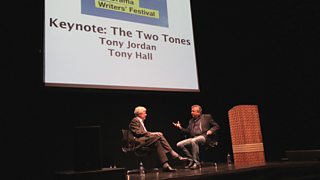
Tony Hall, Tony Jordan (Credit: Michelle Brooks)
Next up Tony Jordan and Tony Hall were in conversation – an unlikely but delightful double act. The BBC DG makes no secret of his love of the arts (having run the Royal Opera House) and here made it clear he thinks that the BBC’s content is key, and that the writers are at the heart of it: "Keep doing what you are doing". He also revealed he was roped into taking an 'extra' role in a BBC Radio drama crowd scene for the upcoming World War One series Tommies, but promised he won’t be giving up the day job just yet.
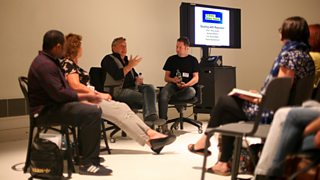
Levi David Addai, Barbara Machin, Tony Jordan, Danny Brocklehurst (Credit: Michelle Brooks)
Some achingly candid personal experiences followed in Dealing with Rejection: where all the panel, Barbara Machin, Levi David Addai, Danny Brocklehurst and Tony Jordan spoke honestly and openly about some of their most difficult periods as writers – rejection 'doesn’t mean anything – everything’s subjective'. They also talked about how they had dealt with those tough moments, 'contain the fire, don’t talk to everyone about your disappointments, just a few trusted friends and then work on something else for a bit.' They also all agreed that 'nothing is ever wasted', even if the thing you are working on isn’t picked up those characters and ideas may live again in another script. And their final bit of advice was, that during 'dry' periods to 'write, write, write, and fill that bottom drawer for the future.'
I rather felt like I was stalking Mr Jordan in the afternoon (but he was very nice and didn’t call the police), as I followed him on to a conversation with Jane Featherstone, the woman behind Kudos who have brought us television shows like Spooks, Broadchurch and The Tunnel. Jane talked about the different kinds of difficult writer – difficult in that you want a real debate and conversation around your work is good, but difficult in being not nice to deal with is bad. Makes sense.
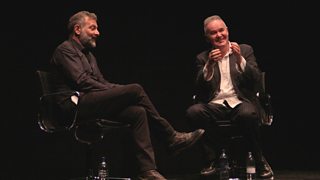
Jed Mercurio, Adam Curtis (Credit: Michelle Brooks)
The final keynote was from the dazzlingly smart Adam Curtis talking about his latest project Unstorifiable, in which he proposes that the modern news narrative is stuck in a repetitive loop and unable to make interesting or articulate the really key stories of our time. Suffice to say his analysis was deep, detailed and fascinating – I couldn’t do it justice but here’s an interview from the New Statesman with Adam talking eloquently about it.
Strangely I went into that last session with a headache which I feared would get worse with the big ideas that my poor, tired brain was trying to compute, but somehow those ideas seemed to free my mind and I left the building with a spring in my step akin to the one I’d started the day with. And I’m sure that was nothing to do with the glass of wine I had in the bar before I left.
Hannah Khalilis Digital Content Producer, About the BBC Website and Blog.
- Read BBC Creative Director of New Writing and Head of Writersroom, Kate Rowland's blog about the festival
- See a summary of the day including key points and photos (with video interviews to follow) on storify
- Also see Hannah's blog about last year's festival
- Find out more about BBC Writersroom
