75 Years of the BBC Radio Drama Company

Rebecca Wilmshurst
Production Executive, Radio Drama
Tagged with:
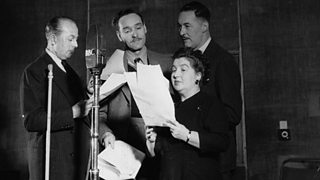
Leslie Perrins, Duncan McIntyre, Marjorie Westbury, and Kim Peacock record 'Paul Temple and the Curzon Case' in 1949
If your radio script requires actors to be mice, ants, naiads or dryads, men morphing into hares, maggots in a fisherman’s sack, or even a tray of fancy cakes – look no further than to the Radio Drama Company. The RDC’s celebrating its 75th year - though, interestingly, had the first BBC Repertory Company survived, this year would have seen 85 candles on its cake. I’m indebted to David Wade’s 1991 radio feature on the Rep for filling in the facts.
The first Rep, formed in January 1930, had just nine actors. By the summer Val Gielgud (the BBC’s then equivalent to Head of Drama - and brother to Sir John), was querying the merits of so small a Rep on artistic and economic grounds. And so, the actors completed their contracts and by December the Rep had gone.
By 1939, however, tensions were growing in Europe and plans were needed to maintain broadcasting in the event of emergency. Val Gielgud proposed that in time of war drama would be well-served by an in-house company of actors – adding that he knew the best ones for the job. In September, with war now declared, the first Rep group was contracted and sent to BBC Wood Norton. It was supposed to be a discretely managed business, but actors travelled with families, carrying vast supplies of tinned food and noisy domestic pets: even Mr Gielgud took his cats. Makeshift studios were set up in stable blocks, and bear-pits converted to echo chambers. Not surprisingly, the Rep’s first few plays broadcast from here got limp reviews. But the Company settled and material grew braver: an early milestone was The Shadow of the Swastika a dramatised feature about the rise of Hitler starring young Rep actor, Marius Goring.
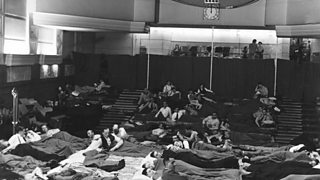
The Radio Drama Repertory Company and BBC staff sleeping on mattresses in the Concert Hall during the Second World War
In 1940 the Company was moved in part to Bristol, and part to Manchester until it was felt best to bring everyone back to London and Broadcasting House. Despite the war, extraordinary live dramas were broadcast night after night with a real 'show-must-go-on’ approach. Actors recognised flashing lights in studio that meant the enemy was approaching, and those that meant the enemy was overhead. Lights were understood but ignored. Actors working late would reserve a mattress in the Concert Hall [now the Radio Theatre] (as pictured above) and after transmission would go to find a bed there... often still warm from previous use!
Some RDC actors broadcast in various languages overseas, their voices becoming familiar and comforting to the listeners. War-time RDC actress Gladys Spencer recalled that some years later, while visiting Chartres Cathedral, her voice was instantly recognised by the tour guide – who embraced her and thanked her for the support she’d given to the war effort in France.
With the end of war came talk of disbanding the RDC – but it was saved. The benefits of retaining a dedicated, highly-experienced, in-house repertory company were now widely recognised. Countless live broadcasts (that would terrify most directors and casts of today) had created confident radio actors, who worked quickly and perfectly understood one another’s rhythms. Rep actors formed an invaluable nucleus in big cast productions, and time-efficiency was a virtue if a crash with the 'pips upon the hour’ was to be avoided. [Once, famously, a live transmission of Hamlet was over-running. As the pips approached the sound of Hamlet’s fight with Laertes strangely receded and an announcer quietly advised “…And there we must leave Elsinore”!]
The RDC was at the heart of Radio’s Golden Age. Company actors like Carleton Hobbs and Norman Shelley became household names as Sherlock Holmes and Dr Watson. The rapport between them made life at 221B Baker Street a compelling reality for the listeners. Half the country fell in love with Majorie Westbury’s (pictured at top) 'Steve Temple' – the sophisticated and elegant foil to suave husband Paul. Marjorie herself, however, was rather short and dumpy - so as physically far removed as possible from the soigne Steve. Adoring fans gathered outside Broadcasting House after Paul Temple transmissions to catch a glimpse of Steve. The BBC, not wishing to break the spell, would ensure attendants ushered Marjorie out unseen via a side door. Far from being disgruntled, this amused her.
RDC actors can play against physical type and in a range of parts impossible to achieve in any other walk of the profession. Radio’s a speedy medium too. The late great theatre actor, John Moffatt, (also an RDC member) summarised this: working in the theatre, he said, is like crafting an oil painting where you add a little more colour to the canvas with each performance; working in radio, however, is like a Japanese watercolour –the ink brushed across highly absorbent paper dries instantly and is set.
Some years ago, actor Edward de Souza (Radio 4’s Man in Black during the 1980s) designed a motif for the RDC: a microphone with the letters NKU printed on its base – they stood for 'never knowingly underused’ – which of course is still perfectly true! As I write, the RDC actors have just completed work on a new production of Julius Caesar for Radio 4, others are busily travelling to Birmingham to continue recording episodes of Home Front before starting work next week on an exciting portfolio of plays set all around the world about Oil – an idea masterminded by guest director Nicolas Kent.
Today’s Company is a lean, fit and infinitely multi-talented ensemble of up to 16 actors. They’re offered three-month contracts – a time span that most find attractive. Contracts can be renewed (most are) and sometimes actors stay for nine months (exceptionally, even a year). Actors who win a place through either the Carleton Hobbs (CHBA) or Norman Beaton (NBF) events receive bursary contracts that run for five months and are binding. But it’s a win-win investment: those same actors, like their Wood Norton counterparts, become so radio-experienced that they return to record for us regularly as their freelance careers progress. The profile of CHBA is high in the business – the NBF is catching up - and former winners 'pop up’ in all manner of different places: four are regulars in The Archers, another continues his stellar career as robot C3PO, and at least two actors in the cast of The National Theatre’s new production of The Beaux Stratagem which opened this week have been lauded in past CHBA despatches.
I joined the department in 1987, bringing with me a listener’s love of radio dramas and radio actors – their names like poetic evocations at the end of a play: Kate Binchy, Katharine Parr, Manning Wilson, Garard Green, David March. Sharing responsibility for the RDC’s well-being has been a privileged part of my work, and I’ve enjoyed many RDC milestones in that time but two stand out : the SONY Award that the RDC received (for services to Radio) in 1990 on reaching its 50th birthday; and the celebration at the National Theatre in 2003 of CHBA’s 50th anniversary with the launch of the BBC Norman Beaton Fellowship and the unveiling of our new (((soundstart))) branding – motto: “Tuning in to new Talent”. We printed tee-shirts boasting this, and then realised the folly of having that slogan across the chest…
Our quest to uncover acting talent and bring new voices to Radio continues, and others in the future will follow in the steps that, in my time here, Stephen Tompkinson, Julian Rhind-Tutt, Emma Fielding, Bertie Carvel and Jimmy Akingbola have taken.
The RDC has a defined rhythm to its life each year – and in blogs beyond this one we’ll share with you more stories around that and the partnerships we’ve established through (((soundstart))) events, so watch this space.
Rebecca Wilmshurst is Radio Drama’s Production Executive and has worked with the RDC for nearly 30 years.
