Val Gielgud’s legacy to Radio Drama today

Hannah Khalil
Digital Content Producer, About The BBC Blog
Tagged with:
At this year’s BBC Audio Drama Awards, David Tennant said: "The quality of our radio drama is one of the things that makes me proud to be British." It would be fair to say that Tennant was unwittingly thanking Val Gielgud, big brother of actor Sir John Gielgud and one of the most important people in the history of radio drama at the BBC.
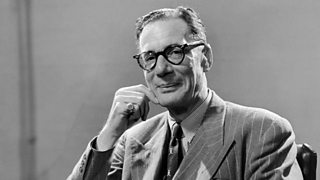
Val Gielgud
Sometimes called the 'Cinderella' of the Gielgud family, Val graduated from Oxford and was married five times. A dramatic personal life? Maybe. But, I’m more interested in his professional life where after a not-very-successful go at acting he took a job at the Radio Times. In his autobiography Val admits that in his time on the publication, he penned some of the reader’s letters criticizing the BBC’s dramatic output. By 1929, he was given the chance to take matters into his own hands when he was appointed Head of Variety (effectively Radio Drama). Here he remained in the post for 35 years until 1963.
When Gielgud took up the role, radio drama was in its infancy. The first full-length Shakespeare - Twelfth Night - had been broadcast in 1923 (see Jeremy Mortimer’s blog about Radio Drama at 90) but it wasn’t until 1925 that the first play written specifically for radio – Danger by Richard Hughes – was aired. So when Gielgud took up the post in 1929 he was to be key in shaping this nascent art form.
Gielgud was a prolific writer, turning out 26 mystery or detective novels, one mystery story collection, two historical novels and seven non-fiction books, some of which were autobiographical, others about playwriting. He also wrote 19 plays, four screenplays, directed six plays (including the first ever play for television) and appeared in six works as a member of the cast.
One of his most noteworthy was called Party Manners, and although it failed to raise many eyebrows when it played at the theatre and then subsequently on radio and television, it was when it came to be re-broadcast that it gained some notoriety. The play was a comedy about a Labour minister who gets into a bind over nuclear energy. Not such a big deal when Labour was in the majority, but by 1950 when the play was planned to be re-aired, the Labour party had suffered a blow in the General Election, getting re-elected to power with a very low majority. Lord Simon, the then BBC Chairman, bowed to pressure from government and cancelled the planned broadcast, subsequently getting widely criticised for doing so. Hence Party Manners became key in BBC history - Lord Simon regretted his decision to pull the broadcast and said, "quite obviously no Chairman will ever dream of doing anything of the sort again".
Gielgud's radio legacy shouldn't be overlooked. He had high hopes and values for the form, and in a time before subsidised theatre he considered his and the Corporation’s job to be building a “bridge over the gulf … between the business theatres of today and the national theatre of tomorrow.” His successor Martin Esslin used the expression a “National Theatre of the airwaves”, a view quite possibly borrowed from Gielgud’s sentiment.
Despite this comparison Gielgud knew there were many differences between the two media and encouraged the use of larger casts and exotic locations for radio.
Val Gielgud epitomised theatricality and helped shape radio drama.
There’s an anecdote about him having a theatre actor pinned to the back wall of the radio studio – he was performing in recording of Othello and the manhandling was to compensate for his booming voice, which, despite working well on stage, played havoc with the delicacy of the microphone.
This was the time when modernist writers like George Orwell, James Joyce and Virginia Woolf were experimenting with form and Gielgud encouraged innovation and exploration in the dramas produced under his tenure.
The truth is, however, that in all my reading about Gielgud, I find he was a mass of contradictions: he claimed to want to move away from theatre-style productions on radio, but was from a theatre background; he pushed the boundaries and experimented with the form, and yet he was more at home with Shakespeare than he was with contemporary writing; he recognized that radio was for the masses, but he loathed soap operas or anything too populist.
Despite the contradictions, what I find so exciting about him is his commitment to find a particular mode for radio – to make it an original form, particular to itself. This continued search for work that is definitely 'radio' still exists in the BBC’s drama commissioning brief today. In this year’s Afternoon Drama tender document on the BBC's Commissioning website it states: “Changing the way radio drama sounds is very important for Radio 4, and in our view Afternoon Drama is the best slot in which to experiment.” Something Val himself might have said in one of the several articles he wrote for the Radio Times, which were ‘how to’ guides for aspiring ‘Wireless’ writers.
He didn’t always get it right however, as I say he hated soaps – there’d be no Archers under him. He also had issues with two of my favourite dramatists – he called Harold Pinter “incomprehensible” and if it weren’t for him Samuel Beckett’s Waiting For Godot would have had its first public performance on radio rather than the West End stage in 1955 – as he rejected it.
That said his sense of innovation and radio for radio’s sake culminated in a programme pre-World War II called Experimental Hour to explore the form, and although it was short-lived it showed his commitment to innovation. It was that same commitment to exploring sound that led to the creation of the BBC Radiophonic Workshop in 1958 – a sound effects unit that quickly became “the most important electronic music studio in the UK” and continued at the BBC until 1998 and then was revived in 2012.
That is his legacy, and his strong commitment to making dramas specifically for the radio, exploiting all the wonders that sound rather than sight have to offer. He created radio drama as we know it, and I thank him for it as the medium keeps the lost art of listening alive: 2.15pm brightens up my weekdays, as Radio 4 continues to air a daily Afternoon Drama. Perhaps without Gielgud, some of my favourite radio dramas like Katie Hims's beautiful Lost Property trilogy or Csaba Szekely's brilliant Do You Like Banana, Comrades? wouldn't exist - and my afternoon listening wouldn't be so wonderfully transporting as a result.
Hannah Khalil is Digital Content Producer for About The BBC website and Blog.
