
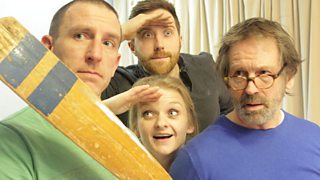
Alex Palmer, Joseph Kloska, Alex Tregear and Stuart Fox record On The Rocks for Radio 4
Founded in 1939, the BBC Radio Drama Company features actors who take part in many hours of plays, series, dramatisations and readings that BBC Radio Drama records for Radio 3, Radio 4 and other networks. Jo Kloska reflects on his time as a member of the Company.
I auditioned for the BBC Radio Drama Company (RDC) nine years ago (where on earth did that time go?) and while I didn't truly realise it at the time, winning a five-month contract at the BBC as my first job would be right up there with the very best opportunities I've had in my career so far.
It was a job which introduced me to the slightly weird world of working as an actor and, amazingly, brilliantly, has been a really important part of my career ever since. Radio helped me learn how to be a better actor, introduced me to so many great people in our community (on both sides of the microphone), occasionally enabled me to pay the rent (both my agent and I give thanks), and continues to challenge and stimulate me in my work.
Alongside my fellow Carleton Hobbs Award winners, our contract with the RDC began a few days after leaving drama school in 2006 and in those early months, it was a wonderful transition into actually being an actor, with lots more training (both formal and informal, some of the latter involving what your elders tell you in the bar afterwards) and the chance to work on so many parts of the BBC radio drama output. We were initiated into such things as radio technique for acting (including the art of silently turning a page with your back to the microphone), the secret lore of the well-told theatrical anecdote (reaching the punchline just after the director comes into the studio to give you notes) and getting shed-loads of practice with different directors on all sorts of plays, prose readings and poems in a medium that demands you have decisiveness, commitment and real concentration.
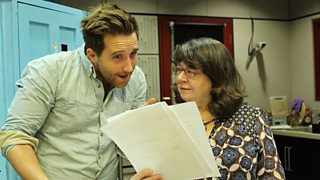
Joseph Kloska and Christine Absalom in a recording of On the Rocks for BBC Radio 4
I think it's really demanding to perform on radio, perhaps not physically, but because the microphone seems to really know when you're not being truthful when you speak. And it can be such a collaborative and collegiate way of working, you work it out with the producer and your fellow actors: you have to commit and to work quickly because you normally only have a handful of days to finish something. One of the best things is that there is so much new writing in radio drama and you get the chance to meet and work with writers who can guide you towards what they were hearing when they wrote the piece.
I recorded so many different things during that first contract, with a huge range of parts and characters. Some of my personal favourites include a World Service broadcast of King Lear recorded live on stage at a packed Globe Theatre, an epic version of The Brothers Karamazov, and, on one series, watching Peter Bowles and Lesley Phillips totally ignore the flashing green light imploring them to start acting because neither had finished their anecdote. I recorded with Ian Richardson in the final months of his life and that was amazing: when we'd finished he took us all to the Nellie Dean in Soho and gave me a masterclass in how to find your light on stage - it involved using his prodigious nose as a sort of beacon. I remember his eyes sparkling in the dingy pub light. Indeed, many of my memories from that time are of my colleagues, the working actors who loved doing radio: they welcomed me in, told me about their lives and work and (of course, because we're actors) how unhappy they were with their agents. They made me feel part of the acting community, and showed me that radio drama can be a beautiful thread through our careers.
Since leaving the RDC in 2007, I began to work in all the other bits of the acting profession which we all take for granted. But, happily, I kept getting asked back. Over the years I have probably recorded 5 to 10 plays or readings for the BBC every year. Every time is different: I've played French lovers, Cornish postmasters, villains and romantic heroes. It is the range of work which is so satisfying.
Other actors often ask me how to get into radio, thinking it's a closed shop unless you know someone or can bribe the security guards to let you in. They think I seem to have cracked it. Well, I know the producers are constantly at the theatre and bringing in actors they meet who are new to the medium so I would say you have to keep asking. The actors who do come and do radio drama seem to end up loving it as much as I do. I don't really feel I've cracked it, but I am very grateful for that first stint on the RDC and the chance to get started in the medium.
The BBC as an organisation has obviously changed a lot over the last decade and I hope it never forgets how important Radio Drama is to the people who listen: and people are listening all the time. I receive messages of my appearances from friends I haven't seen for years, who were listening to a play in the car or at home and suddenly realised I was in it (which is either a compliment to my extraordinary acting, or more likely because we haven't seen each other for a while). It's a wonderful medium to tell stories and create characters and long may it continue on the BBC.
So I just wanted to share one thought: much as I enjoy the lovely studio 60A at Broadcasting House and the hike up Delaware Avenue in Maida Vale to good old MV6, sadly the place I first entered the BBC has now gone. My audition for the RDC was in the large N41 studio beneath Bush House, a bunker full of history, several floors below the Aldwych, which was partly used as an air raid shelter during the war. At first, it was a strange place with no natural light featuring stand-alone doors scattered around the large space, thickly padded walls and slightly insane staircases leading nowhere. In the course of working there for half a year it became very familiar of course, and I loved it. Now that it is some kind of faceless corporate hotel on the Strand, I hope the ghosts of actors and producers whispering all that was shared between those walls over the years somehow remains... and scares the guests.
Joseph Kloska is an actor and former member of the BBC Radio Drama Company
- The new series of On The Rocks featuring Joseph starts on Monday 11 May at 11.30am on BBC Radio 4
