Overview of Gap Year by Jackie Kay
Gap Year describes Jackie Kay’s feelings for her son Matthew as he is travelling on his gap year:
- She remains at home wondering what he is doing.
- She reminisces about her pregnancy, his birth and childhood.
- She reflecting on how quickly he has grown up.
The title Gap Year implies the ‘gap’ his absence leaves in Kay's life and the separation between the two.
Despite the literal ‘gap’, their relationship is obviously a close one.
The poem deals with themes of growing up and love.
Looking for some quick revision? Try an interactive quiz or flashcards for National 5 English.
Listen to a reading of Gap Year by Jackie Kay
You can listen to Jackie Kay read 'Gap Year' on the Bitesize Scotland Poetry podcast.
You can read Gap Year on the Scottish Poetry Library website
Poetry Podcast: Gap Year by Jackie Kay
Jackie Kay discusses her poem Gap Year with Zara Janjua. You can listen to episodes on all of the National 5 set text poems by Jackie Kay on BBC Sounds.
Form and structure of Gap Year
Gap Year is divided into two sections with four line stanzas throughout. Kay uses Poetry that doesn't have an intentional rhythm or rhyme, but instead can sound more like speech with only the odd moment of rhyme to convey the sense that she is speaking to her son.
Section I
The first section of the poem charts Kay’s pregnancy and the birth of Matthew. It is only four stanzas in length. This suggests the brevity of babyhood and how it is quickly over.
The section begins with Kay staring at the empty Moses basket awaiting her baby’s arrival and ends with Kay laying her new son in the basket. This suggests suggests completion and contentment.
Section II
Matthew soon grows up and the second section begins with Kay standing in his room when he is away travelling.
She describes how she follows his journey and the moments when he phones home or they talk using a webcam.
Woven through this much longer section are Kay’s memories of Matthew’s scan pictures - this links back to his early life. She is obviously proud of him but possibly also concerned about her once-little child is out in the big wide world.
Warnings from his grandfather are also threaded into the verse. The reader feels Kay’s anxiety when Matthew says he will be home four weeks later than he had planned. However, the tone that ends the poem is upbeat and the final line returns to the first in a circular manner by mentioned the basket once more.
Parallels and contrasts
The first lines of each section draw a parallel between the expectant Moses basket and the older son’s vacant bed. This implies that the last time Kay waited so long for her son was before he was born. Both then and now he is outwith her control. In each case all she can do is wait, filled with love, for him to come to her when he is ready.
His face on the webcam is described as being grainy, blurry - a consequence of being so far away. This indistinctness reminds us of the scan photograph, and also his birth when he emerged blue and floury.
The final image of Matthew with his arms outstretched amidst vast landscapes contrasts with the earlier images of containment the basket and the tight tub. It is as if in embarking on this gap year he is becoming an adult and breaking free of the constraints of childhood to find his own path in life.
Section I: stanzas one to four
I remember your Moses basket before you were born.
Gap Year begins with the image of the empty Moses basket - fitting for a text about waiting and longing. The word "stare" suggests Jackie Kay’s focus on the imminent presence of her child.
Kay gives us a vivid impression of the basket. Its "fleecy white sheet" suggests the purity and innocence of a baby. The enclosed basket suggest the baby's current ‘container’ of his mother’s "tight tub of a stomach".
I’d feel the mound of my tight tub of a stomach
The phrase "tight tub" emphasises the snugness of the child safely held in the womb. But "tight" also suggests the baby is pushing at the sides, ready to move on and be born.
foot against my heart, elbow in my ribcage
Kay conveys the experience of having a child grow inside you in an evocative manner. The closeness of their bond is expressed. There is also a hint that the baby is pushing against the constraints.
The list of present participles, "moving", "turning", "burping" suggests ongoing feelings - they may have happened in the past but Kay has experienced them so fully that they seem fresh and current.
The A phrase combining two or more contradictory terms, often used for emphasis - eg. 'deafening silence'."close stranger" highlights the contradiction of someone so close to her physically but as yet unfamiliar. Already she has great love for her child but it is implied that he is someone separate with experience that she is not fully part of. In this way Kay looks ahead to when her son is on the other side of the world, doing his own thing. The baby finally arrives:
late, the very hot summer of eighty-eight
The strong rhyme of "late" and "eight" suggest the impact he has on her life and the significance of his birth.
The fact that he was pulled out with forceps implies his reluctance to leave her. This contrasts with the wanderlust he has later. The vivid description of the new baby "blue" and "floury" conveys the intensity of her memory as she gets to know her "stranger". The section ends with Kay laying the baby in the basket, creating a sense of completion. The wait is over. The basket is no longer empty.
Section II
Stanzas one to five
Kay now jumps ahead in time - she flies past her son's childhood, as if it has passed in an instant.
She peeks into his room, suggesting the action of an anxious parent checking on their young child. The use of "stare" recalls the opening of the poem and we empathise once again with her sense of longing. Her son is "away, away" travelling the world. The repetition here emphasises the distance between them and how strongly she feels the separation.
In stanza two the mother follows the child's progress, reversing the parent/child roles. The different places mentioned highlight the extent of his travels.
- Costa Rica
- Bolivia
- Lima
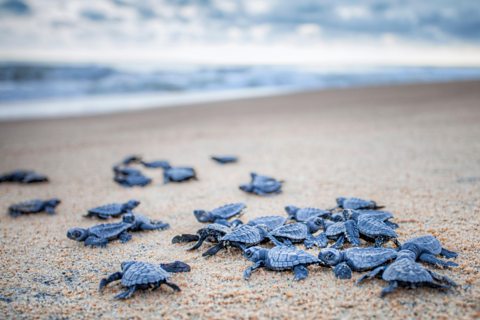
She compares her son's travels and his growth to adulthood to sea turtles:
From the Caribbean side of Costa Rica to the Pacific,/ the baby turtles to the massive leatherbacks…
The contrast is apposite here - it implies that this journey enables growth from child to adult. The "baby turtles" reminding us of Matthew in his Moses basket.
The grandfather’s words inject the poem with a voice of realism which contrasts with Kay's rather romantic tone. The practicalities like "altitude sickness" interrupt her wistful narrative. The reader is alerted to the challenges of Matthew’s daring adventurous nature. But to Kay he is an explorer searching for "the lost city" wearing a "Peruvian hat", at one with his new environment.
The webcam allows Kay to see her son first hand. He has a "new haircut", suggesting he is changed by his experiences. His face is "grainy, blurry". This recalls the initial "floury" baby he used to be.
The webcam itself contrasts with the scan photograph mentioned in the following stanza: one is wholly in the present; the other a memento from the past. Even in the womb, Kay implies, he had maturity and eloquence:
you were lying cross-legged with/ an index finger resting sophisticatedly on one cheek.
This grown up posture adds humour to the image. It suggests character and confirms Kay’s affection for her son.
Stanzas six to eight
Kay's son has travelled from "Arctic conditions" to a "subtropical" climate, suggesting the sheer scale of his adventure.
The grandfather warns once again of conflict in Bolivia - suggesting the (grand)parental urge to protect. But Kay's son is drawn to the open space of the "salt-flats" and natural world of "the rainforest". The list of experiences and countries creates the impression of a young man who is looking to expand his world. This contrasts with the earlier images of his protective containment at the beginning of the poem.
And now you are not coming home till four weeks after / your due date.
Kay’s slightly exasperate tone here conveys her disappointment that she will have to wait longer for her son’s return. The expression "due date" takes us back to the expectant mother at the beginning. Once again she can do nothing but wait for her son.
Stanzas nine to twelve
In stanza nine Kay declares that she feels like "a home-alone mother". She has switched places with her son - become like a child wearing his "large black slippers" - just like children play grown ups by trying on their parents shoes and clothes.
She returns to his bedroom and contemplates its emptiness - symbolising her disappointment. She then stares at his photographs:
you on top of the world, arms outstretched
It is as if she is there, imagining sharing the experience with her son. He opens his arms, bringing her into his journey and suddenly she is there amidst the "Blue sky, white snow". Both these expressions convey the idea of a blank canvas, a fresh world he is discovering.
My heart soars like the birds in your bright blue skies
This simile compares her sudden elation to ‘birds’ ascending into the sky. It suggests like her son she is being liberated from the restrictive, encompassing need to be together that she has been absorbed in.
Now she is released from this, her "love glows like the sunrise over the lost city". She has become bound up with the landscape he is travelling through. Her love reaches across continents just like the sunlight.
Despite the distance, the ‘gap’ between them, he still brings her happiness. It could be that her unstinting love has given him the courage to travel so far from her. This thought comforts the poet as she sings jazz music that recalls some of her early feelings of sadness.
The minor sentences are joyful however, "A tisket. A tasket", returning us to the nursery once again. Her little boy is now "out in the big wide world". The phrase suggests space and the potential for new experiences both good and bad. Kay now seems happy to accept the situation.
The final line, standing on its own, recalls the "Moses basket" of line one. The short sounds in "flip" and "skip" emphasise the brevity of Matthew’s childhood and how quickly he has grown up. Once he was dreaming and now he is out there ‘living’, leaving his mother behind to imagine his adventures.
The rhyme between "tasket" and "basket" adds a sense of finality and inevitability to the circumstance: This is something all mothers must go through at some point.
What are the themes in Gap Year?
Growing up
Jackie Kay explores the theme of growing up in Gap Year - mainly from a parent’s perspective.
Childhood is all too brief and soon your child is out in the "big, wide world". The image of the basket which frames the poem suggests both joy and a mother's instinct to protect her child. It suggests that for a parent, their child will always partly be remembered as an innocent, vulnerable baby.
As much as the ‘Gap Year’ is about Matthew’s adventure into maturity, Kay herself must also ‘grow’ to accept that she must let go of her urge to follow him around. She must embrace that he is away exploring without her. By the end of the poem we get the impression that Kay has accepted this, despite the fact she cannot believe how quickly he has grown up.
The fact that the poem is dedicated "for Mateo" (the Spanish for Matthew) shows that Kay embraces her son's new identity, as an adult exploring Spanish-speaking countries.
Love
Kay's love for her son pervades the whole poem. Her affection is expressed in the initial nicknames like ‘Tumshie’ and the way she stares longingly at the Moses basket. A loving bond she has established even before he is born.
This is then developed by the portrayal of a very close relationship as we move into Section II. She charts all his travels on her atlas and recognises any changes in him - a "new haircut", his "eagerness" to explore.
She paces his empty room imagining his "soft face" - it is clear that she misses him. But through her love she is able to let him go. Kay finds herself exuberant at the end of the poem, contemplating her son "out in the big wide world", despite the fact he has delayed his return. Her feelings are no longer about herself, but her son and his adventure. This suggests the ultimate selfless act of a mother to put the needs of her child before her own.
Comparing Gap Year to other Jackie Kay poems
Gap Year is a poem about a mother at once celebrating and cherishing her love for her son, whilst also feeling wistful about him being fully grown and far away. This is in direct contrast to Keeping Orchids which is about the first meeting of a mother and child, but they do not know each other and so any reflection is on their separation rather than on happy shared memories.
Mothers are also the narrators of Whilst Leila Sleeps and Maw Broon Visits a Therapist. In Whilst Leila Sleeps, the threat felt by the mother in the poem is foreboding and real, while in Gap Year the worries of the loving family at home feel more like natural concern for a young man making his way in the world.
Both speakers however refer to singing to their babies, on one hand the "cradle song" that Leila's mother uses to soothe her, and on the other the Ella Fitzgerald song referred to in Gap Year.
Maw Broon is a much less demonstrative speaker than the speaker of Gap Year, but nonetheless in both poems there is a sense of motherhood becoming the woman's whole identity - both of them are at a loose end when they are not in the maternal role.
Grandpa's Soup is a poem written from the perspective of 'Mateo', the same boy that travels the world in Gap Year, and their bond can be seen in his Grandpa's worry about his travels as a young man:
"…Your grandfather/ rings: ‘Have you considered altitude sickness,/ Christ, he’s sixteen thousand feet above sea level'."
The remembrance of childhood is important in both of these poems, even though one is written from the mother's perspective and the other from a child's. We can feel in both the inevitability of growing up, of life changing and, ultimately, of loss.
Revise more of Jackie Kay's poems from the National 5 English set text list.
Maw Broon Visits A Therapist revision-guide
Study Jackie Kay's poem for National 5 English
Keeping Orchids. revision-guide
Revise Jackie Kay’s ‘Keeping Orchids’ for National 5 English.

Grandpa's Soup. revision-guide
Study Jackie Kay’s poem Grandpa's Soup for National 5 English.

Revise Gap Year by Jackie Kay
Revise Gap Year and other poems by Jackie Kay with interactive quizzes and flashcards for National 5 English.
Quizzes - Jackie Kay. quiz
Test your knowledge of the set texts by Jackie Kay with interactive quizzes for National 5 English.

Flashcards - Jackie Kay. interactive
Check your understanding of the set texts by Jackie Kay with these interactive flashcards.

More on Jackie Kay
Find out more by working through a topic
- count2 of 9
- count3 of 9

- count4 of 9
- count5 of 9
