Overview of Keeping Orchids by Jackie Kay
The poem Keeping Orchids deals with the event of Jackie Kay meeting her birth mother for the first time. Kay uses the symbol of the orchid, a gift from her mother, to portray the difficulties in their relationship.
The orchid is an exotic flower that is challenging to look after. It comes to represent:
- Kay as a baby, given up for adoption
- the reunion between the women
- the difficulty of keeping their relationship alive
The meeting is emotionally complicated. The mother is very reticent and keeps the ‘story of her life’ hidden and secret. Kay finds it hard to understand her mother and to process her own feelings and responses to the situation. She uses the orchid to explore emotion stirred up by her past and this woman.
Keeping Orchids is available to read on the Scottish Poetry Library website.
Looking for some quick revision? Try an interactive quiz or flashcards for National 5 English.
Listen to a reading of Keeping Orchids by Jackie Kay
You can listen to Jackie Kay read 'Keeping Orchids' on the Bitesize Scotland Poetry podcast.
You can read Keeping Orchids on the Scottish Poetry Library website.
Poetry Podcast: Keeping Orchids by Jackie Kay
Jackie Kay discusses her poem Keeping Orchids with Zara Janjua. You can listen to episodes on all of the National 5 set text poems by Jackie Kay on BBC Sounds.
Form and structure of Keeping Orchids
Use of couplets in Keeping Orchids
Jackie Kay structures the poem using A pair of lines in a poem, usually rhyming and of the same length. until the last line.
The two line stanzas suggest a sense of coming together, as these two women unite; however, the frequent use of The use of run on sentences with no punctuation at the end of lines or across stanzas. and A pause that breaks up a line of verse by using punctuation, particularly a full stop. unsettle the reader.
Keeping Orchids never fits into the type of set Rhythm can be described as the beat and pace of a poem. Rhythm is created by the pattern of stressed and unstressed syllables in a line or verse. that is common with writing in couplets. Perhaps Kay is reflecting the unease between her mother and herself, as each woman tries to understand the other.
The last line is on its own reflecting the poet’s separation from her mother.
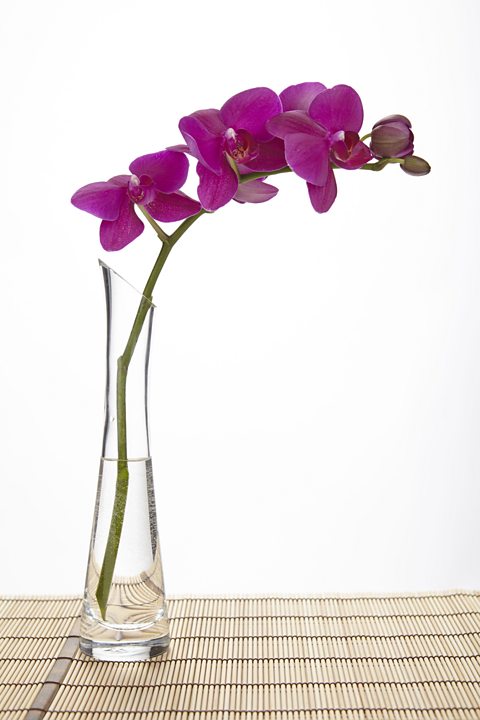 Image source, Zoonar GmbH / Alamy Stock Photo
Orchid as symbol
Keeping Orchids begins and ends with the orchids. This stresses their significance. Kay projects her emotions onto the flowers, leaving the poem itself detached in tone.
The orchids are used as a A symbol is an object, person, image or event used to represent something bigger. For example, doves are often used as a symbol of peace. for:
- the potential relationship between Kay and her birth mother
- Jackie Kay herself, as a baby who needs to be nurtured and cared for
- the mother's guarded and secretive personality.
The orchids are "still alive" at the beginning of the poem. By the end, they are in need of extreme measures to make them "live longer". The last line of the poem stands alone, carrying a sense of finality.
The poem ends on a description of "cutting" with a "sharp knife". This could suggest severing ties and separation:
- between the mother and daughter who struggle to reunite
- the initial separation between mother and baby when Kay was put up for adoption
There is a feeling of dissatisfaction, frustration and even anger. It is uncertain whether Kay will continues to "keep" the orchids.
Image source, Zoonar GmbH / Alamy Stock PhotoStanzas one to six
The orchids my mother gave me when we first met
The first line of Keeping Orchids seems odd - it is unusual for the speaker to be meeting her mother for the "first" time. This establishes the situation of the poem and immediately connects the mother-daughter relationship with the orchids.
Jackie Kay insists that they are "still alive, twelve days later". This suggests that she has looked after them carefully. The A pause that breaks up a line of verse by using punctuation, particularly a full stop. in line two and the The use of run on sentences with no punctuation at the end of lines or across stanzas. between stanza one and two unsettle the reader. We learn that the orchids are not flourishing:
some of the buds remain closed as secrets
This connects the flowers to the mother and her reticence about her past. Kay notes how protective she has been, carrying them like a baby in a shawl. The A comparison using 'like' or 'as' to create a vivid image, eg as big as a whale; float like a butterfly, sting like a bee. looks back to the past, when Kay was a baby in need of protection - protection that the mother could not provide.
the whole glass carafe has crashed / falling over, unprovoked
Here Kay conveys a sudden and intense event. The use of The repetition of vowel sounds in a series of two or more words. in "glass", "carafe", "crashed" creates a sense of her panic and fright. The orchid and the glass are fragile and could easily be destroyed. But they have survived.
The minor sentence "All the broken waters" is significant here as it deliberately connects the incident to birth.
The poet attempts to "rearrange" the "upset orchids" but she has "troubled hands". Her emotion is affecting her deeply. It is implied that meeting her mother for the first time has unsettled her. There are things unresolved that she wants to know, but her mother will not open up to her. The "closed" buds do not open:
The skin / shut like an eye in the dark
The use of "skin"Personification is when a writer gives human characteristics to something that isn’t human. the flowers here and the simile gives us an impression of the mother’s secretiveness.
Stanzas seven to eleven
Jackie Kay struggles to remember her mother after their meeting:
Her face is fading fast
Her voice Describing something by saying it is something else. While a simile compares things using 'like' or 'as', a metaphor creates a direct comparison"rushes through a tunnel" away from her as she forgets its sound. This reminds us of the different train stations used in stanza three to highlight the distance between them.
In trying to recall her, Kay lists items of dress -
a paisley pattern scarf, a brooch, a navy coat
But she significantly fails to mention her mother’s face, her expressions or gestures.
A digital watch her daughter was wearing when she died.
In stanza nine what the mother is wearing takes on more personal significance. A digital watch reveals that she had another daughter who died. This provides an interesting parallel:
- Does the mother tell the story of one daughter without registering that the woman in front of her is also her daughter?
- Does she place more importance on the life of one child over the other?
- Or does she regret giving her daughter away, feeling that she has lost both?
The mother's hands are "awkward" and "hard to hold". She seems unable to be tactile with her daughter, detached in nature or ill at ease with this reunion. The use of The use of run on sentences with no punctuation at the end of lines or across stanzas. spilling into the first line of stanza eleven: "fold and unfold" works with the The repetition of vowel sounds in a series of two or more words. to portray the continual discomfort at being forced to confront her past.
Stanza eleven confirms that the mother keeps the story of her life "Compressed. Airtight."
These minor sentences suggest that the mother has perhaps simplified her story in order to deal with her actions. She is now unprepared to look back to her past and dig up the detail and complexity.
A sad square, then a crumpled shape. […] a box of love letters.
We do not know whether the "love letters" mentioned are from Kay’s father, but the implication is that the mother has kept her past deeply concealed while she pursued a new life. The repetition of the suggests her detachment from these items as well as the strangeness they must have for Kay as she sees them for the first time.
Stanzas thirteen to fifteen
This meeting obviously affects Jackie Kay, but again this is described in a detached manner ("A door opens and closes…"). As well as describing the actual door in the café or venue in which they are meeting this experience metaphorically ‘opens the door’ to her past, but only briefly.
Time is outside waiting…
This sentence conveys the idea that time itself is suspended. The poet has come away from her everyday life to meet her mother. But once the meeting is over she must return to her current situation.
Final lines
Boiling water makes flowers live longer. So does / cutting the stems with a sharp knife.
These final lines return to the orchids. Kay appears to be almost quoting instructions for prolonging the life of flowers. Both "boiling water" and "cutting the stems with a sharp knife" sound harsh actions but they do keep the flowers alive. They could suggest the mother’s decision to put her child up for adoption, as she felt it was the best life for her.
In this context "cutting the stems" could signify the wrench as mother and daughter are separated, as well as the cutting of the umbilical cord after birth. It implies that this relationship was cut off in its infancy.
However, we could also read the final lines as a comment on the new relationship between mother and daughter. Is this something that should be nurtured and allowed to grow or should it be dismissed? Should they simply sever ties and stop trying to resuscitate a bond broken so long ago?
Ultimately, Kay does not know how to "keep" this strange new relationship with its "closed" buds and "secrets". Perhaps she needs to be more forthright, equipping herself with a "sharp knife" to "cut the stems" after this first awkward meeting.
What are the themes in Keeping Orchids?
Adoption and motherhood
Keeping Orchids examines the consequences and challenges of adoption and a difficult maternal relationship.
The orchids my mother gave me when we first met…
The first line throws the reader, as we are surprised to find she has only just met her mother. We then realise the context and the paradox of meeting someone you are so closely related to but who is a complete stranger at the same time.
Jackie Kay uses the orchids to depict the mother’s reticence. They also symbolise the difficulties Kay faces in beginning a relationship with someone she lacks connection with.
The meeting must be an emotionally charged one, and yet the mother’s response is to shut down and keep her "secrets". She holds her past in a green carrier bag and unpacks it in a systematic fashion. Kay is affected greatly by her mother’s detachment. It is implied that Kay seeks much more from this meeting than her mother is prepared to give.
The line "Time is outside waiting…" suggests that Kay doesn’t need her mother. Her life can go on without her - after all she has lived without her all these years.
But although she can get back to her life, she is left disappointed. Instead of the warmth of reconciliation, she leaves with fragile flowers that appear unresponsive to her care.
Relationships
Jackie Kay explores her regular theme of the connection, or lack of connection, between mother and daughter. The symbol of the orchids reflects different aspects of their relationship.
Here the relationship is portrayed entirely from the daughter's point of view. There are clear suggestions as to Kay's emotions of worry, frustration and anger.
The mother is portrayed as being detached and awkward, unable to confront or explain her past. Kay is keen to reach out to her mother, but is hurt by her lack of emotional engagement. Instead of explicitly describing the problems she experienced, Kay uses the orchids with their ‘closed’ buds to portray the mother’s coldness and the struggle to look after the flowers.
Comparing Keeping Orchids to other Jackie Kay poems
The uncommunicative nature of the mother figure in Keeping Orchids has some connections with the opening stanzas of Jackie Kay's poem Maw Broon Visits A Therapist, where Maw is struggling to open up and express her feelings. ("canny think of whit tae say"). For different reasons, these women find their situations awkward and particularly when reflecting on their roles, or lack thereof, as mothers. By contrast, the mother in Whilst Leila Sleeps says "I bite my tongue, hard", and "I cannot lie". There is no lack of closeness between the mother and daughter in this poem, but there is an external threat that the mother is fearful of, and is protecting her young daughter from.
There are links with Darling and Grandpa's Soup about the inexact and fading nature of memory. In Keeping Orchids the speaker states:
"Her face is fading fast… I close my eyes and try to remember exactly"
whereas in Darling the speaker reflects:
"You might forget the exact sound of her voice/or how her face looked when sleeping."
Both Grandpa's Soup and Gap Year, on the other hand, deal with memory in a bittersweet way that is to do with the loss of childhood, and about loved ones leaving (whether to travel and seek adventure, or through death). These compare with Keeping Orchids as while memory of the brief and awkward meeting in Keeping Orchids is quickly lost as Kay and her birth mother meet and then travel off to different destinations, in Gap Year Kay's relationship with her son stays strong despite the geographical distance between them, because of the years of shared memories shown in the poem.
Revise more of Jackie Kay's poems from the National 5 English set text list.
Maw Broon Visits A Therapist revision-guide
Study Jackie Kay's poem for National 5 English
Whilst Leila Sleeps. revision-guide
Study Jackie Kay’s poem Whilst Leila Sleeps for National 5 English.
Darling. revision-guide
Study Jackie Kay's poem about loss and remembrance for National 5 English

Revise Keeping Orchids by Jackie Kay
Revise Keeping Orchids and other poems by Jackie Kay with interactive quizzes for National 5 English.
Quizzes - Jackie Kay. quiz
Test your knowledge of the set texts by Jackie Kay with interactive quizzes for National 5 English.

Flashcards - Jackie Kay. interactive
Check your understanding of the set texts by Jackie Kay with these interactive flashcards.

More on Jackie Kay
Find out more by working through a topic
- count6 of 9
- count7 of 9

- count8 of 9
- count9 of 9