Overview of Maw Broon Visits A Therapist by Jackie Kay
Maw Broon Visits A Therapist by Jackie Kay is a one-sided conversation between:
- famous Scots cartoon character Maw Broon
- the therapist she has been persuaded to see
The poem is a gradual exploration of Maw Broon’s true feelings about:
- motherhood
- womanhood
- a lack of identity
Told in her inimitable Scots voice, it is a picture of a woman:
- frustrated by life, unsure of her role anywhere outside of her comfort zone
- and then suddenly realising that there is an immense, electric feeling of freedom at the thought of being truly honest
The voice of the therapist is absent from the poem. The reader only listens to Maw Broon. This is ironic as it becomes clear that no one else truly listens to her in her day to day life.
The poem deals with themes of identity and motherhood.
Looking for some quick revision? Try an interactive quiz or flashcards for National 5 English.
Listen to a reading of Maw Broon Visits A Therapist by Jackie Kay
You can listen to Jackie Kay read 'Maw Broon Visits a Therapist' on the Bitesize Scotland Poetry podcast.
You can read Maw Broon Visits A Therapist on the Scottish Poetry Library website.
Context
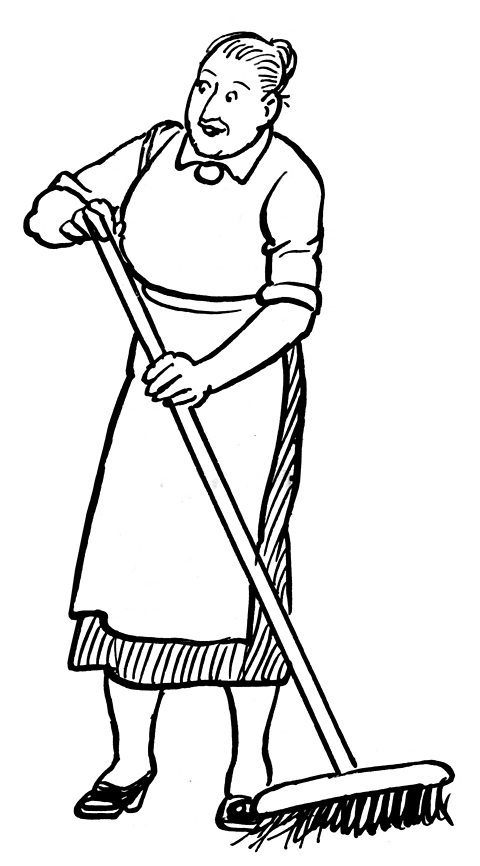
The Broons is a Scottish cartoon strip that appears weekly in the Sunday Post newspaper, making its first appearance in 1936.
The cartoon follows a large family who live together in a small tenement flat in the fictional town of Auchentogle (or Auchenshoogle). The family is made up of Paw and Maw Broon, their eight children, and Paw's widowed father, Granpaw Broon. Maw Broon is the homemaker and head of the household - taking care of her husband and eight children.
Source: The Broons - DC Thomson
Poetry Podcast: Maw Broon Visits A Therapist by Jackie Kay
Jackie Kay discusses her poem Maw Broon Visits a Therapist with Zara Janjua. You can listen to episodes on all of the National 5 set text poems by Jackie Kay on BBC Sounds.
Form and structure of Maw Broon Visits a Therapist
The poem is a stream-of-consciousness When a character speaks for an extended period of time, revealing thoughts, feelings, and motivations to another character or the audience.. We do not hear from the therapist, instead it is Maw's thoughts, occasionally half-formed and jumping between topics. Written largely in four line stanzas, the irregular line length and lack of formal A repeated pattern of rhymes, usually written with letters ABAB would mean lines 1 and 3 rhyme; and lines 2 and 4 rhyme also rhyme but differently. creates a choppy, uncomfortable feel to Maw Broon’s words - mirroring how she feels about therapy itself and her own identity.
There is an Presenting an idea in a way that is interesting or strange because of being very different from what you would expect. in Maw Broon’s initial assertion that she “Canny think whit tae say” at the start of what ends up being a long, fourteen stanza poem, and this shows us how pent up she has been all these years - when she starts, she actually has a lot to say.
Stanzas one to four
Maw Broon Visits a Therapist gets off to an awkward start with:
- a classic exclamation (“Crivens!”)
- short, punchy sentences
Maw Broon explains that she “canny think”, painting a picture of a woman unused to being asked for her opinion.
Stanza two is a sudden shock to the reader as Maw Broon makes a more serious, heavy confession that:
- “A’ canny hawnle life”
- “everything is awfy”
- and perhaps most importantly, “A’m no masell”
These desperate, depressing statements contrast our expectations of comedy from the famous cartoon character and set up the poem’s darker themes. She references that "folks cried me something", that she had a name once, when she was a "wean"(child), but immediately negates that possibility with:
The idea o' me ever being a bairn / is impossible.
Maw Broon's backstory is never explored in The Broons. She has always, like the other characters, been presented to the audience as she is, fully-formed and never ageing, so there is little room for anyone to see her as a child who once had a name - not her family, and certainly not the audience. She is, and has always been, Maw.
The repetition of “A’” (the Scots word for “I”) three times in stanza three is a reminder of the focus of the poem - Maw Broon is struggling to know who she truly is. She then explains that she cannot even remember her own first name, reduced to her role as mother to her family.
The idea of her identity becoming solely Maw is furthered in stanza four when she explains that she is forever clad in her “pinnie and this heid scarf”, erasing her true identity and replacing it with the domestic uniform of the mother.
A've aye worn this same pinnie and this heid scarf
The upsetting confessions here are coupled with the Scots word “cried”, which simply means “called” in context, but the English A word used to describe the ideas or feelings that a word might suggest. For example, a skull conjures up thoughts of fear, mortality and death. of sadness and upset cannot be ignored. Maw Broon is clearly an unhappy figure.
Stanzas five to eight
The narrative staggers here as Maw Broon’s self-doubt from stanza one returns. She pauses in her confessions to remind the therapist (and the reader) that she is out of her comfort zone in therapy. She clearly seeks the therapist's input, and then approval, but when nothing is forthcoming the sentences become shorter as her discomfort grows.
Exclamations like “Jings” and “Crivens” become ways to stall for time to think of an answer, and show Maw Broon’s constant surprise that someone would actually ask for her thoughts and opinions.
In stanza seven, Maw Broon makes a second mention of being “a wean” and the implication is that the girl she was before marriage and children was one who knew who she was and had high hopes and aspirations. The dual meaning of “dream” implies that Maw Broon does not sleep well, nor does she have any hope left for her life.
A've no had a dream since A' wis a wean.
The repeated questions at the end of stanza seven become almost aggressive as Maw Broon grows frustrated. She is a woman used to the tangible things in life and the therapist is pushing her too far, asking her to imagine more than the life she is so used to now.
She confesses this frustration with the Scots word “crabbit” and explains that she isn’t finding the therapy process helpful. But with her domestic life leaving her so unfulfilled she is in danger of being unable to find happiness anywhere. Kay concludes this stanza with Maw Broon misunderstanding the therapist’s question about how she sees herself, allowing for a brief interjection of humour in her response.
How dae A' see masell?
Revise the use of questions and exclamations for National 5 English here: Why do writers use question and exclamation marks?
Stanzas nine to twelve
Maw Broon takes the question “how dae a see masel?” literally and describes her appearance, listing the many ways her outward identity makes her unhappy.
The comparison of her bun to “jist a big onion” implies perhaps that there are more layers to her character than people might think, but she is unable to explore these, as she explains with the dual meaning of:
A’ canny let ma hair doon.
The Rhythm can be described as the beat and pace of a poem. Rhythm is created by the pattern of stressed and unstressed syllables in a line or verse. of stanza ten suddenly lifts and Maw Broon finds her voice as she did in stanza three. The close-quarter between “bothy” (it’s no surprise that she compares herself to a house here - she runs one every day) and “hefty”, “grantit” and “dae it”, and the When poets rhyme the stressed syllables in two words or phrases, such as 'sing' and 'ring'. of “wabbit” and “crabbit” imply that she’s finally getting something off her chest. The confession bolsters her and in stanza eleven she allows herself a compliment, although still belittling the process with the word “lark”.
Unfortunately, that confidence also derails Maw Broon’s train of thought and she turns the belittling word choice into an assault on the therapist and his profession. Once more, she feels she’s the one doing all the work. She describes it as “money for auld rope” which contrasts to the significant labour and difficulties she deals with as a housewife and mother-of-eight each day.
Stanzas thirteen and fourteen
Vulnerability rears its head in stanza thirteen as Maw Broon’s comment about rope is expanded upon. She describes herself as “tatty”, linking back to her earlier comments about her clothes and her hair, and states that she is rope “nibiddy wuid want tae climb”, hinting at her feelings of uselessness but also using a sexual pun to explain how undesirable she feels. A further layer of her identity as a woman has vanished, reducing her again to simply Maw.
The poem ends with Maw Broon cutting herself off at the end of stanza thirteen as she finally feels free enough to express herself. She at last finds therapy “exciting” - something lacking in her personal life. The giddy, dangerous tone of the final line, and the possibility implied by the repeated use of “could”, implies the dazzling freedom she might find if she were to allow herself to “jist give in” to her emotional fragility.
Words that otherwise could sound so negative, with the double meaning of giving up or breaking down, could possibly imply something else entirely here: breaking free from her current role and mindset, and giving in to her new-found openness.
A' could break. A' could jist give in.
What are the themes in Maw Broon Visits a Therapist?
Identity
Maw Broon is a woman stuck in an identity she is no longer sure fits her. She has lost the girl she was in her youth, finds no excitement in her life, and is left feeling all-at-once overworked, under-appreciated, and undesirable. Things like her pinnie, scarf, or hair bun take on greater significance as they Stands for a much larger idea. the tired, worn-out Maw identity.
Motherhood
Maw Broon is mother to eight children and as matriarch of the Broon family, her role has usurped her identity to the point of becoming her new name. She talks of how despite all she does for her family, she feels taken advantage of and how it has left her feeling bereft. The poem concludes with a startling realisation that she has more power than perhaps she thought, and that if she were to “break” she might find some excitement in watching the fallout.
Comparing Maw Broon Visits a Therapist with other Jackie Kay poems
Although a different, more negative, view of motherhood, Maw Broon Visits a Therapist can be compared and contrasted with other Jackie Kay poems Gap Year and Whilst Leila Sleeps with their:
- mother-narrators
- confessional, personal writing style
The themes of identity and family also pair well with Grandpa’s Soup, which features Scots vocabulary throughout that shows their strong bonds. The use of Scots words in both poems has the speakers reflecting on domestic life using the vocabulary they share with their families. This shared communication is in contrast with the initial awkwardness of Maw ("canny think whit tae say") and the mother character in Keeping Orchids.
In Keeping Orchids, the speaker of the poem is meeting her mother, and like Maw in the beginning of this poem, the mother appears uncomfortable and uncommunicative. She is described through the metaphor of the flowerbuds as being "closed as secrets", and in Maw Broon Visits a Therapist, Maw initially doesn't know what to say or how to communicate her feelings. The impression is that both women find their roles difficult, for different reasons, and have repressed their feelings about it.
Revise more Jackie Kay poems from the National 5 English set text list.
Grandpa's Soup. revision-guide
Study Jackie Kay’s poem Grandpa's Soup for National 5 English.

Keeping Orchids. revision-guide
Revise Jackie Kay’s ‘Keeping Orchids’ for National 5 English.

Whilst Leila Sleeps. revision-guide
Study Jackie Kay’s poem Whilst Leila Sleeps for National 5 English.
Revise Maw Broon Visits A Therapist by Jackie Kay
Revise Maw Broon Visits A Therapist and other poems by Jackie Kay with interactive quizzes and flashcards for National 5 English.
Quizzes - Jackie Kay. quiz
Test your knowledge of the set texts by Jackie Kay with interactive quizzes for National 5 English.

Flashcards - Jackie Kay. interactive
Check your understanding of the set texts by Jackie Kay with these interactive flashcards.

More on Jackie Kay
Find out more by working through a topic
- count5 of 9
- count6 of 9
- count7 of 9
- count8 of 9
