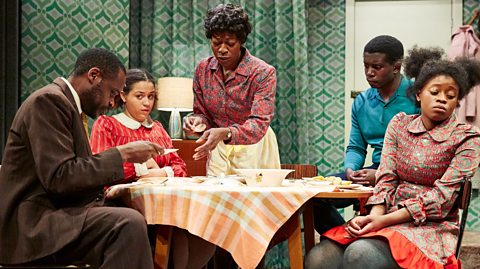
Who are the key characters?
The three main characters in Princess & The Hustler are:
- Phyllis ‘Princess’ James
- her brother Wendell ‘Junior’ James
- her mother, Mavis James.
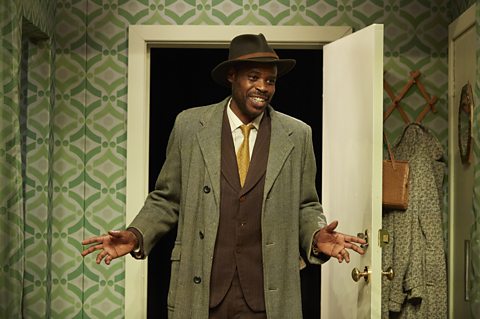
The audience are also introduced to Wendell ‘The Hustler’ James and his daughter, Lorna, at the start of the play.
The two other characters in the play are Margot, who is Mavis’ friend, and Leon, who is Junior’s friend.

Remember
When writing about a character, you should think about:
Key moments for the character
If and how the character changes throughout the novel
The writer's intentions and message relating to the character
How a reader or audience might respond to the character.
Phyllis 'Princess' James
- Curious
- Imaginative
- Friendly
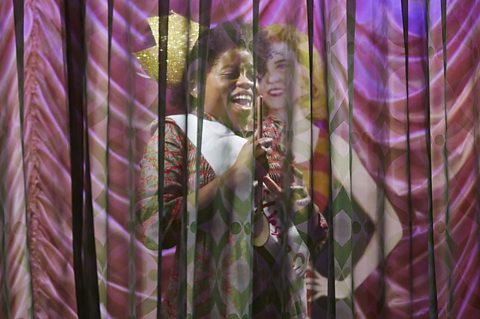
Princess is the play’s The main character in a novel or a play.. She is 10 years old. Princess lives in Bristol – a city in the southwest of England – and dreams of travelling to the nearby seaside town of Weston-super-Mare to enter its ‘Beauties of the West’ contest.
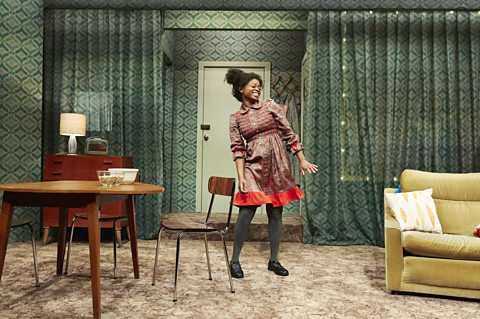
Princess imagines a world of An elaborate ceremony or event. In the play, it refers to beauty pageants, where people are judged mostly for their looks. in her cupboard, where she wears a cardboard crown and a sash and imagines exploding fireworks and music playing. Throughout the play, the To be ‘vibrant’ means to be full of colour and light. of the ‘cupboard world’ reflects how Princess is feeling.
Princess is innocent and child-like. She does not resent her father leaving, like Junior does – perhaps because she was too young to remember it. Her relationship with Wendell blossoms by the end of the play – he is the only other character invited into Princess’ imaginary world.
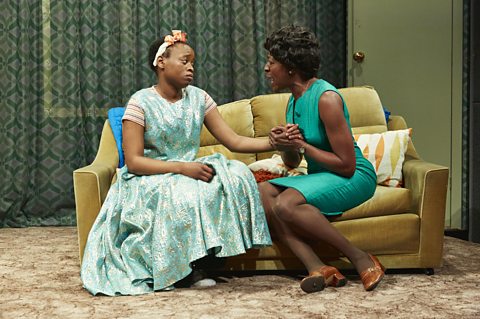
Princess is very friendly, curious and talkative when meeting Lorna but in Act Two, Scene Five, there is a shift in her character. Princess becomes unwell and lies on the sofa watching her family. At the end of the scene she angrily destroys her cupboard world, runs away and cuts her hair. It is clear that the racist bullying that Princess experiences at school is damaging her happiness and self-esteem.
Through Princess, Odimba communicates lessons about the effects of Unfair treatment of a person or a group of people because of their nationality, gender, religion or other reasons. and also about self-love. Through the course of the play, and with the help of her family, Princess learns to love and celebrate herself.
Mini quiz
Mavis James
- Hardworking
- Protective
- Caring
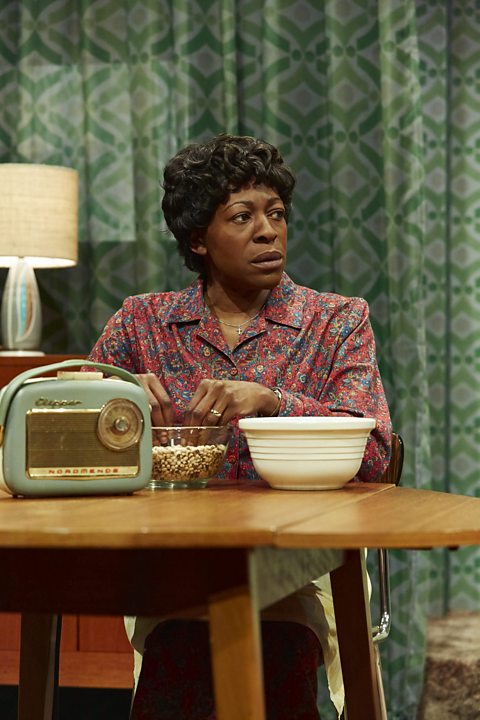
Mavis is Princess and Wendell Junior’s mother. She works hard making curtains for a living and is close friends with Margot, her white neighbour.
Mavis is 38 years old and has raised her two children alone since Wendell left her. She shows her love through high expectations and strict boundaries, but is also playful and affectionate with her children.
When Wendell returns, she does not take him back easily. She sets boundaries and rules for him.
When she accepts Wendell’s marriage proposal at the end of the play she says that if he can’t promise to be a good father to Princess and Junior, “then better to leave now”.
Mavis encourages Princess to love herself and to appreciate her own beauty. She tells her:
We are everything that is beautiful on this earth. And you…you the prettiest of them all because you are my girl.
Question
Mavis says this to Wendell when he returns:
Wendell how you think we have food? When mi nuh here sewing till my fingers turn blue, mi out there asking every woman if she need a new dress. Then I come back and sew them ones too!
What does this show about Mavis?
This quote shows how hardworking and Able to recover quickly when something difficult has happened. Mavis had to be to take care of her children on her own.
It also reveals how difficult her life must have been after Wendell left, and explains why she is so angry when he turns up unannounced and is so reluctant to let him back into their lives.
Wendell ‘Junior’ James
- Independent
- Outspoken
- Responsible
Wendell Junior is Princess’s older brother. He is 17 years old and loves photography. He teases Princess but also takes care of her.
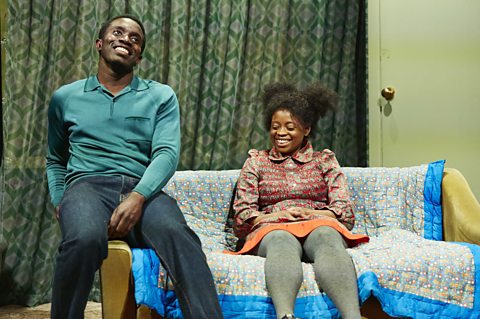
Junior is outspoken and able to express his emotions clearly. He makes it clear from the start that he does not approve of his father returning. He is responsible and looks out for his family, for example by sending Princess and Lorna home with Leon when he finds them alone at the docks.
He is also independent and passionate, as shown through his involvement in the In 1963, the Bristol Omnibus Company were upholding a colour bar which meant that they refused to hire anyone who was Black or Asian as bus drivers or conductors. In April 1963, people in Bristol protested against this racial discrimination and refused to ride the buses until the bus company ended their colour bar. This finally happened in August 1963.. Even after he is attacked, he continues to protest showing his strong values and commitment to Fair behaviour or treatment..
Despite receiving presents from Wendell, Junior doesn’t allow himself to be won over easily. Wendell greets Junior as “My son!” at the end of the play, and Junior instigates taking a family picture, which suggests that the success of the bus boycott has brought them together.
Question
What evidence could be used to show that Junior is outspoken in the play?
Through Junior's early support for the boycott, it is clear that he is willing to speak out against prejudice. His continued support shows bravery.
We can’t ride the buses no more until they win.
Junior also speaks out for his family when Wendell returns, saying that he won’t let him hurt Mavis or Princess. He tells his father:
I don’t hate you. I just love them more.
Wendell ‘The Hustler’ James
- Charming
- Unreliable
- Able to recover quickly when something difficult has happened.
Wendell is Mavis’s When someone no longer lives with their partner. husband and father to Princess and Junior. He is described in the stage directions as “tall and handsome”. Wendell left his family years earlier, but returns at the start of the play with another daughter, called Lorna.
Wendell does not present as a trustworthy father. For example, he leaves Princess and Lorna alone at the docks and is seen hiding a bundle of money from them whilst there. He also tries to charm Mavis and buys Junior gifts, possibly to try and win his affection.
Throughout the play, Wendell and Mavis become close again. Wendell reveals some of the racial prejudice he has struggled against as a Black man and supports the bus boycott, showing his growing political awareness and sense of responsibility. He undermines this though, when he disappears for two days and reappears drunk.
At the start, Wendell is proud of his nickname ‘The A person who does something dishonestly and sometimes illegally. ’ but after he proposes to Mavis he rejects this title. He says, “Hustle nuh win anything far mi”, suggesting that he is planning to change his ways.
A new, more fatherly side to Wendell is seen right at the end of the play when he walks “hand in hand” into the cupboard with Princess and “gently” places the crown on her head.
Activity
Lorna James

- A person described as ‘reserved' keeps their emotions hidden. They are slow to reveal their feelings or opinions.
- Quiet
- Protected
Lorna is Wendell's other daughter. She is nine years old and reserved, in contrast to Princess’ talkative nature.
Lorna’s mother who never appears in the play is white and Wendell is Black so Lorna is mixed-race. In the 1960s, some people still held hostile, racist attitudes towards Relationships between people of different races. For example, Lorna’s mother is white and her father is Black..
It is hinted that Lorna has been protected from learning about racism when Mavis asks Wendell, “You don’t think to educate that girl?”. He replies that “Where she come fram dese things nuh spoken ‘bout”.
Through Lorna, Odimba explores the damaging impact of Discrimination against people with a dark skin tone, typically among people of the same ethnic or racial group. and its effect on family relationships and identity.
In some situations, Lorna’s lighter skin seems to benefit her: she is invited to parties that Princess isn’t. However, in Act Two, Scene Three, Lorna reveals that she is struggling with her mixed-race identity. She tells Princess that:
I’m not Black like you. I’m only half. Half of everything.
This struggle with feeling "half" extends to her identity within the James family. She rejects Princess as her sister saying “I’m not like you”.
It could be argued that Lorna is the character who is most displaced at the end of the play – she is still adjusting to the changes in her life.
Margot
- Talkative
- Caring
- Prejudiced
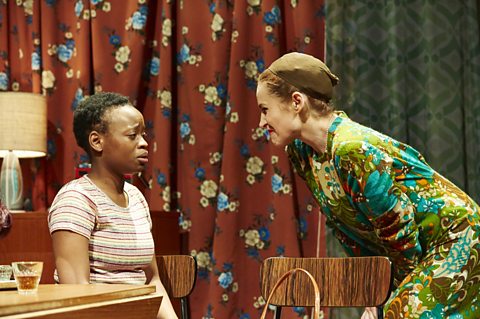
Margot is a 42-year-old white woman and Mavis's friend and neighbour. She is a complex character – loyal and loving, but also racially prejudiced.
Margot is very talkative and Behaving in a way that suggests a playful sexual attraction. with Wendell before she realises he is Mavis’s husband. She also flirts briefly and, some might argue, inappropriately with Leon. She is single, lives alone and enjoys male attention.
Margot is supportive, loyal and cares a lot for Mavis and her children, particularly Princess. She explains to Wendell that, “Mavis and me are always together. I look out for her and she… She looks out for me.”
Despite seeing Mavis as family, Margot doesn’t understand the motivation behind the bus boycott or see any issue with the When equal employment opportunities in a particular industry or organisation are denied to members of ethnic minorities.. She calls the boycott “silly” and worries that it will take jobs away from white people, like her brother.
There is a real conflict between Margot’s love for the James family, and her lack of interest in racial equality. This creates tension between herself and Wendell, in particular.
When Princess runs away, she hides in Margot’s home. Margot knows how to comfort Princess and make her feel safe. She responsibly lets Mavis know her daughter is found and returns Princess the next morning.
Question
When talking with Wendell and Mavis about the bus boycott, Margot says:
Peoples haves to be accommodated that's for sure, and many people round here doing their best to be tolerating of youse, and your West Indian churches, and you've got to be mindful of us.
How does the language in this quote reveal some of Margot's racist beliefs?
Margot groups Mavis and Wendell together with all other Black people by using the pronoun “you”. She repeats "youse", "your" and "you've" in an accusatory way.
In contrast, Margot groups herself together with the white community as “us” showing a distinct sense of difference or separation. Even though she views Mavis as "family", she distances herself from their struggles.
The verb “tolerating” also suggests that Margot views the immigrant community as something to be put up with, but not celebrated.
Leon
- Responsible
- Mature
- Caring
Leon is 19 years old and is Junior's best friend. They share an interest in photography.
Leon is a good friend and responsible influence on Junior. When he and Junior find Princess and Lorna alone at the docks, he takes them home safely saying the docks are “no place for young girls”.
Junior seems to respect Leon and looks for his approval: “You think my photos are getting better Leon?”. At times he is a calming, mature influence on Junior too. He encourages him to control his emotions around his father:
Cool it Junior.
Leon speaks highly of his own father, who is outspoken about important social issues and a lead figure in the bus boycott.
Princess & The Hustler Characters Quiz
Test your knowledge of Princess & The Hustler by taking this multiple-choice quiz.
GCSE English literature revision podcasts. audio
Whether you're at home or on the go, listen to these podcasts by Bitesize and BBC Sounds to refresh your memory of key texts.

More on Princess & The Hustler
Find out more by working through a topic
- count3 of 5
- count1 of 5