Key points
Chinonyerem Odimba wrote Princess & The Hustler as a play in three acts.
It has a cyclical structure, so it starts and ends in a similar way with Princess in her cupboard world.
Odimba uses stage directions to give additional details about how lines should be delivered or how actors should behave.
Mavis and Wendell’s lines are written to sound like Jamaican A form of language or dialect different to the standard or official language of a country. to illustrate how the Caribbean community in Bristol might speak.

Remember
As Princess & The Hustler is a play, it is important to read and consider the stage directions carefully.
Think about the purpose and effects of stage directions and word choices, rather than just identifying them.
Structure
Cyclical structure
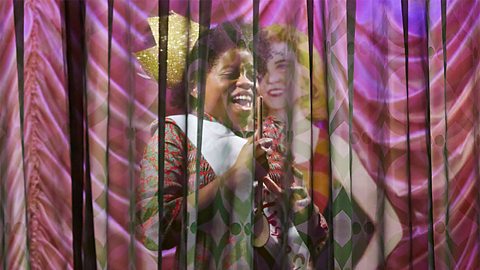
The play begins with Princess alone in her An elaborate ceremony or event. In the play, it refers to beauty pageants, where people are judged mostly for their looks. world in the cupboard. She places “a crown made of cardboard and tinsel” on her head and announces herself the pageant winner.
The plays ends with Princess back in her cupboard room. This time Wendell, her father, is there. He places “a crown of the most wonderful sparkles” on her head and announces her the pageant winner.
Apart from Wendell’s presence and loving support, the other key difference in the final scene is that:
for the first time she imagines a pageant where all the beauty queens look like her.
This is significant as it shows that Princess’s feelings about her own appearance and self-worth have changed over the course of the play.
The stage directions instruct that “A line of the most beautiful Black women of all sizes and nations” joins Princess on the stage and she takes a bow “with her fellow queens”.
The ending shows Princess empowered and confident, supported by her family and community.
Mini quiz
Language
Jamaican patois
In Act Two, Scene Four, Mavis talks to Margot about when she and Wendell left Jamaica to live in England. She says they married in 1945 and she was pregnant with Junior when they arrived, so it is implied that they emigrated as part of the Windrush generation in 1948 onwards.
All of Wendell’s lines replicate Jamaican A form of language or dialect different to the standard or official language of a country.. For example:
When mi come to dis country I was ar good man. Ar soldier. Fight far King an’ country.
Some of Mavis’s lines use patois too – particularly when she is speaking with Wendell.
Realistic dialogue
Princess & The Hustler is written using Refers to how ordinary people from a specific region or country speak. speech – that means the characters speak like ordinary people.
To make the dialogue even more realistic, Odimba uses specific speech directions, which she lists under “Things” at the start of the play.
For example, Odimba uses:
Ellipsis to show when a character should pause or “trail off”. For example: "I think I hear something…"
Overlapping speech indicated by /. For example:
PRINCESS. Beauties of the West /
MAVIS. What you say?
PRINCESS. Nothing Mummy /
MAVIS: Good.
These techniques illustrate how comfortable the characters are as they talk over and interrupt one another – like close family would.
Question
Did Mavis and Wendell find moving to England easy?
No. Mavis tells Margot how Wendell was “a second lieutenant back home”, but in England had to start work as a junior clerk in an office. He felt “invisible” so took to staying out “all hours of the night” before he left her.
The fact that Mavis still calls Jamaica “home” suggests that she still feels a deep connection to the Caribbean and perhaps has never fully adjusted to living in Bristol due to racial hostility.
In Act One, Scene Seven, Wendell also speaks about the racist abuse he experienced when he moved to England, particularly after Lorna’s birth. He says that people wrote “nonsense ‘pon mi door” and “windows break every day”.
He says he came home one day to find a rope hanging from the tree outside his house – a violent threat and reference to racist When a group of people execute someone publicly (often by hanging) without a legal trial..

Form
Stage directions
Odimba gives stage directions throughout Princess & The Hustler to instruct how lines should be delivered. For example:
LEON (whispering). Look I better be going…
This helps Odimba to communicate what emotions she wants the actors to portray in those lines.
Most of Odimba’s stage directions, however, focus on physical instructions which might non-verbally communicate ideas and insights about the characters to the audience too.
Example 1
In Act One, Scene One, Princess is about to argue back with her angry mother and “tell tales” on Junior, when Junior:
gestures a ‘shush’ at PRINCESS behind MAVIS’s back.
This simple gesture could have many interpretations. It could show that Junior is:
- Protecting Princess from getting into an argument with Mavis
- Ensuring that Mavis is not angered further and can enjoy Christmas day
- Exerting control over Princess as the older sibling.
Example 2
When Margot first meets Wendell she pulls up a chair “very close to WENDELL” and sits down:
crossing her legs seductively.
This instruction from Odimba reveals Margot’s flirtatious nature. It could also hint at more complex aspects of Margot’s character that the audience don’t learn through the dialogue. For example, the suggestion that she might To romanticise or glamorise someone or something from a different country. Wendell because he is a Black man.
Question
In Act Two, Scene Five, Princess “lies on the sofa – a blanket almost covering her entre head and face”.
She stays this way throughout the whole scene before standing up and destroying her cupboard world.
What does she witness?

In Act Two, Scene Five, Princess:
- Witnesses an argument between Wendell and Junior, who seem to have forgotten she is there
- Sees Junior give his bag of savings to Wendell, and tell him to leave
- Hears Junior tell Wendell what it was like when he left them the first time
- Hears Wendell call her and Lorna “baby sisters” which angers her.
When Junior exits, followed by Wendell, the bag of money is left on the table. Princess sees this.
Odimba directs that the audience sees Princess destroying her cupboard world, but do not see her take the bag. This helps to increase the tension later in the play when it appears that Wendell has left with the money.
Staging
Places
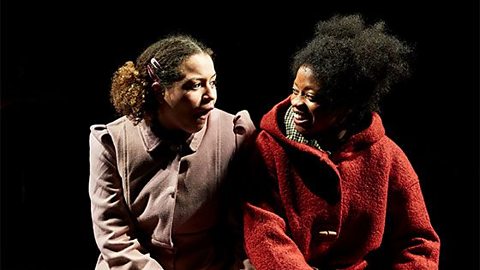
There are just four “places” specified by Odimba at the start of the play.
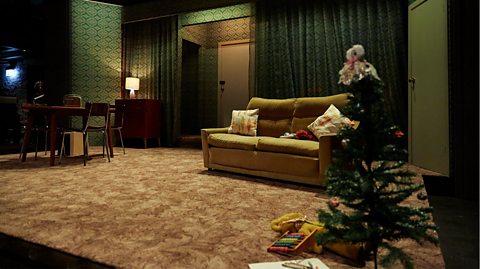
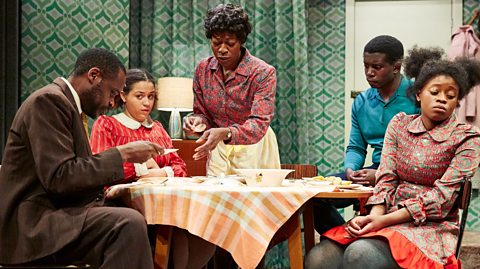
Mavis’s front room – sparsely decorated
Princess’s cupboard room – only lit when she is in there
The other room – a bedroom
The Docks, Bristol
Almost all the scenes happen within the house, apart from Act One, Scene Six, which takes place on the docks.
This helps to focus the action on the domestic life of the James household, emphasising the theme of family and the importance of home.
The docks scene helps to set the play in its wider geographical context of Bristol city. It also emphasis how irresponsible Wendell is, when he leaves Princess and Lorna in this unfamiliar environment.
Doll's house
At the start of Act One, Odimba specifies that:
The stage opens like a big box – as though opening the front of a doll’s house.
Odimba may have made this choice to:
- Create the idea that the audience are being given a glimpse into a private, personal story
- Suggest the idea of a ‘time capsule’ – this play is set in a very specific historical period: the Bristol Bus Boycott
- Make links to the idea of childhood and make-believe mirroring Princess’s imaginary world.
Question
Princess and Lorna both talk about school and the racist things that are said to them there.
Why might Odimba have chosen to not include any scenes set at school?
This play tells Princess’s story. Home, for Princess, is a safe space where she can be herself and imagine a different reality. Not showing her experiences at school focuses the play on Princess and her personal journey with her family.
Quiz
Test your knowledge of the language, structure and form of Princess & The Hustler by taking this multiple-choice quiz.
Revise for your exams with BBC Bitesize
Get ready for the GCSEs with quizzes, past papers, flashcards, podcasts and more resources!

More on Princess & The Hustler
Find out more by working through a topic
- count6 of 6
- count1 of 6
- count2 of 6