Key points
The main themes explored in Princess & The Hustler by Chinonyerem Odimba are:
- Family
- Responsibility
- Treating someone differently, unfairly and unkindly because of their skin colour or race.
- Love and empowerment

Remember
A theme is a big idea that can be found throughout the text. It is created by repeating images and ideas.
Major themes can overlap with other smaller themes and ideas.
For example, the theme of love can include the smaller themes of unconditional love or empowerment.
Family
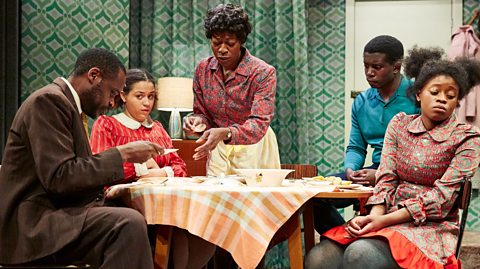
The James family
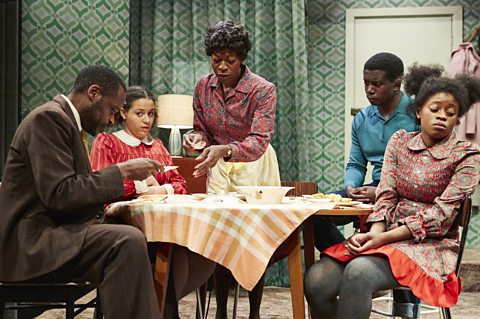
Family life is central to Princess & The Hustler. In the first scene, the audience are presented with a busy family setting: Junior is being To be told off. for going out early, Princess is in her imaginary cupboard world, Mavis is busy preparing Christmas dinner. There is shouting, laughing and dancing, and the family tease each other light-heartedly.
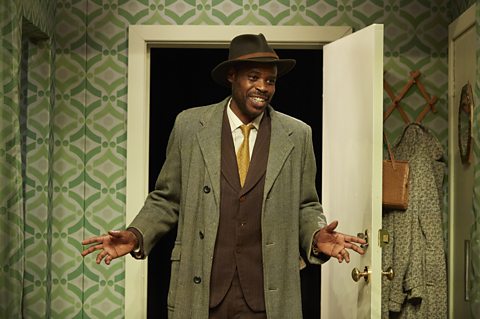
When Wendell arrives the atmosphere changes.
Question
How does Wendell’s arrival introduce conflict into the family home?
Mavis has built a life as a single mother, overcoming hardships and heartbreak, and is now faced with her estranged husband.
Junior has taken on a lead role in the family. He has looked out for Princess and his mother in Wendell’s absence and now his position is being challenged.
Princess is alarmed by his arrival. She thinks he has come to take her mother away.
Lorna
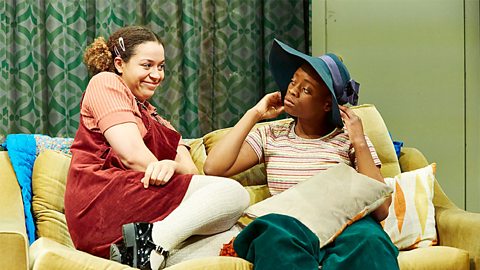
Lorna is uprooted from her old life – which the audience don’t learn much about – and thrust into the James family. In Act One, Scene Five, when she has just arrived, the stage directions instruct that she is “shoved into” the bedroom with Princess and Junior.
Lorna is quiet – she has very few lines in this first scene, particularly in comparison to Princess, which shows how she feels out of place and uncomfortable.
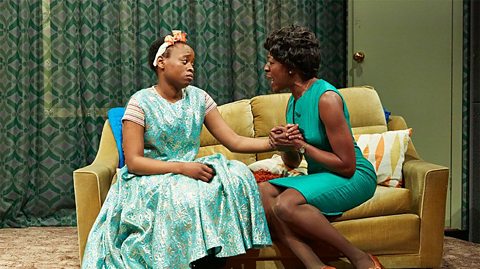
Lorna and Princess become close, but in Act Two, Scene Four, Lorna distances herself from Princess saying “I’m not like you”. Despite their similar ages, the fact of their racial difference causes conflict between them.
Lorna also says “I want my mum. I want to go home”, reminding the audience that Lorna is struggling with her own feelings of To be ‘displaced’ means to be moved from the usual position..
Margot
In Act One, Scene Seven, Margot says that Mavis is “family”:
That’s what you do for family. You look after your family.
Despite this, Margot doesn’t engage with issues that affect Mavis and her children. She doesn’t try to understand the motivation behind the In 1963, the Bristol Omnibus Company were upholding a colour bar which meant that they refused to hire anyone who was Black or Asian as bus drivers or conductors. In April 1963, people in Bristol protested against this racial discrimination and refused to ride the buses until the bus company ended their colour bar. This finally happened in August 1963., which she calls "silly", or see any real issue with the When equal employment opportunities in a particular industry or organisation are denied to members of ethnic minorities..
Margot’s status as part of the James “family” is complex.
- She enjoys the privilege of being welcomed into their home and having companionship.
- However, she isn't willing to acknowledge the ways racist policies in England impact on the family's fundamental right to lead ordinary lives. For example, to secure a steady job and enjoy the financial security and dignity that comes with it.
Question
What does the following quote from the scene at the docks illustrate about Junior’s role within the family?
He brought you here? Where is he now? Why are you waiting for him all alone like this?
Junior’s repeated questioning emphasises his shock at Wendell’s careless act of leaving Princess and Lorna alone at the docks. It shows his concern for his sisters’ safety.
Junior also repeats the A word that can be substituted for a name or noun. "he" and "him" in an accusatory way, instead of using Wendell’s proper name, or even ‘Dad’. This creates distance between them, suggesting that Wendell feels like a stranger to Junior.
Responsibility
Wendell has a responsibility to his family and children, but leaves them without warning years before the play begins.
This leaves Mavis with the responsibility to be the sole parent for Princess and Junior. Mavis tries to explain how hard this has been to Wendell by saying:
What about these hands that been doing the work of two people?
Partly because his father left them, Junior assumes a parent-like responsibility for Princess, then for Lorna too.
Junior is also presented as having a strong sense of social justice that compels him to support the protests and In 1963, the Bristol Omnibus Company were upholding a colour bar which meant that they refused to hire anyone who was Black or Asian as bus drivers or conductors. In April 1963, people in Bristol protested against this racial discrimination and refused to ride the buses until the bus company ended their colour bar. This finally happened in August 1963. – something that his father and mother also support.
Wendell begins to take responsibility as a husband and father again at the end of the play when he proposes to Mavis and begins to take more interest in his children.
Mini quiz
Racism
Historical context

Racism in Princess & The Hustler is closely connected to its historical context. Odimba gives specific dates throughout the play – it starts on 25th December 1962 and ends in September 1963. This sets it in a particular period of time in UK history, and Bristol’s history too.
In the 1960s, the population of Britain, was becoming increasingly When something is varied and contains lots of different types of people or things. as people from all around the world arrived to make new lives. This was especially true in cities with busy ports, like Bristol. This is something that Wendell comments on after he, Mavis and Margot have gone out dancing. He says:
Only inna Bristol yuh see so many different different people in same place.
Whilst some people embraced the new cultural scene, others felt threatened and responded with racism. Margot expresses this concern when she says that she doesn’t want to see her brother out of work “because of this raucous…”.
Racist policies were still legal in Britain, for example the When equal employment opportunities in a particular industry or organisation are denied to members of ethnic minorities. upheld by the Bristol Omnibus Company. Many Black people also faced racist violence and harassment in their daily lives.
The In 1963, the Bristol Omnibus Company were upholding a colour bar which meant that they refused to hire anyone who was Black or Asian as bus drivers or conductors. In April 1963, people in Bristol protested against this racial discrimination and refused to ride the buses until the bus company ended their colour bar. This finally happened in August 1963. was one of many protests held in Britain against Policies, rules and practices that form the basis of how an organisation works, but cause a continued unfair disadvantage to some based on their race. in the 1960s. Protests are still held to raise awareness of racism in the 21st century.
Racial discrimination
Anti-Black racism is the term for racism directed specifically towards Black people. It recognises the specific historical and lived experiences of Black people that are different to other racial minority groups., Policies, rules and practices that form the basis of how an organisation works, but cause a continued unfair disadvantage to some based on their race. and Discrimination against people with a dark skin tone, typically among people of the same ethnic or racial group. are illustrated in Princess & The Hustler.
Anti-Black racism is seen through:
- the physical attack on Junior after the protest
- Margot’s opinions about Black people protesting and their right to work.
Instituitonal racism is seen through:
- the bus company’s policies against hiring people of colour
- Wendell’s difficulty finding employment.
Colourism, where lighter skin is preferred over darker skin, is seen when:
- Lorna is invited to the party, but not Princess.
Windrush Generation
In Act Two, Scene Four, Mavis talks to Margot about when she and Wendell left Jamaica to live in England. She says they married in 1945 and she was pregnant with Junior when they arrived in England, so it is implied that they emigrated as part of the Windrush generation in 1948 onwards.
Watch this video to learn more about the Windrush generation.
Video
Narrator: In 1948, Britain was just starting to recover from the Second World War. Towns and cities had been bombed, thousands of homes and buildings were destroyed and they all needed to be rebuilt.
In the Caribbean, thousands of men and women had served in the British Armed Forces. After the war, some of them answered an advert to come to Britain, where there were lots of different jobs available. Other people just wanted to see England, which they had heard so much about.
They all got on a ship: the Empire Windrush, which left the Caribbean to travel thousands of miles across the Atlantic Ocean. This was the first time so many Caribbean people had come to live in Britain. Many more arrived in the following years.
It was on 22 June 1948 that the Empire Windrush arrived at Tilbury Docks in Essex. But when its passengers got off, they found that Britain was not as friendly to them as they had hoped. It was cold and grey and the Caribbean people soon experienced racism and discrimination. They found it hard to get proper homes to live in and to make friends with British people.
Later, many of their children were bullied at school because of the colour of their skin. There were racial attacks and years later race riots broke out in cities across Britain. Settling into a new country was difficult, and Black people had to stick together and support one another.
Love and empowerment
Love
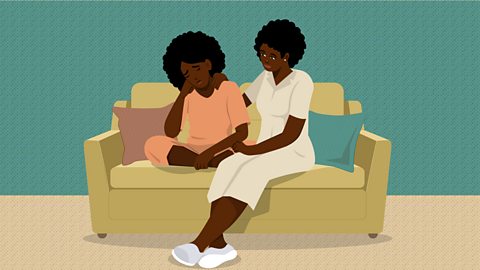
Mavis’s Not depending on any conditions or rules., motherly love for her children is central to the play. She has dedicated her life to providing for them as a single parent.
The sibling love that Junior and Princess share is also an important part of the play. Junior takes care of Princess and tries to cheer her up when she’s upset.
Margot, the family friend, also shows love towards Mavis, Junior and Princess. She is fiercely protective of Mavis when Wendell makes a joke about her in Act One and is the person Princess runs to when she is upset.
Margot’s love is complicated by her racism though and her time spent with Princess often revolves around encouraging superficial beauty standards. She provides Princess with “pictures of beauty queens” from pageants to obsess over and comforts her by letting her wear an old ball gown to bed.
Empowerment
In contrast to Margot's love, the love that Princess receives from her mother, Mavis, is empowering and affirming.
In the final scenes of the play we see Mavis praising Princess for who she is, rather than what she looks like. She tells Princess "You free to be anything" because “So many princesses before you fight for our right to that freedom.”
Wendell also empowers Princess by stepping into her cupboard world at the end of the play and acknowledging her dreams.
Self-love
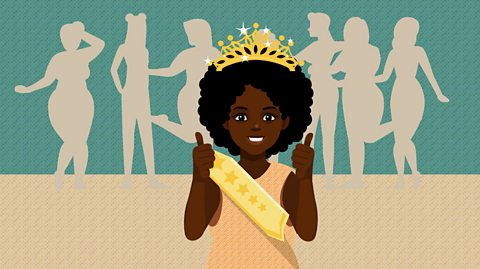
Princess also learns to love herself throughout the play. Her cupboard world can be seen as a A metaphor is a word or a phrase used for dramatic effect, to describe something as if it were something else. to represent her self-esteem.
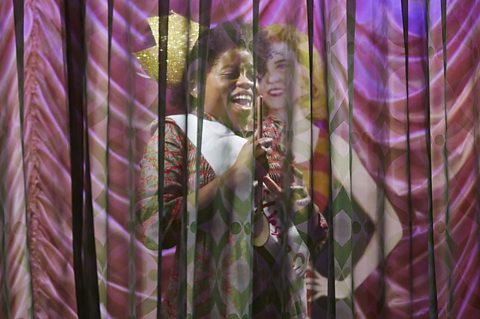
In Act One, Princess’s cupboard world “explodes into a world of pageantry” with music and fireworks. It is Christmas day and Princess is happy.
In Act Two, Scene Two the cupboard world is “less alive” and “subdued”. In the previous scene she is upset that she hasn’t been invited to a party.
At the end of Act Two, when Princess has overheard Junior tell Wendell to leave and she is being racially bullied at school, she “destroys her cupboard world”.
In the final scene, when her worth has been reaffirmed by her parents, her cupboard world “explodes into a world of pageantry” once more and is more spectacular than ever.
Question
Mavis tells Princess:
Us…girls and women with our skin dark as the night, every shade of brown, glowing like fresh-made caramel, or legs spindly like a spiders we are everything that is beautiful on this earth.
What language device does Odimba use in these lines about beauty?
Odimba uses similes.
- “our skin dark as the night”
- “glowing like fresh-made caramel”
- “spindly like a spiders”
In these lines, Mavis is illustrating to Princess that there are many different types of beauty in the world.
Quiz
Test your knowledge of the themes in Princess & The Hustler by completing this multiple-choice quiz.
GCSE English literature revision podcasts. audio
Whether you're at home or on the go, listen to these podcasts by Bitesize and BBC Sounds to refresh your memory of key texts.

More on Princess & The Hustler
Find out more by working through a topic
- count1 of 5
- count2 of 5