What are the key points about space travel and life on other planets?
DetectingAn exoplanet is the name given to a planet which orbits a star outside our Solar System..
Measuring distances in space.
Limitations of space travel.
What are exoplanets?
All of the planets in our Solar System orbit around the Sun.
Planets that orbit around other stars are called exoplanets.
They are very hard to see directly with telescopes as they are relatively small and very far away.
In addition, exoplanets are hidden by the bright glare of the stars they orbit.
Astronomers have to use other ways to detect and study these distant planets.
One way to search for exoplanets is to look for “wobbly” stars.
A large planet orbiting a star causes the star to orbit off-centre.
It is pulled to the side by gravity between the star and the planet.
From a long way away, this makes the star look like it is wobbling.
Only large planets can be detected this way but already hundreds of exoplanets have been discovered using this method.
To detect smaller, Earth-like, exoplanets, a second method is used.
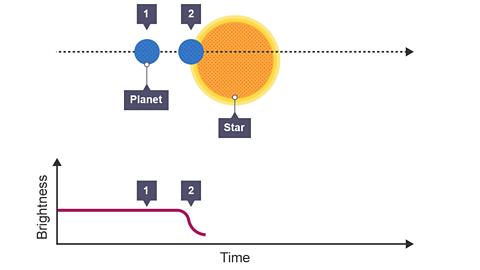
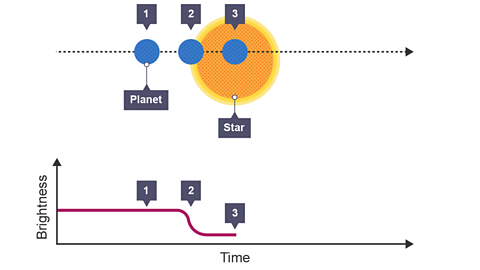
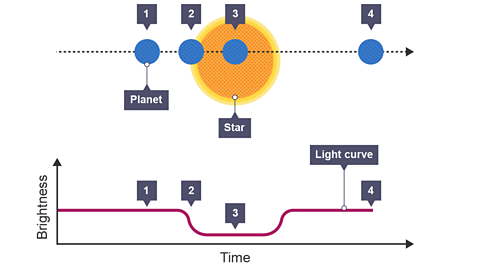
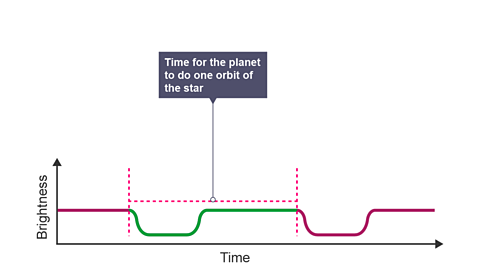
Astronomers look for the drop in the brightness of a star as an exoplanet, orbiting the star, passes between it and the Earth.
This is called the transit method.
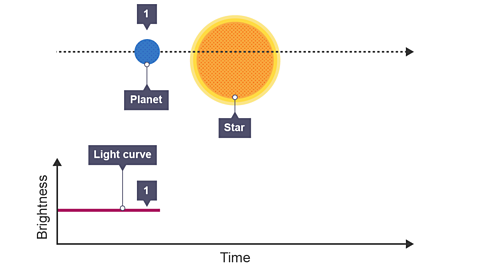
Image caption, 1. Before the exoplanet passes in front of the star the brightness detected on Earth is constant
1 of 5
Key fact
An exoplanet is the name given to a planet which orbits a star outside our Solar System.
Small, earth-like exoplanets have been discovered by the transit method.
The first confirmed detection of an exoplanet occurred in 1992.
As of 1st October 2024, there are over 5000 confirmed exoplanets.
How is space explored?
The conditions in space are hostile to life and travelling in spacecraft is difficult and expensive.
So scientists are using different methods to see if there is life on planets other than the Earth.
Space probes can explore other planets without needing astronauts.
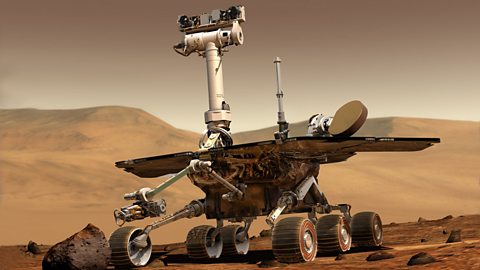
Some of the missions undertaken by space probes include:
Viking 1 and Viking 2 - landed on Mars in the 1970s, took photographs and analysed soil samples.
Mars Global Surveyor - went into orbit around Mars in 1996/1997 and mapped the surface in 3D.
Spirit and Opportunity - two robot vehicles that landed on Mars in 2004.
NASA’s InSight – a Mars explorer that landed on the 26th November, 2018. It is the first robotic explorer to study in-depth the crust, mantle and core of Mars.
Is there life on other planets?
The atmosphere of the Earth contains about 21 per cent oxygen as a result of Chemical reaction that happens in plant cells. It converts carbon dioxide and water into glucose and oxygen in the presence of light. The glucose can then be used for a number of processes including growth.by plants and single-celled organisms.
If we found evidence of oxygen in the atmosphere of another planet, it could indicate the presence of life forms.
It is possible to detect oxygen and other gases on other planets by studying the light reflected from planets.
It is thought possible that alien civilisations, capable of transmitting radio signals, may exist.
The Search for Extra-Terrestrial Intelligence (SETI) is a programme that uses radio telescopes to look for non-natural signals coming from space.
Space probes and landers are also looking for extra-terrestrial life.
There are photographs of channels on Mars that may have been created by flowing water.
Landers touch down on planets and take a soil sample, which is then analysed for evidence of life.
It is estimated there are up to 400 billion stars in our galaxy, the Milky Way.
There could be 50 billion exoplanets orbiting these stars.
If even 1% of these were Earth-like there are 500 million stars in our galaxy alone capable of supporting life.
It is estimated that there are at least as many galaxies as there are stars in our galaxy.
When was the first manned mission to the Moon?
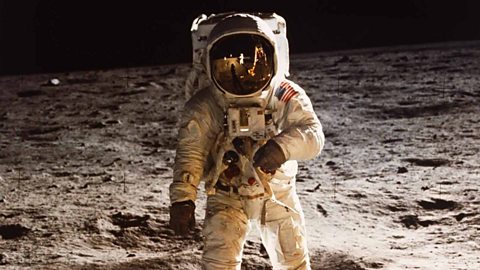
The United States' Apollo 11 was the first manned mission to land on the Moon.
Mission commander Neil Armstrong and pilot Buzz Aldrin, both American, landed the lunar module Eagle on July 20, 1969.
On July 21st, with more than half a billion people watching on television, Armstrong climbed down from the lander and proclaimed: "That's one small step for a man, one giant leap for mankind."
Buzz Aldrin joined him shortly afterwards and described the moon surface as: "magnificent desolation."
The moon is the furthest humans have gone - a distance of just under 240,000 miles.
Space missions are difficult to justify as leaving planet Earth is an expensive business and dangerous.
What are the limitations of space travel?
The distances involved are huge. The nearest star to Earth, Proxima Centauri, is about 4 x 10¹³ km or 40 trillion km away.
The speed of space travel is too slow. With present technology it would take over 81,000 years to travel between Earth and Proxima Centauri. Even travelling at the speed of light it would take 4.2 years to get there.
There are problems of logistics – how to carry enough food, water, oxygen water and fuel to make long flights possible.
Costs are very high. Leaving planet Earth is an expensive business because of the technology involved.
Long periods of weightlessness is not good for the human body. It brings about muscle wasting and bone loss. It can also stop some important cells doing their job properly.
Space radiation can cause cancer and is hard to shield against. Outside the safe cocoon of the atmosphere of the Earth and its magnetic field, particles move around at close to the speed of light. This is space radiation and it is deadly. Aside from cancer, it can also cause A cloudy area on the lens of the eye that causes blurry vision and difficulties in seeing clearly..
How to measure distances in space
The distances to stars and galaxies are so large that miles and kilometres are meaningless.
The Sun is 150 million kilometres or 93 million miles from the Earth, but that’s a tiny distance compared with the distance to other stars, or other galaxies.
Larger units of length are used for these measurements.
One popular one is the light-year.
What is a light year?
A light year is defined as the distance light travels in a year.
It takes light over four years to reach us from the next nearest star, Proxima Centauri.
We say that the distance to Proxima Centauri is 4.2 light years.
It takes over 100,000 years to cross our galaxy, the Milky Way.
We say that the diameter of the Milky Way is 100,000 light years.
The most distant galaxies observed are about 13,000 million light-years away.
Key facts
Distances to stars and galaxies are so large that they are measured in light years.
A light year is the distance light travels in one year.
Calculations involving light years and distance (Higher tier only)
A light year is a distance (not a time).
It is the distance light travels in one year.
As light travels at constant speed, the distance light travels in a year can be calculated using the equation:
Distance = speed x time
Speed of light = 300,000,000 m/s = 3 x 10⁸ m/s
time = 1 year = 365 x 24 x 60 x 60 = 31,536,000 s
1 light year = 3 x10⁸ m/s x 31,536,000 s = 9.46 x 10¹⁵ metres
1 light year = 9.46 x 10¹⁵ m
Key facts
A light year is a distance not a time.
One light year is a distance of 9.46 x 10¹⁵ metres.
Example
A galaxy is found to be 20 million light years away.
How far is that in metres?
Answer
20 million light years can be written as 20,000,000 light years or 20 x 106 light years.
1 light year = 9.46 x 10¹⁵ metres.
20 x 106 light years = 20 x 106 x 9.46 x 1015 metres = 1.89 x 10²³.
The galaxy is 1.89 x 10²³ m away.
Question
The Sun is 150 x 106 km away.
If light travels at 3 x 10⁸ m/s, how long does it take light from the Sun to reach the Earth?
time = \(\frac{distance}{speed}\)
distance = 150 x 106 km = 150 x 106 x 1000 m = 150 x 109 m
speed = 3 x 10⁸ m/s
time = \(\frac{{150}\times{10}^9{m}}{{3}\times{10}^8{m/s}}\)
time = 500 s = 8.3 minutes
It takes 8.3 minutes for light to reach the Earth from the Sun.
Question
A galaxy is observed to be 2.4 x 10²⁰ m away from Earth?
How far is that in light years?
How long would it take for light to travel from the galaxy to Earth?
- 1 light year = 9.46 x 10¹⁵ m
The number of light years = \(\frac{{2.4}\times{10}^20{m}}{{9.46}\times{10}^{15}{m}}\)
The number of light years = 25,370.
The galaxy is 25,370 light years away.
- It would take 25,370 years for light to reach the Earth from the galaxy.
Test your knowledge
More on Unit 2: Space physics
Find out more by working through a topic
- count1 of 4
- count2 of 4
- count3 of 4