What are the key learning points about the Universe?
The origin of the Universe (the Big Bang).
Evidence for the Big Bang.
What is the Big Bang?
Scientists have gathered a lot of evidence and information about the Universe.
They have used their observations to develop a model called the Big Bang to help explain its formation and evolution.
The theory states that about 13.8 billion years ago all the matter in the Universe was concentrated into a single incredibly tiny point.
From this tiny point, the whole Universe expanded outwards to what exists today.
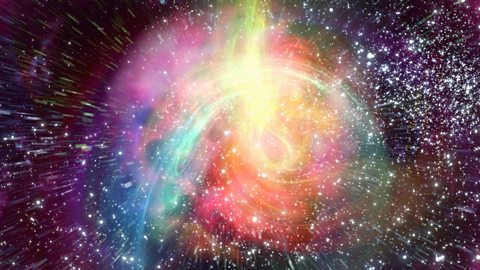
The Universe is thought to have originated 13.8 billion years ago from a very small, extremely hot and dense region called a singularity. The Big Bang was a massive expansion that blew space up like a gigantic balloon.
Initially, the Universe expanded rapidly. Rapid expansion is always accompanied by cooling, so, as the Universe got bigger, it cooled down. This enabled Subatomic particle with a positive charge and a relative mass of 1. The relative charge of a proton is +1. and Uncharged subatomic particle, with a relative mass of 1. The relative charge of a neutron is 0 (neutral). to form.
Further expansion and cooling allowed protons and neutrons to combine to form Nuclei is the plural of nucleus. The nucleus is the central part of an atom. It contains protons and neutrons, and has most of the mass of the atom..
The Universe continued to expand, although now more slowly. As it cooled even more, electrons combined with neutrons and protons to form atoms of hydrogen.
The force of gravity acted on the atoms of hydrogen, pulling them together into bigger and bigger clumps.
Some 400,000 years later the first stars formed from the clumps of hydrogen and begin to light-up the Universe.
Evidence for the Big Bang includes:
All other galaxies are moving away from us.
The further away a galaxy is, the faster it is moving away.
The Universe is filled with the left over energy from the Big Bang known as Cosmic Microwave Background Radiation, Electromagnetic radiation, detected throughout the Universe that is left over from the Big Bang. CMBR has a wavelength of about 2 mm.. This is received from all parts of the Universe and is thought to be the heat left over from the original explosion.
What is redshift?
You may have noticed that when an ambulance, fire engine or police car goes past, its siren is high-pitched as it comes towards you, and then becomes low-pitched as it goes away.
This effect, where there is a change in The number of waves produced each second. The unit of frequency is hertz (Hz). and The length of a single wave, measured from one wave peak to the next., is called the Doppler effect.
It happens with any wave source that moves towards or away from an observer.
If the object is moving towards an observer, the waves are shifted to a higher frequency, shorter wavelength.
If the object is moving away from an observer, the waves are shifted to a lower frequency, longer wavelength.
This happens with light as well as sound.
Our Sun contains helium.
We know this because there are black lines in the spectrum of the light from the Sun where helium has absorbed light.
These lines form the absorption spectrum for helium.
When we look at the spectrum of a star in another distant galaxy, the absorption spectrum is there, but the pattern of lines has moved, or ‘shifted’, towards the lower frequency, longer wavelength, red end of the spectrum, as you can see below:
This is called red-shift.
Light is shifted towards the long wavelength, red end of the spectrum.
This tells us that:
Other distant galaxies are moving away from our galaxy.
The Universe is expanding.
Astronomers have found that the further from us a star is, the more its light is red-shifted.
This tells us that:
- The further away a galaxy is, the faster it is moving away
Since we cannot assume that we have a special place in the Universe, it suggests that everything is moving away from everything else as you would expect with an explosion.
What is cosmic microwave background radiation (CMBR)?
Further evidence for the Big Bang comes from the discovery of cosmic microwave background radiation (CMBR).
Astronomers discovered cosmic microwave background radiation in the 1960s.
The The length of a single wave, measured from one wave peak to the next. of this radiation appears to be the same no matter where in space that it comes from and it corresponds to a temperature of about –270 °C.
It comes from all directions and from all parts of space.
Scientists believe that the continuous microwave background radiation is the remains of the heat energy from the Big Bang, spread thinly across the whole Universe.
The Big Bang is currently the only model that explains the existence of CMBR.
| Prediction from Big Bang theory | Evidence observed and explanation | Does evidence support the Big Bang theory? |
|---|---|---|
| Galaxies should move outwards. | • Light from stars in other distant galaxies is redshifted. • This indicates that other galaxies are moving away from ours. | Yes |
| More distant galaxies should move away faster. | • More distant galaxies have greater redshift. • This indicates that more distant galaxies are moving away faster than nearer galaxies. | Yes |
| Heat energy left over from the Big Bang should now be thinly spread across the whole Universe. | • CMBR is everywhere at a temperature of about -270°C. • CMBR is the remains of the heat energy from the Big Bang, spread thinly across the whole Universe. | Yes |
Question
Many scientists believe that the Universe began in an explosion known as the Big Bang.
Describe and explain two observation that supports the Big Bang Theory.
Answer
- Redshift - When we look at the Refers to the visible spectrum, the range of the electromagnetic spectrum visible to the human eye. It can be seen when white light is split by a prism, or by raindrops to form a rainbow. of a star in another distant galaxy, the pattern of lines in the absorption spectrum has moved, or ‘shifted’, towards the lower The number of waves produced each second. The unit of frequency is hertz (Hz)., longer The length of a single wave, measured from one wave peak to the next., red end of the spectrum.
The shifting of the light to longer wavelength is an indication that the galaxy is moving away from our galaxy.
- Astronomers discovered cosmic microwave background radiation CMBR in the 1960s.
The wavelength of this radiation appears to be the same no matter where in space it comes from and corresponds to a temperature of about –270°C.
It comes from all directions and from all parts of space.
It is thought that the continuous microwave background radiation is the remains of the heat energy from the Big Bang, spread thinly across the whole Universe.
Test your knowledge
More on Unit 2: Space physics
Find out more by working through a topic
- count1 of 4
- count2 of 4