What are the key learning points about the Solar System?
The structure of the Solar System.
The order of the planets.
Natural and artificialBody that orbits a planet. For example, the Moon is a natural satellite of the Earth but communication satellites are artificial satellites of the Earth..
What is the structure of the Solar System?
The Earth is our planet.
It is one of eight planets that move around the Sun, each in an oval shaped,An orbit that is the shape of an ellipse. An ellipse is similar to a slightly stretched circle..
Our Moon orbits the Earth.
All of the other planets except Mercury and Venus have at least one moon.
A ball of icy rock that follows an elliptical orbit around the Sun. and A rock in space. Asteroids orbit the Sun but some may cross the Earth's orbit, producing a small risk of collision. also orbit the Sun.
Together the Sun, the eight planets, the moons, asteroids and comets make up our Solar System.
Key point
The main features of our Solar System are:
The Sun.
The eight planets.
Moons.
Asteroids.
Comets.
What is the Sun's role in our Solar System?
The Sun is the largest object in the Solar System and was the first to form.
The huge gravitational pull of the Sun keeps many other objects - planets, dwarf planets, asteroids and comets - in orbit around it.
The Sun alone contains 99.8% of the total mass in the Solar System.
Planets
The Earth is one of eight planets in the Solar System.
The planets orbit the Sun at different distances.
The following sentence may help with remembering the order of the names of the planets from the Sun outwards:
My Very Easy Method Just Speeds Up Naming
- Mercury
- Venus
- Earth
- Mars
- Jupiter
- Saturn
- Uranus
- Neptune
The different planets have different properties and conditions.
In general, as the distance from the Sun increases:
The temperature decreases, for example, Mercury is 430 °C whereas Neptune is -200 °C.
The time taken to orbit the Sun increases, for example, Mercury orbits once every 88 Earth days, but Neptune orbits once every 165 Earth years.
What are the different planet groups?
Astronomers have divided the planets into two groups of four:
The four inner planets (Mercury, Venus, Earth and Mars), which are small, rocky, dense planets, close to the Sun, therefore they are generally warmer.
The four outer planets (Jupiter, Saturn, Uranus and Neptune), which are large balls of gas, far from the Sun, therefore they are generally colder. They are called the gas giants.
When the Solar System formed, rocks (and other dense, heavy materials in the dust cloud such as iron and uranium) tended to gather closer to the Sun, and these materials combined together to form the inner planets.
Lighter gaseous substances gathered together further away from the Sun and formed the outer gas giants.
For a planet to form, its own gravity must be strong enough to make it round or spherical in shape.
Its The region of space surrounding a body in which another body experiences a force of gravitational attraction. must also be strong enough to ‘clear the neighbourhood’, pulling smaller nearby objects into its orbit.
What other objects make up the Solar System?
The Moon
A body orbiting a planet is called a satellite.
The Moon is the only natural satellite that orbits planet Earth.
Many planets have moons, and some planets have many moons - as of March 2025 - Saturn has 274 confirmed moons, over 100 of these were discovered in 2025.
Dwarf planets
Pluto is a A planetoid that is too small to be considered to be a planet, eg Pluto..
The The region of space surrounding a body in which another body experiences a force of gravitational attraction. of a dwarf planet is not strong enough to 'clear the neighbourhood', so there may be other objects in its orbit around the Sun.
The Solar System contains hundreds of dwarf planets, including Ceres (the only dwarf planet in the asteroid belt).
Asteroids
Asteroids are made of metals and rocky material.
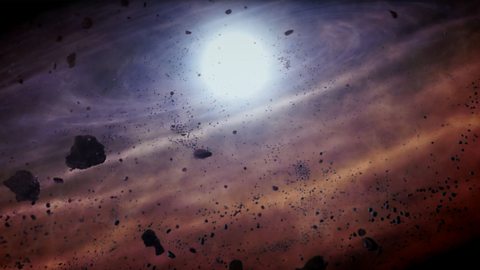
There are many asteroids in our Solar System which orbit the Sun in oval or egg-shaped elliptical orbits which can take millions of years to complete.
There are large numbers of asteroids orbiting the Sun in the asteroid belt between Mars and Jupiter.
There are also many in a region beyond Neptune called the Kuiper Belt.
Comets
The Solar System also contains objects called comets.
Comets are similar to asteroids, but are made of ice, dust and rocky material.
As a comet approaches the Sun, it begins to vaporise, which means that it turns into a gas. It then produces a distinctive tail.
The main difference between asteroids and comets is their composition, as in, what they are made of.
Asteroids are made up of metals and rocky material.
Comets are made up of ice, dust and rocky material.
Both asteroids and comets were formed early in the history of the Solar System about 4.5 billion years ago.
What are artificial satellites and orbital motion?
Gravity is the force needed to maintain the orbit of planets, asteroids and comets around a star and moons and artificial satellites around a planet.
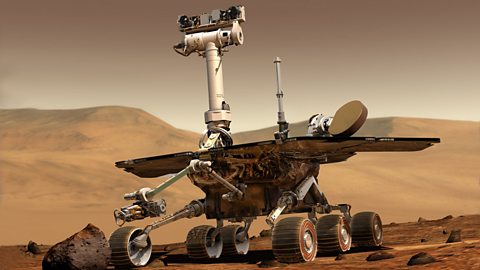
An artificial satellite is a man-made body placed in orbit round the Earth or another planet in order to collect information about it or for communication purposes.
The International Space Station is an example of an artificial satellite.
Key Point
Artificial satellites can be used for:
Communications – satellite television and phone calls.
Earth observation - including weather forecasting, tracking storms and pollution, spying and satellite photography.
Navigation - including the Global Positioning System (GPS).
Astronomy – looking into outer space from our Solar System.
How much do you know about the Solar System?
More on Unit 2: Space physics
Find out more by working through a topic
- count2 of 4
- count3 of 4