What are some of the causes and consequences of conflict?
Conflict can happen on a local, national and global scale.
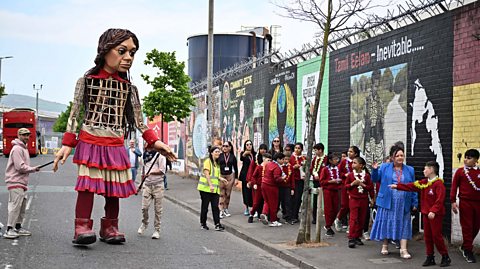
Local - dealing with sectarianism
The main conflict in Northern Ireland over the past fifty years has been sectarian — that is, between different religions (in this case, Catholics and Protestants).
Sectarianism in Northern Ireland has taken several forms:
- Hostility and tension in certain communities or at ‘flashpoints’ between Catholic and Protestant areas. Hostility is often demonstrated through the flying of flags, to show that only one side of the community is welcome.
- Exclusion as some communities ‘stick together’ and don't associate with people from other groups.
- Discrimination as people are denied jobs or rights based on their religion.
- Violence broke out across Northern Ireland during the Troubles, mainly perpetrated by paramilitary groups such as the IRA and the UVF. This violence continues on a much smaller scale today.
National
Here are some examples of conflicts that have occurred throughout the UK:
- Exclusion: minority groups may feel marginalised and may not integrate with the rest of society.
- Sectarianism: religious intolerance in the UK has risen dramatically in the last decade. Reports of antisemitic incidents in the UK in the first half of 2024 have reached a record high, up more than 100% than in the first half of 2023. Islamophobia is also on the rise and was an instrumental element of the anti-immigration race riots across the UK in 2024.
- Racism and ethnic tensions: some people hold negative views of those from other ethnic backgrounds. These views may be expressed as racist remarks, discrimination or even violence. Racism was the a major player in the anti-immigration riots in 2024.
- Social unrest: this arises when sections of society are opposed to government policy or to actions of the state. Social unrest happens when protests and demonstrations turn into rioting and sometimes looting. Again, the race riots in 2024 were an example of civil unrest - demonstrations fuelled by misinformation and social media disintegrated into violent rioting and clashes with police.
- Inequality: this is the difference in wealth and income between different groups in society. It is normal to have some rich people and some people less well off. However, conflict arises when these differences become too great.
Global conflict
Global conflict refers to disputes between nations. These conflicts can be driven by a range of factors, including political, economic, ethnic, religious and territorial disputes.
Some notable examples of global conflicts are outlined below.
- World Wars: The two World Wars in the 20th century.
- Current conflicts: Ongoing disputes, such as those in the Middle East, Africa and Europe.
- Lack of resources: Conflicts over resources like water and energy.
- Climate Change: The impacts of climate change, such as resource shortages and natural disasters, can increase existing conflicts or create new ones.
Global conflicts can have a wide range of effects, including economic disruptions and humanitarian crises, for example, the displacement of huge numbers of people.
What role does the United Nations play in resolving conflict?
The United Nations is a global organisation that was created in 1945 in the aftermath of World War II. Its aim was to help prevent future wars and encourage countries to solve problems through peaceful means - by discussion and cooperation. Currently there are 193 member states that work together to try and keep peace and solve major world problems.
The United Nations (UN) has a number of ways that it can help to resolve conflict between nations peacefully — some of these are outlined below.
| Peacekeeping missions | Deploys peacekeeping forces to maintain ceasefires, protect civilians and monitor peace agreements. Troops are neutral and act with the consent of conflicting parties. |
| Mediation and diplomacy | UN officials mediate negotiations between countries or groups to resolve disputes. Example: UN mediation in Cyprus conflict. |
| Sanctions | Imposes economic or political penalties (eg trade bans) to pressure groups or countries into peaceful actions. |
| Humanitarian aid | Provides food, shelter, medical care and support for displaced people during and after conflict. |
| Promoting human rights and international law | Encourages respect for human rights to prevent causes of conflict. Can refer serious human rights violations to the International Criminal Court (ICC). |
| Supporting elections and governance | Helps organise free and fair elections in post-conflict countries to promote stability and democracy. |
More on Cultural identity, diversity and inclusion
Find out more by working through a topic
- count5 of 6
- count1 of 6
- count2 of 6