Overview of All That Glisters by Anne Donovan
- The short story All That Glisters by Anne Donovan is told in A first-person narrative is when the story is told from the point of view of one person using the pronoun ‘I’. from the perspective of the main character, Clare.
- All That Glisters, like many of Donovan’s short stories, is an As if we are hearing characters’ thoughts..
- Clare’s thoughts are captured in her own accent. This helps to root the story in Scotland (more specifically, Glasgow) and gives authenticity to Clare’s thoughts and actions.
The title is a reference to a quote from The Merchant of Venice by William Shakespeare.
All that glisters is not gold.
This means that not everything shiny is valuable. The title captures the joy and sadness of the story.
The main themes of the story are
- isolation
- relationships
- loss and grief
Looking for some quick revision? Try an interactive quiz for National 5 English.
Video
Watch this video from the archive, featuring dramatised parts of All That Glisters, and an interview with Anne Donovan.
An archive clip of drama and interview around the story 'All that Glisters', featuring the writer Anne Donovan.
Plot of All That Glisters by Anne Donovan
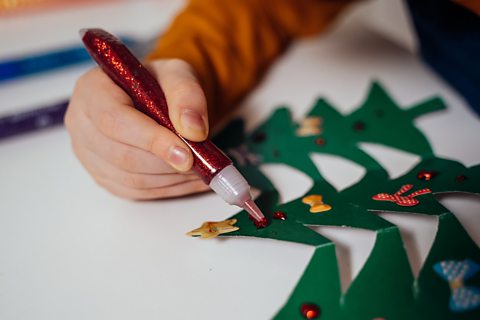 Image source, Getty Images
Making the card
Anne Donovan's short story All That Glisters is set around Christmas time.
Clare is a schoolgirl of around twelve years old, who is shown to be a warm and positive character in spite of the hardships she faces. Her father, with whom she is very close, has been unwell for a long time.
Clare repeatedly tries to:
find sumpn that cheers him up even a wee bit
When her school class are given "coloured cardboard and felties" to make Christmas cards, Clare makes a:
right neat wee card for ma daddy wi a Christmas tree and a robin and bit of holly on it
Image source, Getty ImagesClare finds that using glitter pens brings:
everthin to life, gleamin and glistern agin the flat cardboard
Her enthusiasm is captured in her statement that it "wis pure brilliant". Clare’s colourful word choice and imagery often demonstrates the positive way she sees the world. She finds that adding glitter to her card
wis like the difference between a Christmas tree skinklin wi fairy lights an wan lyin deid an daurk in a corner
Her dad is "dead chuffed" with her Christmas card, telling her that it "fair brightens up this room hen".
Clare and her father
Clare reveals that her father is "really sick" because of his previous job. He worked with asbestos, a group of minerals that can damage a person’s lungs. He explains the word to Clare, which:
comes fae a Greek word that means indestructible […] they cried it the funeral dress of kings
Clare remembers when her father used to come home with "his hair and his claes clartit wi it" and pretend he was a ghost. He is described reading books about asbestos "tae try and understaun it fur the compensation case". Many workers who had to handle asbestos in their jobs were judged to be entitled to compensation payment, as their health issues resulted from working without adequate protective equipment.
Clare uses the pens again to make her father another card. She finds "a different way a daein it almost by accident", which makes the glitter "finer and lighter". The teacher says that the card is "lovely, Clare. It’s more … subtle".
Clare repeats this description to her father when she gives him the card. Just as her father explained the meaning of asbestos to her, Clare explains to her father what her teacher meant by the word "subtle":
Ah showed him the middle finger of ma right haun, which wis thick wi it solid gold, then pressed doon on his palm. The imprint of ma finger left sparkly wee trails a light
Video - Use of statements and commands
When Clare shows her dad the card, she uses a statement, followed by a command, in a loving father-daughter moment:
Ah took his haun in mines and turnt it roon so his palm faced upward. Look, daddy.
Her dad is very ill, and weak, and Clare is gently guiding him with her hands and her voice. Donovan's use of statement and command here is gentle or even loving.
Find out more about this technique in this short revision video for National 5 English.
What are statements and commands? Find out more about these sentence types and why they're used.
Statements and commands
A statement tells someone a fact or an idea about a topic.
The dog wants a treat.
A command tells someone to do something.
Sit!
“Your room is a mess” is a statement.
“Go clean your room!” is a command.
Statements are very common in writing.
A statement must give you information and finish with punctuation, like a full stop.
The soldiers were scattered across the field.
The general might command them to stand.
“Stand in a line!”
In real life, you would find commands as instructions, like in a recipe book.
A command must start with a verb telling someone to do something.
Chop, stir, pour, mix
These are called imperative verbs.
Commands in writing, particularly prose fiction, tend to be part of the dialogue.
In Anne Donovan’s short story, ‘All That Glisters’, she uses a statement, followed by a command, when she describes a tender moment between the speaker and her dying father.
A statement describes the girl showing her dad the glitter pen she’d used at school:
“Ah took his haun in mines and turnt it roon so his palm faced upward. Look, daddy”
Donovan shows that a command doesn’t have to be bossy. It can be gentle or even loving.
Her dad is very ill, and weak, and his daughter is gently guiding him with her hands and her voice.Now you know how to make a statement with your writing.
Take command!
Deterioration of her father's health
Clare implies that her father’s illness is worsening. She describes the "terrible colour" of his skin and his "hollow cheeks". Despite this, he manages a "wavery wee smile" at his daughter and agrees with her teacher about the card: "Aye, hen. Subtle". Even though he is too ill to thank her properly, it is enough for Clare. She loves her father deeply and wants to make him happy in any way that she can.
Clare tries to buy her own glitter pen so that she can make more cards for her father. She does not have enough money to buy a pack of them. Clare reveals that her friend Donna often steals things from shops.
Donna’s big brother claims:
it wis OK tae steal ooty shops cos they made such big profits that they were really stealing affy us.
Clare understands Jimmy’s perspective but respects her father’s opinion that "stealin is stealin" more.
Instead of stealing, Clare sells her dinner tickets at school to save up for the pack of glitter pens, meaning "all week ah wis starvin for ah only hud an apple or a biscuit ma ma gied me fur a playpiece". Although a homemade Christmas card is only a small gesture, the lengths Clare goes to to do this demonstrates her kindness and the love she holds for her father.
Facing grief
When Clare returns home with the glitter pens, her mother tells her that her father has died. Although she felt she "knew it wis comin", Clare describes the "coldness" that:
shot through me till ah felt ma bones shiverin
Clare is very upset by the news and her mother comforts her. In the days before the funeral, the body of Clare’s father is returned to the house and Clare sits with him, still feeling that she wants "tae dae sumpn fur him".
On the day of the funeral, Clare dresses in:
a red skirt and a zip-up jacket wi red tights tae match
Her Auntie Pauline tells her that "you cannae wear red tae a funeral", suggesting it is disrespectful.
Auntie Pauline warns Clare not to disturb her mother who, in her grief, has been increasingly distant from her daughter since the father’s death.
Clare is very upset but changes into her grey school skirt and sweatshirt and her navy-blue coat. She thinks they make her look a "dull drab figure", which is not representative of how her father saw her. Remembering her glitter pens, she squeezes the gold, silver, red, and green glitter onto her fingers and rubs it into her hair and on her face.
Characters in All That Glisters
Clare
Clare, the central character of All That Glisters, is a likeable character who is sensitive, caring, and kind. Like other The main characters. in some of Anne Donovan’s stories, Clare faces challenging circumstances. She demonstrates her strength of character in her response to her father’s death, remaining true to herself.
Sacrifice
In the story, Clare demonstrates the personal sacrifice she is willing to make for her father. She gives up her lunch for a week as a way to afford glitter pens after seeing how her cards cheers up her father.
Moral
Her refusal to steal the pens suggests that she is honest and respects her parents. Because she looks up to her father, Clare does not want to disappoint him and this influences her life choices. Just as she is determined to buy the pens, she is also determined on the day of the funeral to celebrate the relationship she had with her father.
Mature
Clare is a mature character, an effect of having to deal with a difficult situation. Her maturity is also an effect of how her parents treat her. Her mother and father are straightforward and honest with their daughter, rather than treating her like a child who is unable to understand or deal with difficult situations. She is respectful of adults, demonstrated when she obeys Auntie Pauline without argument.
Strength of character
However, she also proves that she knows her own mind and can make her own choices. She is clever and resourceful, finding a more appropriate way of remembering her father that does not go against her auntie’s command. By covering herself in glitter, she is able to pay tribute to the final conversation she had with her father, in which they shared their appreciation for subtlety in beauty.
Positive
Clare is characterised by her positivity. Her narrative includes many adjectives and verbs that highlight the positive way she perceives the world, such as:
- "glistery"
- "sparkled"
- "gleamed"
- "glowin"
Clare's father
Clare’s father instills many key values in Clare, such as kindness, respect, and honesty. He is appreciative of the small things that Clare does for him. He focuses a lot of attention on her despite struggling with his illness. This keeps their relationship strong.
Like his daughter, Clare’s father has a strong sense of determination. He seeks justice for the damage that the asbestos has done to his body, researching information for the compensation case.
Clare’s father "used tae kid on he wis a ghost" when he came back from his work "strippin oot buildings". This shows the playful nature of their relationship before his illness. The memory also gives the reader a sense of foreboding. Clare’s father is shown making a game out of something that will eventually kill him.
Clare’s mother
Clare’s mother struggles to cope with her husband’s illness. She loses weight because of the stress his illness has caused. This is evidenced by the loose wedding ring, which used to be "that tight she couldnae get it aff".
When she breaks the news of her husband’s death to Clare, she explains that it is:
fur the best, no fur us but fur yer daddy
She also explains that he "wis in a lot of pain". This shows her teaching Clare an important lesson, that sometimes we have to put what is best for others first. Clare’s mother loves her husband, wanting him to be "at peace" despite her own feelings of grief.
In her grief, Clare’s mother becomes more distant from her daughter. Clare feels "she wis haudin me away fae her" and describes her smile as "watery" and "far-away". This suggests that Clare’s mother feels unable to be as emotionally supportive as Clare needs. She is perhaps not doing what is best for her daughter, but it is a difficult situation.
Auntie Pauline
Auntie Pauline is focused on supporting Clare’s mother on the day of the funeral rather than her niece. She warns Clare not to "disturb your mother on a day like this". Her attitude to Clare is very different to that of Clare's parents.
Although Clare’s decision to wear red at the funeral is her way of paying tribute to her father, Auntie Pauline believes she is being deliberately disrespectful. She uses firm and forceful language, stating that "ah don’t want to hear another word aboot this". She does not show compassion to Clare, in contrast to her father and mother.
Auntie Pauline tells her that:
you’re no a baby, it’s time you grew up and showed some consideration for other folk
This suggests that she does not understand Clare’s essential character. She doesn't see the maturity and compassion that Clare has demonstrated throughout the story.
Symbolism in All That Glisters
How is colour significant in All That Glisters?
 Image source, Getty Images
Colour is significant throughout Anne Donovan's short story All That Glisters. The colourful glitter Clare decorates her cards with symbolises her positive spirit and the way in which she perceives the world. At night time in her bedroom, she can see that:
the tips of ma fingers were still covered in glitter, and they sparkled in the dark
This represents the brightness of Clare’s personality even in dark and difficult times.
In All That Glisters, colour represents life. The red outfit Clare picks out for the funeral highlights her desire to celebrate her father’s life rather than mourn for what has been lost. Unlike the "dull, drab coat" Auntie Pauline directs her to wear, Clare’s red outfit holds connotations of love and warmth.
When she covers herself in glitter, the depressing grey and navy-blue of her outfit is transformed. Instead of holding A word used to describe the ideas or feelings that a word might suggest. For example, a skull conjures up thoughts of fear, mortality and death. of death and sadness, the dull cloth is "bleezin wi light" and gives the impression of being alive.
The Personification is when a writer gives human characteristics to something that isn’t human. of Clare’s glitter-filled hair as "glisterin" and "dancin" in the light suggests that colour evokes life. The reader is reminded of the "faint powdery whiteness" of asbestos that Clare remembers floating around her father’s head when they played ghosts.
Although the ghost scene foreshadows the father’s death, Clare uses it to inspire her glitter tribute. When Clare smiles in the mirror at "the glowin figure afore me", the reader is shown Clare’s positivity and her ability to look past tragedy and focus on the beautiful.
Image source, Getty ImagesWhat do hands symbolise in All That Glisters?

Hands symbolise loving relationships in the story. Clare explains the word "subtle" to her father through action. She "took his haun in mines and turnt it roon so his palm face upwards". Having "pressed doon on his palm" with her glittery finger, the "imprint" of Clare’s finger "left sparkly wee trails of light". Clare "imprints" this loving memory, reflecting on it on the day of her father’s funeral.
Clare is comforted by her mother after her father’s death:
We sat for a long time, no speakin, just haudin hands
Although they are not ready to speak about their loss, by holding hands Clare and her mother share a physical connection, reminding them that they still have each other. It symbolises the loving bond between mother and child.
Video - What is symbolism?
Donovan uses colour and hands as symbols for bigger ideas in the story.
Find out more about symbolism with this short National 5 English video.
What is symbolism? How and why would you use it?
Symbolism
The use of symbols to represent deeper meanings or themes.
Symbols are usually objects which are easy to understand.
What they represent is more complex.
We use symbols every day. Some are universal.
We all know that a red rose symbolises love or romance.
A clock is a symbol of time.
Diamonds can represent wealth or value.
A white flag symbolises surrender or a truce.
Symbolism helps writers illustrate and develop the themes of their story.
If you wanted to explore the theme of death, you might use symbols like:
The colour black
Angel’s wings
or even a skull
These symbols provoke emotions in the reader linked to death, adding depth beyond action or conversation.
In her poem 'Revelation', Liz Lochhead uses symbolism to explore the idea of evil through a young girl’s experience on a farm.
“I remember once being shown the black bull… In the yard outside, oblivious hens picked their way about…”
The black bull, half seen in the darkness, symbolises evil. This evil is a danger to order and calm, which is symbolised by eggs as well as innocent female hens.
“I had always half-known he existed – this antidote and Anti-Christ, his anarchy threatening the eggs”
Once these are established as the symbols of the poem, Lochhead uses them to guide us through the heavy concept of evil versus good.
The next time you explore difficult themes in your writing, why not give symbolism a go?
You might just crack it!
Themes and comparisons with other stories by Anne Donovan
Isolation
Clare suffers from isolation. This is largely due to the death of her father. Clare’s mother becomes increasingly distant from her daughter, highlighted by her absence from the final scenes of the story. Auntie Pauline’s objection to Clare’s way of remembering her father further emphasises that Clare is alone and feels a sense of isolation.
Although Clare feels isolated, it does not stop her from remaining true to herself and what she believes her father would have wanted. This underlines her strength of character. After covering herself in glitter, she looks in the mirror at the:
glowin figure afore me
She remembers her conversation with her father about subtlety. This helps to alleviate her sense of isolation, realising that she carries her father with her in her memories.
The theme of isolation is also shown in the other stories:
| Hieroglyphics | Mary is isolated from others due to her different way of learning - her thoughts and feelings are not understood or accepted by others. |
| Me and the Babbie | The narrator experiences emotional and social isolation, however, this is a choice for her. |
| Loast | Although she does not live alone, the narrator is emotionally isolated. Her relationship with her sister is cold and distant, and the narrator longs for connection. |
Relationships
All That Glisters explores family relationships and demonstrates the impact that parents can have on their child’s character. It captures the challenges that families can be faced with and highlights the values of love, honesty and respect.
Clare’s father treats his daughter with love and affection, instilling important values in her. Both he and Clare’s mother demonstrate their respect for Clare by being straightforward and honest about the difficult situation of the father’s illness and his subsequent death. Clare possesses positive qualities from her parents, showing herself to be compassionate and kind with a strong sense of self.
Clare’s relationship with Auntie Pauline suffers from an imbalance of respect. Auntie Pauline perceives Clare to be a child not capable of making her own decisions. By refusing to accept Clare’s viewpoint, Auntie Pauline highlights her lack of respect for her niece.
Clare, on the other hand, shows she is capable of respecting her auntie’s feelings while still paying tribute to the relationship that she had with her father. Through this, Clare demonstrates her own maturity that is built upon the values and lessons taught to her by her parents.
Clare is at an age where she will soon be moving into adolescence. Although she is aware of some adult experiences, she is still a child. In this transitional period, she is treated in different ways by different adults depending on how they perceive her, either as a child or as a young woman capable of dealing with difficult situations. In Anne Donovan's short story Hieroglyphics, Mary encounters similar challenges.
The theme of relationships is also shown in the other stories:
| Hieroglyphics | Mary's relationships are challenging and this has an emotional impact on her. Her teachers fail to support her and she is socially isolated from her peers. |
| Me and the Babbie | The narrator has a difficult relationship with her family, who regularly criticise her. She makes a point to distance herself from them and to protect her autonomy. |
| Loast | The narrator has a strained relationship with her sister. She also conveys regret about missed potential relationships. Her regret at not having a daughter highlights her emotional emptiness and her desire for unconditional love and to be cared for. |
Loss and grief
The theme of loss is explored in this story through the death of Clare's father.
Clare’s language portrays her feelings of shock and numbness to pain when she learns of her father’s death. She describes the "coldness" that "shot through me till ah felt ma bones shiverin". Clare disassociates from her pain, hearing "a voice, far away in anither room" and shouts that:
were muffled as if in a fog
Although Clare realises that these sounds are coming from her, she distances herself from her own trauma as a way of coping. The fog simile highlights her inability to make sense of what has happened.
She focuses on trivial thoughts, asking herself "why were veins blue when blood wis red". When her father’s body is returned to the house, Clare sits with him but:
no sayin anythin, no even thinkin really
She still finds it difficult to process the situation. The ending of the story shows Clare coping with death by remembering cherished memories of her father and their relationship.
The theme of loss is also shown in the other stories:
| Hieroglyphics | Loss of voice and belonging: Mary has a loss of confidence, dignity, and social inclusion. |
| Me and the Babbie | There is a sense that the narrator has lost part of herself by sacrificing her independence, her previous life, and her own needs for those of her child. |
| Loast | The narrator is losing a sense of who she is: a loss of memory, autonomy, objects, and words. |
Revise All That Glisters by Anne Donovan
Revise All That Glisters and other short stories by Anne Donovan with interactive quizzes for National 5 English.
Quizzes - Anne Donovan. quiz
Test your knowledge of the set texts by Anne Donovan with interactive quizzes for National 5 English.

More on Anne Donovan
Find out more by working through a topic
- count2 of 6
- count3 of 6
- count4 of 6
- count5 of 6