Overview of Me and the Babbie by Anne Donovan
- Me and the Babbie is a short story written by Anne Donovan.
- It is about a young mum’s experience raising her baby boy on her own after her partner leaves them.
- The story is written in the A first-person narrative is when the story is told from the point of view of one person using the pronoun ‘I’. style, from the point of view of the mother, whose name we are not given.
- It is written in Scots, as is Donovan’s usual method. This allows the reader to hear, first-hand, what the young woman thinks, feels, and how she resists the pressures put upon her by others.
Some of the key themes explored in this story are:
- motherhood and identity
- judgement and social control
- poverty
Looking for some quick revision? Try an interactive quiz for National 5 English.
What is the plot of Me and the Babbie?
Life with a baby
The story opens with exclamations from a voice, or voices (likely the narrator or her family), admiring a “three week auld” baby:
Och, look at his wee feet! Och, look at his wee toes! Och, look at his wee ears!
The repeated structure (“Och, look at his wee…!”) creates a rhythmic, almost musical quality. This repetition mimics the way people often coo over babies, emphasising excitement and affection. The use of the Scots words “Och” and “wee” root us in a Scottish setting immediately.
Video - Questions and exclamations
The story begins with the repetition of exclamations admiring the baby, creating a tone of excitement and affection from the offset.
Find out how using different sentence types, like questions and exclamations, can be an effective technique in writing with this short National 5 English revision video.
What are question and exclamation marks? How and why would you use them?
Question marks and exclamation marks
Punctuation marks that go at the end of a sentence, but they tell us more than a full stop does!
A question mark lets you know that the sentence is a question, and usually needs an answer.
Would you like a cup of tea?
Exclamation marks show excitement, shock or anger.
This tea is too hot!
Exclamation and question marks can also tell you how to read the sentence.
You could sound shocked, or aggressive!
Or maybe inquisitive?
You can also use question marks and exclamation marks together to ask an excited question or to show shock and disbelief.
Where on Earth have you been?! This can be shown as ?! or by using an interrobang: ‽
Tongue, Jackie Kay looks back nostalgically at the Scottish language:
“shut yer geggie or I’ll gie you the malkie!”
It might not be clear to people from outside Glasgow that this is a threat, but the exclamation mark gives us an idea, by showing that the sentence is to be said with some force.
"Oh where did all my words go – my old words, my lost words?”
At this point Kay uses a question mark to ask herself a question, giving us an insight into her feelings of uncertainty. The question draws attention to her sense of loss, as well as the speed of the change in her identity.
Do you get it now?
See, it’s easy!
The narrator explains how life has been for her in the baby’s early weeks. She lovingly describes his appearance and also the challenges of disrupted sleep and his constant need to feed.
Throughout the story, she is criticised by her family – her mother, father, and sister – who all have opinions on how she should be parenting. They all have different things to say, but the narrator chooses to parent in her own way.
The reader sees more of the narrator's struggles when she says that the baby’s father has left, telling her he’s “no ready fur this.” He struggles with the constant demands of the baby, the mess of the home, and the exhaustion of the mother. This creates a turning point for the narrator. She is now left alone with her child. This, however, does not seem to be a burden for her.
The narrator adapts to a pattern of parenting that she feels suits her and her baby best, rejecting her family's advice and societal expectations.
- she When a parent sleeps together with their baby, instead of placing them in a separate sleep space. There are risks to co-sleeping and it is not recommended by the NHS. with him
- she does not create a routine
- when he cries to be held, she holds him
- when he cries to be fed, she feeds him
- she begins to carry him in a sling
She adapts to this new approach and ensures that everything she does meets the baby’s needs. Her quiet connection with her baby fulfils her: their walks in the park, the warmth of her whispers to him and their little bubble of love.
However, the difficulties of living on her own with the baby begin to create issues for her. She is living in poverty, leaving the house to avoid paying for electricity and limiting her food. She has to rely on hand-me-downs from her sister. Initially, she is satisfied with this, but she begins to yearn for colour and beauty in her life. When her sister’s hand-me-downs start to come only in shades of grey, she decides her boy deserves better than this.
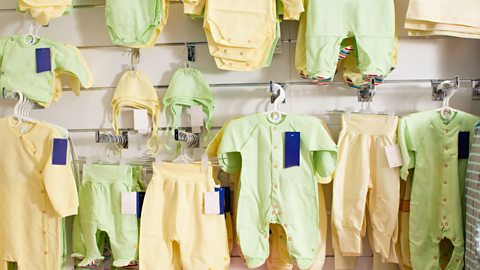 Image source, Alamy Images
Shoplifting
Without the means to buy the beautiful, coloured clothing she sees in a department store, the narrator resorts to shoplifting to add joy and colour to her son’s life.
This criminal act initially brings her happiness, bringing back memories of new outfits for Easter she had as a child, but it also becomes something she can’t stop. When she gets away with it, she feels like she can do it again – and does. However, she is caught, and, at the end of the story, the consequences of her actions are made clear. In what is quite an abrupt ending to the story, the narrator tells us she has had to go to court because of her actions.
Her lawyer has told her that she is unlikely to go to prison, but we leave her at the end, terrified that she will be separated from her son. She doesn’t believe her lawyer’s optimism as there are:
women in jail just cos they've no paid their TV licence.
The story ends with this unresolved tension, leaving the reader very aware of how fragile her situation is. We don’t know if she gets sent to prison or if she finds a way out of her situation.
Image source, Alamy ImagesNarrative voice
The story Me and the Babbie is told entirely from the mother’s point of view, offering a warm and intimate look into her thoughts, feelings, and experiences. This allows the reader to be fully immersed in the narrator’s world:
us cooried doon thigither, me talkin an him starin.’ Then, as he got bigger, smilin, then makin cooin noises.
Donovan also uses Scots to establish the narrator’s identity. Her use of Scots spelling and expressions (such as “Och,”“wee,”“babbie,”“sooked,” and “nae”) creates a realistic Glaswegian voice. She uses the language of the working class, and this creates a sense of authenticity.
The narrative is a An uninterrupted flow of a character’s thoughts.: the story flows with the speaker’s thoughts. It doesn’t have a set structure or even a defined plot; it is fragmented, repetitive, and full of her thoughts and emotions, mirroring the mental exhaustion and emotional swings of early motherhood. This means that Donovan creates a realistic As if we are hearing characters’ thoughts., raw and unfiltered, where we see the sacrifices the narrator makes for her son, and how little thought she has for herself.
Ah’d hardly ony dishes tae wash since he left. Ah just used the wan plate, eatin wi the fork in wan haun and him in the ither.
Throughout, the narrator’s voice stays strong and clear. She conveys tenderness, defiance, confusion, and fierce love. The tone shifts between exhaustion and joy, despair, and resilience. By being emotionally honest, the narrator inspires empathy in the reader – she makes her sacrifices without any complaint.
Sometimes ah did have a wee greet, by my ain, at night. But ah’d decided tae dae whitever it wis that wid keep him happy.
Her narrative voice also makes clear how resilient and assertive she really is. Despite being quiet in the face of criticism, her internal monologue shows how well she resists external judgment – from her family, her partner, and society. She confidently and securely follows her own values and instincts. By making choices like When a parent sleeps together with their baby, instead of placing them in a separate sleep space. There are risks to co-sleeping and it is not recommended by the NHS., breastfeeding on demand, and rejecting grey clothes, we see the voice of a defiant woman taking a stance:
so ah stopped worryin aboot whit they thought.
We see her dignity in the face of poverty and control.
Is she a reliable narrator?
This type of narration can help the reader fully feel the speaker’s emotions. However, it can also allow the narrator to be When a story is told from a first person perspective, the narrator can be fallible or unreliable in their reporting of events. The reader is only seeing things from her point of view and there is no guarantee that her side of the story is accurate. There is no detail about why her partner leaves, except for the reasons she tells us. Her family are only described through the narrator's criticisms but it is likely they also have offered support, like:
- the clothes her sister provides
- the offer her mother makes for her to move back home
Characters in Me and the Babbie
The narrator
Throughout Me and the Babbie, Anne Donovan creates the picture of an emotionally intuitive narrator who is:
- resilient and confident, as evidenced by her parenting choices
- guided by instinct rather than by what other people say she should do
- focused on her baby’s needs, observing these with sensitivity and insight
- willing to adapt her life to fit around his needs, showing remarkable selflessness
- committed to her child’s wellbeing - even in the face of sleep deprivation, isolation, and poverty
From the very start, she is entirely committed to her son, taking pride that his eyes are like hers and “no his daddy.” This shows she is completely focused on this new bond, perhaps to the exclusion of her own wellbeing or relationships with other people. Her partner is only briefly mentioned and only because he leaves the family, unable to cope with parenting, according to the narrator.
The narrator tells us of the hardships of her life:
ah could hardly fine time tae get tae the toilet, let alane get washed or get sumpn tae eat, and a certainly couldnae dae ony housework or make ma man’s dinner.
As a result of this, we hear that her partner:
got fed up wi the hoose lookin like a tip and the wean aye feedin or girnin, and he wanted his tea on the table and me in his bed.
The narrator rejects the stereotypical gender role of a woman who cares for the baby and also cooks and cleans for their partner. It could be seen that motherhood has given the narrator the power to find herself, developing her own ideas about what is important to her, rather than going along with the opinions and expectations of others.
It could also indicate that the mother was struggling with her own mental health. She puts her own needs entirely to one side for her child, neglecting to wash, eat, or take care of her environment. These can be signs of A common form of depression experienced by parents after a baby's birth..
Even when she has been left alone by her partner, she doesn’t seem to feel sorry for herself. She is very matter-of-fact about him leaving, stating:
And that was us, Me and the Babbie, ten flair up.
She describes her setting in a very romanticised way, describing a:
birds eye view of the city night.
Relationships with her family appear very strained. They seem to offer Something that was not asked for, and often not wanted. advice constantly. The narrator feels they are being judgmental and dismissive:
ah felt in my hert they were wrang but ah didnae know whit wis right.
She distances herself to protect her autonomy. She rejects the expectations of family and, through motherhood, finds a new voice and identity:
Ah said go away and leave me alane.
She is also matter-of-fact when she rejects her family, stating “this is it, there’s just Me and the Babbie,” another reference to the story’s title. Her closest relationships do not feel supportive, so she chooses to prioritise what makes her happy.
Her relationship with her son is central to her identity and is clearly sacred to her. Despite the hardship of her life, she does not feel negativity about her life, mainly because of the joy she finds in her relationship with her son. Donovan presents a genuinely beautiful bond between the pair.
The narrator also resists the societal norms around parenting at the time. Her resistance against societal expectations comes in the form of her parenting choices:
- When a parent sleeps together with their baby, instead of placing them in a separate sleep space. There are risks to co-sleeping and it is not recommended by the NHS.
- rejecting second-hand clothing
- stealing to provide nicer things for her son
These can be seen as defiant acts – a protest against poverty and the control of others. Even her maternal instinct turns into a powerful form of protest, as she asserts her dignity and agency within a society that often marginalises her.
She rejects gender roles too and does not conform her partner's expects of a woman’s role in the house. She decides to prioritise caring for her baby over his desires for her to clean, cook, and cater to his emotional and sexual wishes (suggested by "he wanted…me in bed.")
She also rejects the ideas of masculinity that her family want to impose on her son. She chooses to dress him in colours, that were often considered stereotypically feminine:
they’d aw think ah wis tryin tae turn him intae a wee lassie but that’s no it.
She didn’t see the colours as specific to girls, but instead as A symbol is an object, person, image or event used to represent something bigger. For example, doves are often used as a symbol of peace. of spring – of hope, colour, new life, and the positive memories she had of Easter.
Ah wantit the babbie tae wear green and lilac and even pink, the colour o the spring…
She wanted him to have “colours that suited his skin and his eyes and his nature.” Her choice to steal to achieve this is a protest against everything that keeps her poor and keeps her life “grey.” Her desire for colour is symbolic of her ambition – for her son to have better than she had. She becomes “sick of the haund-me-doons” from her sister, and when the latest contribution is:
grey. Wee tracksuit tops and breeks in grey wi a navy or rid strip on them
This is the final straw for the narrator, creating the urge to find something better, no matter the cost.
However, there are times when her narration clearly shows exhaustion, sadness, and isolation. These emotions may affect how she views others, especially her family and ex-partner:
Ah wis knackered and confused and sick of the whole lot at them.
While her family do often seem critical of the narrator's choices, she may also be exaggerating their judgment. The reader only sees a restricted selection of conversations. Other, more caring, conversations may be happening too that the reader is not aware of.
She may also be minimising her own vulnerabilities: maybe there is a good reason for people to be offering her supportive advice, maybe they are seeing something the reader does not.
By using a stream of consciousness rather than a structured plot or storyline, events may be out of sequence or blurred in the narrator’s memory. The details she provides may be incomplete, Prejudice or favour shown for one person, group, thing or opinion over another. or simply untrue. There are times when her internal monologue makes it hard to tell what are facts and what are feelings. When she continues to shoplift, against her own character, she says:
It wisnae conscious, it wis as if ma body wis daein it by itsel wioot ma say-so.
This suggests she may lack control over her own actions. Previously she had “never even thought aboot it” but now the urge to steal “startit tae niggle at me like an itch.” The shoplifting is an act of defiance against class and poverty but at this point, her behaviour has become reckless, without thought of consequences, and it seems like an involuntary action.
She may also be omitting information that may not be in her favour. She doesn’t seem to take responsibility for her own mistakes, not recognising the illegality of stealing; instead, she rationalises it:
why should he have tae wear grey because ah’ve nae money?
She creates a very narrow lens for us to view her world: she doesn’t include much about the legal case against her, leaving out key information, and doesn’t include anything from her family or the baby’s father on this. She may be dismissing very valid concerns that they have. She could be seeing them as judgmental, or interpreting care as control: “they couldnae leave me alane.” The narrator, though, immediately rejects her parents’ advice.
She tells us that she has poor nutrition – that she “lived on pasta” – and that she stayed out all day to avoid expensive electricity bills. There is no indication that she interacts with anyone at all except her baby and this is reinforced by both her father and sister suggesting she take some time for herself.
Through the characterisation of the narrator, Donovan explores contrasting ideas:
- the narrator finds her voice through motherhood and rejects social norms; she is a resilient character finding her independence
- she can also be viewed as an isolated character and unreliable narrator, sacrificing her wellbeing and independence for her child
The narrator’s family
The narrator's mother
The narrator’s mother offers her daughter Something that was not asked for, and often not wanted. advice about parenting:
- how to deal with constant crying (“stoap cuddlin him”)
- how to feed him (“ten minutes on each side then take him aff”)
These are suggestions are seen as very much of her generation, where children were brought up with a strict routine and a hands-off approach. It was often seen that giving too much love could ‘spoil’ a child. This is completely different from the point of view of the narrator, who favours a more intuitive approach to parenting.
The narrator's mother makes several judgmental comments, about how her parenting style is “makin a rod for yer back.” This A series of words together or phrase that convey a certain meaning that does not reflect the meanings of the words separately. An example is "kicked the bucket". means creating future problems for yourself through your actions. It shows the mother's strong disapproval for her daughter's parenting style. She directly states that her daughter’s choices are making things harder for herself and that her parenting style is “no natural.” She thinks it is wrong for a mother to devote so much of herself to her child. Her daughter has an entirely different point of view. The intensity of her mother's criticism highlights the narrator's resilience and strength in choosing her own path.
The narrator’s mother also offers her daughter a return home when her relationship falls through: “Ma mammy said come stay wi us.” However, the narrator is unlikely to return to a home where her decisions would be constantly questioned and undermined. When she rejects the advice of her family, “they went aff in a huff,” suggesting they took this rejection poorly and, perhaps, their advice was rooted in their own egos rather than genuine concern for the narrator.
The mother seems to get increasingly worried about her daughter – the narrator tells us “they couldnae leave me alane.” Her mother continues to give the narrator advice and goes on to say that “it’ll no hurt him tae take a bottle for wanst.”
The mother’s previous advice to breastfeed the baby “ten minutes on each side then take him aff” has not been taken. Things have not changed for the better in the mother’s opinion; therefore, almost as a last resort, she changes her advice, hoping her daughter will take a break from the constant attention she pays to her son.
“For wanst” suggests that she wouldn’t necessarily recommend it as a long-term solution. The suggestion is that it might “hurt” him if she does it more than once, possibly. She is also suggesting her daughter go out to socialise. This could be interpreted as the narrator's mother being unsupportive and judgemental of the narrator's choices or perhaps that she is desperately searching for ways to help her struggling child. This contrast and uncertainty can be seen throughout the story.
The narrator's sister
Her sister also provides unwanted advice about how to deal with crying and feeding. Where their mother suggests firm boundaries with breastfeeding and “cuddlin,” the sister suggests:
- leaving the baby to cry (“pit him in his cot and leave him tae greet”)
- to stop breastfeeding and “pit him oan the bottle.”
Societal views on parenting are always changing; sleeping and feeding are examples of how society's stance has changed over the decades. These strategies were typical of this time period. In the late 1980s and 90s, leaving babies to 'cry it out' and self-soothe was a mainstream form of parenting, so it is unsurprising that the sister has suggested this. However, it is a controversial and divisive method and the narrator does not want to leave her baby to cry and would rather keep him close to her.
Likewise, at this time, women were becoming more independent and less tied to the home than previous generations. It was seen as very difficult to live an independent life, to socialise, and to work, whilst breastfeeding. Therefore, bottle feeding became a sign of an independent woman too, and breastfeeding was often seen as old-fashioned at this point, which is likely why the sister recommends bottle feeding.
According to the sisters’ generation, the ‘modern’ woman should take time for herself, socialise, see friends, and continue hobbies after having children. Again, the sister’s advice can be interpreted as judgemental and critical or it could be viewed as rooted in her desire to encourage the narrator to be more independent. She even offers to support her sister by babysitting.
The sister also seems to criticise why the narrator got pregnant at all:
could you no have been mair careful?
Her sister’s judgmental comment suggest the narrator should not have allowed herself to get pregnant in the first place. To the narrator, this would seem like her sister didn’t want her baby to exist at all and would be extremely hurtful.
She also says that the child will grow up “tae be a right wee mammy’s boy,” another criticism of who her child is and who he will grow up to be. These criticisms are even harsher than the narrator’s mother’s and show the reader why the narrator wants to reject her family and find independence for her and her baby.
Despite this criticisms, the sister does support the narrator by providing clothes for the baby, but it is this support that creates the turning point for the narrator.
The narrator's father
The narrator’s father is given an equal voice to her mother and sister throughout but his input is slightly different and far less harsh. When talking about the baby crying, he doesn’t offer unwanted advice, he states that the boy is “exercisin his lungs.” Unlike the mother and sister, this is neither a criticism of the baby or of his mother.
However, her father does offer parenting advice. Firstly, that she should give the baby a dummy when he is hungry. Later, he also states that:
he should be wi other folk sometimes
Her father suggests that the baby needs socialisation here. The narrator perceives this as judgemental, which could be the case, but her father could also be worried about his daughter and grandson. Socialisation is helpful for infant development and taking a break from caretaking could allow the narrator to rest and care for herself.
Her father also suggests that the baby should sleep in his own cot rather than with the narrator. This could be well-intentioned and helpful advice; co-sleeping is seen as dangerous (according to the NHS). However, the narrator likely chooses to co-sleep to be close to her son, and provide him with comfort. Her parenting choices often reflect her desire to provide her son with the comfort, support and affection that she does not receive from her family. There are NHS safety guidelines around bed-sharing so it is possible she is practising When a parent sleeps together with their baby, instead of placing them in a separate sleep space. There are risks to co-sleeping and it is not recommended by the NHS. safely and that her family are just being critical of her without considering the situation.
When her partner leaves, the narrator’s father, again, doesn’t judge her. He gives a stereotypically paternal exclamation that he “never liked him anyway.” This is intended to support his daughter by blaming the child’s father for his actions. On the other hand, the narrator’s mother’s response is to essentially assume her daughter could not cope and should come home, and the sister’s response is to blame her sister for not being "mair careful" in the first place. The father does neither and basically states that the partner was not good enough for his daughter.
The babbie
At the start of the story, the baby is three weeks old, just beginning to develop his own eye colour as his eyes started to “loss their bright baby blue.” and turn “hazel”. His mother is proud that his eye colour creates a clear connection to her and “no his daddy.”
His mother sees his personality in a way that others likely do not. She describes his hands as:
Wee Muppety hauns flailin aboot
This is an An allusion is when you refer to a person, place, event or idea that other people will know. For example to a famous story or piece of literature. to The Muppets and creates a playful, chaotic description of his soft, floppy, yet animated movements. He is uncoordinated and spontaneous and also vulnerable, still learning how to use his tiny puppet-like body. His mother’s tone is affectionate and warm, giving a loving description which creates visual humour. It creates a light tone and makes the baby seem joyful and animated.
She also sees that he:
kicked his heels wi determination, for aw the world as if he wis settin off on a march.
This suggests that, despite being uncoordinated and chaotic in his movements, he has a surprising level of intensity. He is trying to do something, even if he doesn’t yet know what that is. It’s as if he’s a soldier or a protester, embodying someone with drive and ambition. This likely transferred from the narrator: she wishes him to have these qualities and to have a better future than she had. He is at the start of life’s journey, getting ready for the march of his life, and she imagines his strength through this image.
The description of the baby as happy and determined could also be seen as a projection of the narrator, how she feels when she is with her baby, as well as his personality.
However, he is not what other people describe as “a good baby.” The narrator explains that this description, for an infant, reflects simply how well he sleeps. She sees him as much more than this narrow description. He doesn’t sleep in “any of the places he wis supposed tae sleep,” according to societal expectations, but he does sleep on his mother, screaming and shaking if he is removed from her. He also wants to feed constantly and also screams when he is unable to.
The narrator is unable to easily eat, maintain her own hygiene, have a cup of tea or even go to the toilet because she is solely focused on meeting her baby’s needs. These can be signals that the narrator is struggling to cope with the challenges of early motherhood. However, this is also a reflection of the narrator's strong-willed, determined nature. She rebels against the poverty and unhappiness she experienced growing up and wants to give her son everything she didn't have.
Instead of conforming to what society tells her to do to stop him screaming for things on demand, the narrator instead meets her baby's needs by carrying him around in a sling, allowing him to sleep beside her and feed on demand and “he wis happy, hardly grat.” Her attention stops him from constantly crying, and their bond is a close one. He grows:
healthy and happy…wee fat face like an auld man, soft chubby legs, skin that made ma ain hauns feel like roughcast agin him.
His mother sees his personality and associates him with spring: new life, new hope, new opportunity. She wants him “tae have flooers or a bunny on his claes” now that he was becoming “mair of a wee person.” She was determined that he should have
colours that suited his skin and his eyes and his nature.
The narrator sees him as a source of joy and future potential. He is a person with a future, and she wants to celebrate his innocence and gentleness. She wants to reject a future which will be dull and generic, like those of her working-class background, and instead affirm how unique he is. This, in turn, shows her own uniqueness. She shows her own care, attention and love and her desire for the world to see “the babbie” as she does – beautiful, expressive, and with a personality that deserves to be honoured. She doesn’t want him to be limited to his gender or his social status.
Symbolism
 Image source, Getty Images
The “babbie” is often associated with spring. The narrator wants to dress him in “green and lilac and even pink, the colours of the spring that wis all roon us.” She wants the boy to have something special, recounting stories about happy times when she got new clothes for Easter. She wanted her son to have these positive, happy memories too and to have:
colours that suited his skin and his eyes and his nature.
In this way, the baby has springtime associations. Spring, and Easter, have the A word used to describe the ideas or feelings that a word might suggest. For example, a skull conjures up thoughts of fear, mortality and death. of fresh new life, of hope, transformation, and opportunity. The narrator wants the boy to have:
flooers or a bunny on his clothes
Both flowers and rabbits are linked to spring and Easter time, traditionally a time for emotional renewal and transformation.
She talks to him about “the daffodils comin oot.” These symbolise the narrator’s desire to transform her and her son’s life from mundane, dull, and predictable to something bright, cheerful, and vibrant. She wants him to experience nature, despite her own educational limitations, and to be an individual. She wants her son not to conform to the stereotypes of his class.
Through her choice of colours for her son, she also rejects stereotypical gender roles for him. He is not to be wearing “grey” nor “sports claes.” The turning point for the narrator is when her only choices now become those dull, generic, conformist clothes. This is where she must both resist and celebrate her child’s uniqueness. Colour is used symbolically to reflect mood, maternal pride, and hope.
Image source, Getty ImagesMetaphors and similes
Read these examples of imagery from Me and the Babbie and think about what the effect of each one is.
Wee Muppety hauns flailing aboot
What does this metaphor suggest?
This metaphor is playful and joyful, suggesting the chaotic movements of the baby learning how to use his body. It’s both charming and humorous, suggesting both the vulnerability of the baby and his vibrant, lively personality.
This creates a joyful tone and it often seems like the narrator's descriptions of her son are reflections of how she feels about herself when she is with him.
kicked his heels wi determination, for aw the world as if he wis settin off on a march.
What does this simile suggest?
This simile compares the baby’s movements to the act of marching. The narrator sees strength and spirit in even his smallest movements and that she sees power and agency in him. This shows her ambition for him, she longs to provide a better life for her son. It is also a reflection of her own determination and strong will.
he got fed up wi the hoose lookin like a tip
What does this simile suggest?
This simile compares their home to a landfill or recycling centre. This emphasises the disarray of the mother's life, and environment, as she focuses solely on her baby and nothing else.
fat wee face like an auld man
What does this simile suggest?
This simile is a funny, affectionate way for a mother to describe her baby’s chubby, expressive face.
Describing his face as "fat" indicates that he is well-fed and thriving; she is doing a good job at nurturing and providing for him.
made ma ain hauns feels like roughcast agin him
The narrator uses a simile to compare her skin to her baby's. His skin is soft and flawless but her hands are as coarse as roughcast render. This simile:
- highlights the adoration she feels for her son
- emphasises she is not taking care of herself properly
Themes and comparisons with other stories by Anne Donovan
Me and the Babbie by Anne Donovan explores a number of emotional and social themes, all of which are connected to the narrator’s relationship with her child. The most obvious key theme is motherhood, followed by isolation and resilience. As with all of Donovan’s stories, voice and language are also important themes. Social control and judgement, poverty, loss and having ‘a voice’ are also key to this story.
Motherhood
Motherhood is a central theme to the story. The narrator’s bond with “the babbie” is extremely strong, deeply intuitive, and also resistant to external influences. She rejects her family's advice, and what was expected of parents at the time, by:
- When a parent sleeps together with their baby, instead of placing them in a separate sleep space. There are risks to co-sleeping and it is not recommended by the NHS.
- breastfeeding on demand
- refusing to the baby
Ah decided that ah widnae put him doon if he didny like it…
She does this despite the disapproval of her family, prioritising the baby’s needs over their expectations. Through this, she also challenges what is seen to be “good parenting” by society, by tailoring her care of her son to his individual needs.
The theme of motherhood is also shown in the other stories:
| All That Glisters | Clare’s relationship with her father is the main one in the story. Her mother is present, but subdued by quiet grief. She is emotionally unavailable to Clare. Clare almost takes on a maternal role to her father, trying to meet his emotional needs. |
| Hieroglyphics | There is a distance between Mary and her mother, who misunderstands her. She compensates by developing her own self-mothering, reclaiming her identity for herself. |
| Loast | Narrator’s regret at not having a daughter highlights her emotional emptiness and her desire for unconditional love and to be cared for. |
Loss
The theme of loss is subtle in this story. The narrator would not think that she had lost anything. In fact, she is likely to think she gained a huge amount. However, there is a sense that she has lost part of herself by sacrificing her independence, her previous life, and her own needs for those of her child.
She also loses her relationship with her partner and family, albeit this is not seen as a negative thing.
The theme of loss is also shown in the other stories:
| All That Glisters | Loss and grief: Clare slowly and finally loses her father. |
| Hieroglyphics | Loss of voice and belonging: Mary has a loss of confidence, dignity, and social inclusion. |
| Loast | The narrator is losing a sense of who she is: a loss of memory, autonomy, objects, and words. |
Identity
In each of Anne Donovan's stories, the female character struggles to find agency in her life and asserts their independence in subtle but powerful ways.
In Me and the Babbie, the narrator asserts her agency by refusing to conform with the expectations others have about the right way for her to parent her child. Her identity is bound up in her parenting of her boy, meaning she is entirely focused on his wellbeing. She doesn’t see motherhood as a loss of identity; she sees it as a new identity with new priorities and new needs to fulfil.
Colour is closely linked to identity. The narrator wants colourful clothes for her son, expressing both her own opinions and identity, and reflecting the person she thinks he is, rather than the stereotypical "grey" sports clothing she is expected to dress him in.
The theme of identity is also shown in the other stories:
| All That Glisters | Clare’s identity is shaped by her relationship with her father. She clings to glitter and colour as expressions of who she is and how her father viewed. She refuses to give them up. |
| Hieroglyphics | Mary struggles with her identity because she is excluded because she is unable to read and write. Her sense of self grows as she learns to accept who she is and to stand up for herself. |
| Loast | The narrator’s fading memory causes her to lose her sense of identity. She is no longer sure who she is any more. Her younger self had a clear sense of identity but now she looks back on her life with regret at what was lost. |
Confinement and escape
The narrator in Me and the Babbie is confined to her home with her baby, although this seems to have been a personal choice to escape the judgement of her family. Her greatest escape from her life is by forging a strong bond with her son.
We also see her financial hardship, which is another form of confinement, and her way to escape her poverty is through spending time outdoors, at the shopping centre and, eventually, to escape the drudgery of her life by stealing pretty clothes for her son.
The theme of confinement and escape is also shown in the other stories:
| All That Glisters | Clare escapes her grief through using her creativity, through glitter and colour, and by rejecting dull adult expectations. |
| Hieroglyphics | Mary’s escape is an intellectual one - through her imagination. She is confined by the expectations of the classroom and by the limitations of her teachers. |
| Loast | The tree is a symbol of the mental and emotional darkness the narrator feels. The overgrown branches symbolise the confusion in her mind. The possibility of escape comes in the form of council workers coming to trim the tree. |
Isolation
In Me and the Babbie, the narrator experiences emotional and social isolation, however, this is a choice for her. After her partner leaves, she chooses to distance herself from her family, choosing her own autonomy over their expectations of her. This is a quiet way for her to rebel against class expectations, gender roles and what is considered to be ‘correct’ parenting rules.
Although she may be isolated from her family and ex-partner, her bond with her son is very fulfilling.
The theme of isolation is also shown in the other stories:
| All That Glisters | Clare feels emotionally isolated in her grief, especially as others do not understand her coping strategies. |
| Hieroglyphics | Mary is isolated from others due to her different way of learning - her thoughts and feelings are not understood or accepted by others. |
| Loast | Although she does not live alone, the narrator is emotionally isolated. Her relationship with her sister is cold and distant, and the narrator longs for connection. |
Judgement and social control
In the story, the narrator’s family enforces judgement upon her and tries to assert some social control over her. Their advice aims to get her to conform to societal expectations of her. She is judged for her parenting style, for being poor, alone, and too soft. She is policed by the moral standards of others.
The theme of judgement and social control is also shown in the other stories:
| All That Glisters | Clare is judged by others who don’t understand how she is trying to creatively express herself. She does not conform to societal rules around grief and mourning. |
| Hieroglyphics | Mary is judged by others because of her dyslexia, and her teacher tries to socially control her by shaming her for her struggles. |
| Loast | The narrator is judged because of her cognitive decline, and she is pushed into conforming to what society expects of the elderly – being quiet, invisible, and compliant. |
Voice and silence
As with all of Donovan’s stories, the narrator’s use of Scots authentically establishes her cultural identity as a working-class Glaswegian and lends emotional sincerity. Her voice defies stereotypes and clearly expresses her inner contentment and quiet resilience. Her retreat into silence is her act of defiance against the noise and judgement of others.
The theme of voice and silence is also shown in the other stories:
| All That Glisters | Clare uses her voice to grieve her father and to express her love. Her parents are silent in their grief. Clare’s aunt tries to silence her creativity. |
| Hieroglyphics | Mary is silenced by those who think she is ‘daft,’ and she hides her struggles. However, the narrative shows her strong inner voice as she reclaims her own agency. |
| Loast | The narrator has silence imposed upon her emotionally silent sister and also imposes it on herself as she struggles to find words. Her internal voice, though, is rich and expressive. |
Resilience
In Me and the Babbie, the narrator’s resilience is shown in her a quiet, persistent strength. This has its basis in a fierce maternal pride and emotional clarity. The narrator meets the everyday challenges of motherhood not with fear or resistance, but with warmth and a growing sense of fulfilment. She quietly finds joy in the rhythms of caring for her son and resists bland conformity as a form of emotional agency.
The theme of resilience is also shown in the other stories:
| All That Glisters | Clare’s emotional resilience keeps her going through her father’s illness and death, and she resists the dullness of grief with her creativity. |
| Hieroglyphics | Mary’s struggles don’t stop her from fighting to find her voice. She is determined to be heard and proudly places her ‘hieroglyphics’ on the top of the pile to be noticed. |
| Loss | The narrator’s resilience is shown as she struggles with cognitive decline, emotional isolation, and lost identity to try and preserve a sense of herself. |
Poverty
There are different types of poverty, not just financial poverty. Poverty can manifest in various ways:
| Material poverty | Occurs when you lack the financial resources to meet your basic needs, including having access to food, heating, and clothing. |
| Cognitive poverty | Where you have limited access to education, mental stimulation, or information. This can limit your opportunity or decision-making. |
| Emotional poverty | A lack of love, support, or emotional safety is a feature of emotional poverty. |
| Social poverty | If someone experiences social poverty, they will find themselves left out of their community, family, or social roles. |
| Cultural poverty | When people don’t have access to creative or expressive outlets, or when their cultural identity isn’t recognised. |
| Spiritual poverty | When a person feels ‘lost’ in their own life, disconnected, or that their life lacks meaning. |
| Structural issues | Poverty can also stem from structural issues such as inequality, discrimination, or poor political policies: underfunded schools, limited access to healthcare, or weak council services. |
In Me and the Babbie, the narrator lives in poverty in a Glasgow high-rise flat, living on a very basic income, which means she can barely afford to eat. The location means she does not have an outdoor space of her own, so she spends much of her time in the park. Because she has very little income, she rations her food and heating and is unable to afford clothing. Her choice to steal is driven by the need for dignity rather than greed.
- She is also experiencing cultural poverty (she doesn’t know the names of flowers and trees) and social poverty, albeit partly by her own choice
- Her financial poverty also comes from structural issues: she is not supported by the state with enough to heat and eat; to provide basics for her and her child.
The theme of poverty is also shown in the other stories:
| All That Glisters | Clare experiences emotional and financial poverty. She can’t afford the glitter pens she so desperately wants. Her father is emotionally absent, and her mother is unable to provide emotional support. |
| Hieroglyphics | Mary experiences poverty of empathy – she is deprived of understanding and compassion. |
| Loast | The narrator lives in a cold, uncomfortable house which needs repair and the council is slow to fix things they can’t afford to do themselves. She also experiences emotional poverty: her sister does not care, and she has no daughter to provide compassion. |
Learn more about poverty and inequality in society with National 5 Modern Studies:Nature of social and economic inequality
Revise Me and the Babbie by Anne Donovan
Revise Me and the Babbie and other short stories by Anne Donovan with interactive quizzes for National 5 English.
Quizzes - Anne Donovan. quiz
Test your knowledge of the set texts by Anne Donovan with interactive quizzes for National 5 English.

More on Anne Donovan
Find out more by working through a topic
- count5 of 6
- count6 of 6
- count1 of 6
- count2 of 6