Key points
- The The result of multiplying one number by another, eg the product of 4 and 5 is 20 since 4 × 5 = 20 of two fractions is calculated by multiplying the Number written at the top of a fraction. The numerator is the number of parts used. Eg, for 1⁄3, the numerator is 1 and multiplying the Number written on the bottom of a fraction. The denominator is the number of equal parts. Eg, for 1⁄3, the denominator is 3.
- The word ‘of’ can be replaced by ‘multiplied by’ as it means the same thing. For example,\( \frac{1}{2} \)of\( \frac{1}{3} \)is the same as \( \frac{1}{2} \)multiplied by \( \frac{1}{3} \)
- Sometimes the calculation can be simplified before multiplying.
- A number that is written using a whole number and a fraction, eg 3 4⁄5 must be converted to A fraction where the numerator is greater than the denominator, eg 9⁄4 before multiplying.
How to multiply fractions
To multiply fractions:
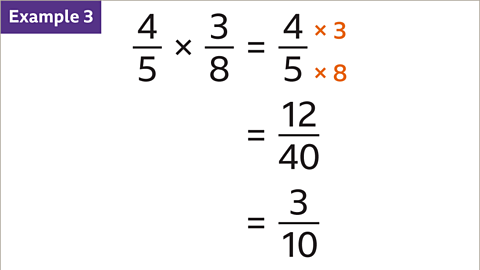
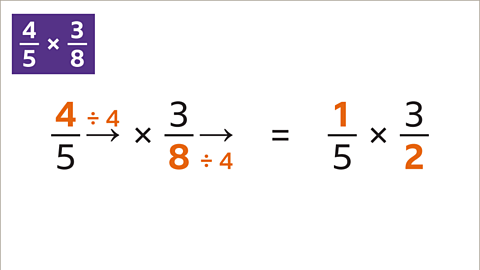
Multiply the numerators.
Multiply the denominators.
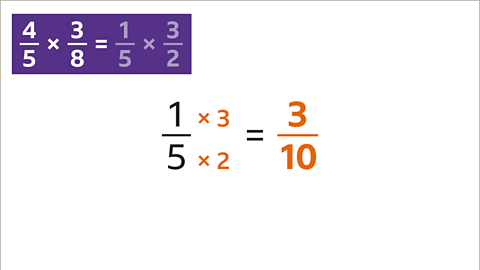
Simplify the answer.
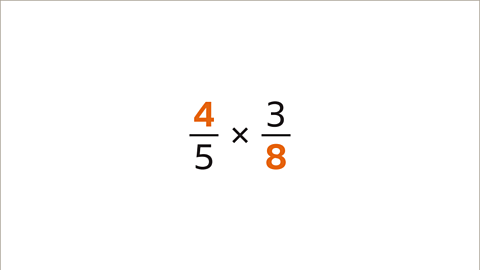
The answer may be simplified before calculation using the The largest factor that will divide into the selected numbers. Eg, 10 is the highest common factor of 30 and 20. Highest common factor is written as HCF.
Examples
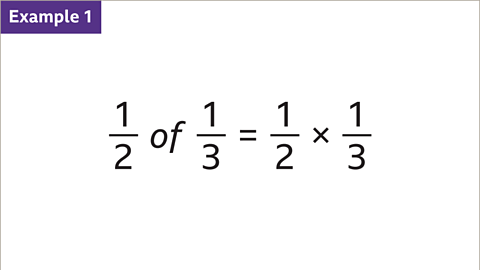
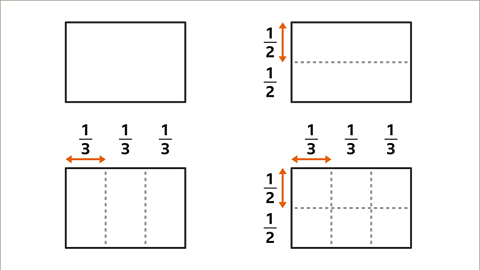
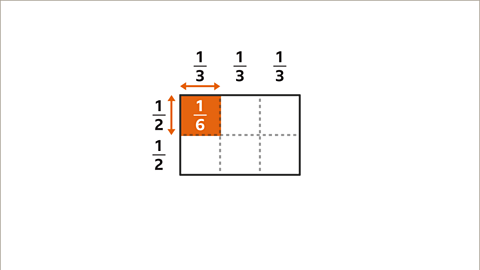
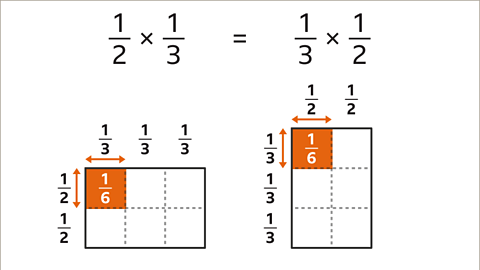
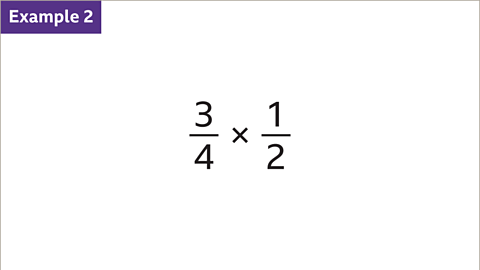
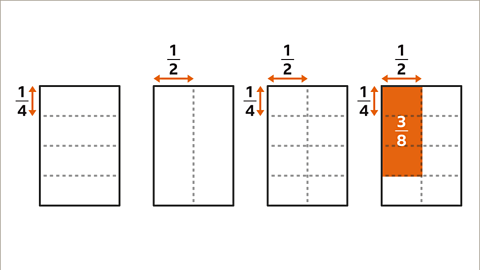
Image caption, 1⁄2 of 1⁄3 is the same as 1⁄2 multiplied by 1⁄3. Work out 1⁄2 of 1⁄3
1 of 10
Question
Find the product of\( \frac{2}{9} \)and\( \frac{4}{5} \)
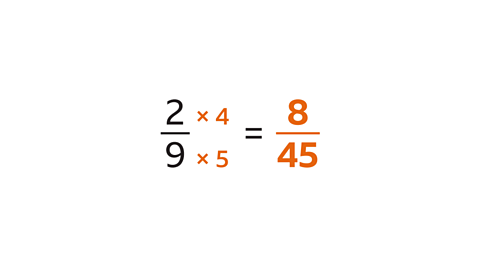
To find the product of the fractions, multiply the numerators (2 and 4) and multiply the denominators (9 and 5). The product is\( \frac{8}{45} \)
How to multiply mixed numbers
To multiply mixed numbers:
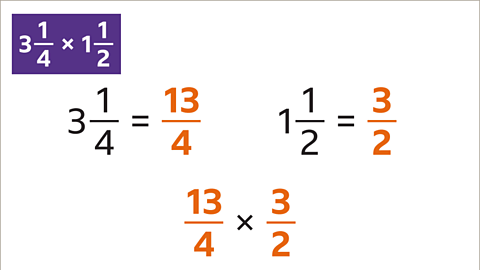
Rewrite the A number that is written using a whole number and a fraction, eg 3 4⁄5 as A fraction where the numerator is greater than the denominator, eg 9⁄4. This is done by multiplying the integer by the denominator and adding the numerator.
If possible, simplify before calculating using the The largest factor that will divide into the selected numbers. Eg, 10 is the highest common factor of 30 and 20. Highest common factor is written as HCF.
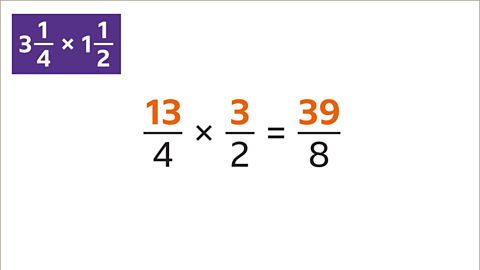
Multiply the numerators.
Multiply the denominators.
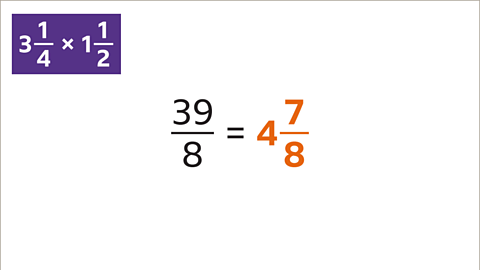
Simplify the answer if possible.
Examples
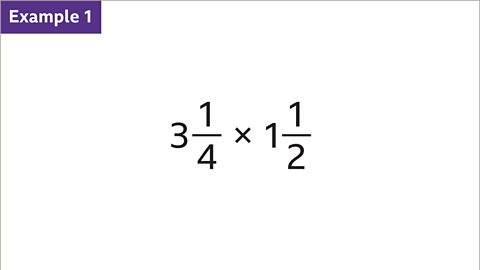
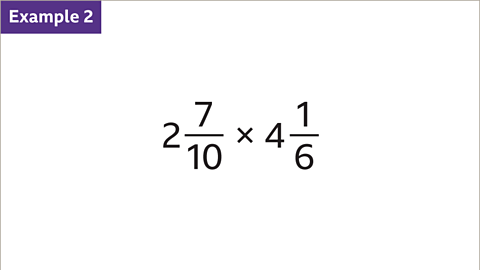
Image caption, Multiply 3 1⁄4 by 1 1⁄2
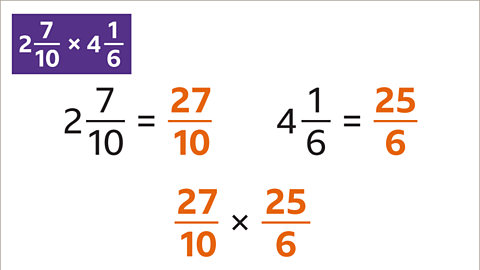
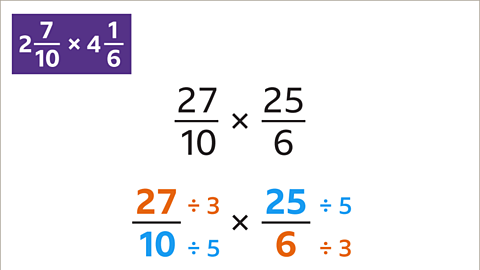
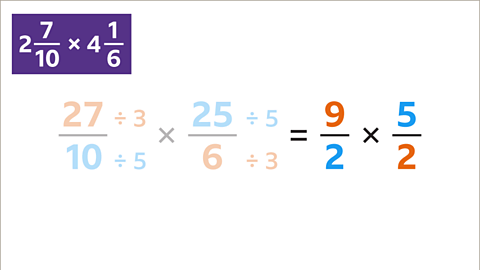
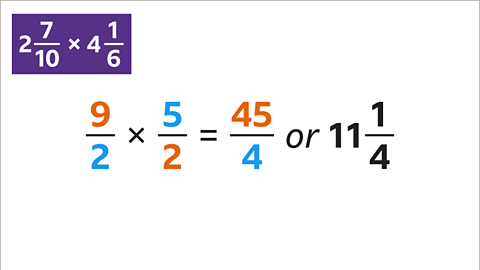
1 of 9
Question
Find the product of \( 3\frac{1}{4} \) and \( 2\frac{2}{3} \)
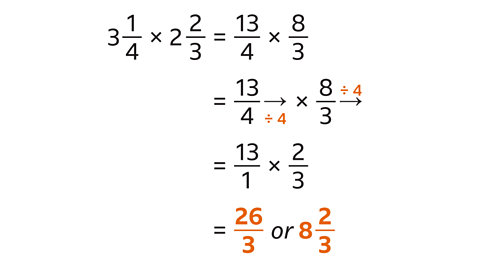
Convert the mixed numbers into improper fractions.
Simplify the calculation by dividing a numerator and a denominator by their highest common factor (4)
Multiply the numerators (13 and 2) and multiply the denominators (1 and 3)
The product is \( \frac{26}{3} \) which is \( 8 \frac{2}{3} \)as a mixed number.
Practise multiplying fractions
Try this quiz to practise multiplying fractions. You may need a pen and paper to solve some of these problems.
Quiz
Real-world maths

In genetics (the study of how genes and characteristics are passed down), multiplying by fractions can help track and predict the likelihood of features being passed onto a child, such as freckles or hair colour.
Half of a child’s genes come from one parent and half from another. When both parents carry the gene for a particular feature, they each have a chance of passing this on to the child.
By multiplying fractions, the chance of the child inheriting that feature can be worked out. For example, if both parents have\( \frac{1}{2} \)a chance of passing a feature on, the likelihood of inheriting is\( \frac{1}{4}\).
Play Sudoku with BBC Bitesize!
Every weekday we release brand new easy, medium and hard Sudoku puzzles. Perfect for testing your skill with numbers and logic.

More on Fractions
Find out more by working through a topic
- count9 of 14
- count10 of 14
- count11 of 14
- count12 of 14

