Key points
- To find a fraction of an amount, divide by the Number written on the bottom of a fraction. The denominator is the number of equal parts. Eg, for 1⁄3, the denominator is 3 and multiply by the Number written at the top of a fraction. The numerator is the number of parts used. Eg, for 1⁄3, the numerator is 1.
- A One or more rectangular bars drawn to represent information. can be used to help explain a problem and support the working out.
- Sometimes the fractional amount is given and the whole must be worked out. In this case the process is reversed. Divide by the numerator and multiply by the denominator.
How to find a fraction of an amount
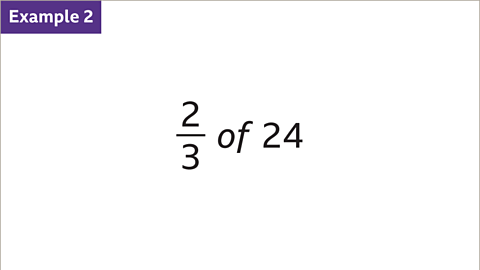
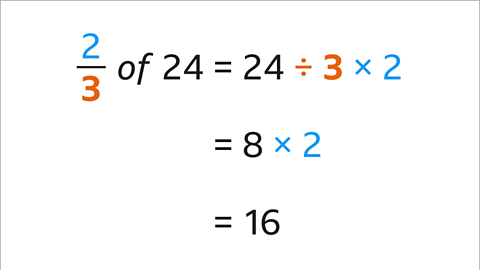
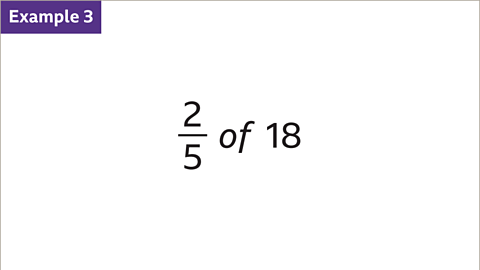
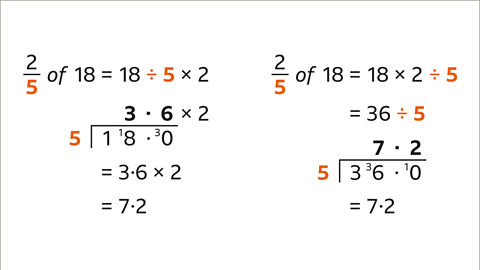
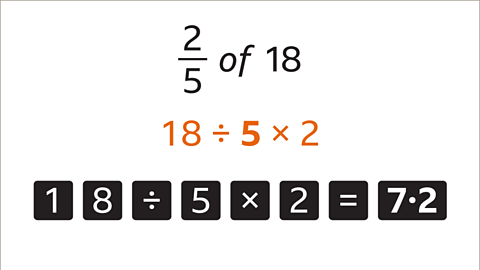
How to find a fraction of an amount:
Divide the amount by the denominator.
Multiply the answer by the numerator.
The multiplication and division can be done in any order. Division is usually done first as the calculation can be easier.
To find a fraction of an amount using a One or more rectangular bars drawn to represent information.:
Draw a bar to represent the total amount.
Split the bar into the number of parts given by the denominator.
Find the value of 1 part by dividing the amount by the number of parts.
Multiply the answer by the numerator.
Examples
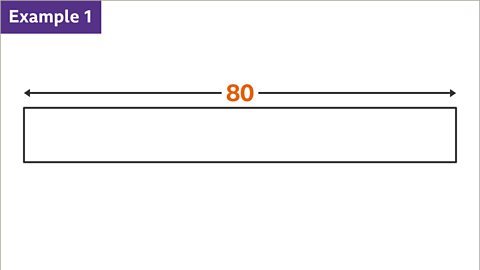
Image caption, The bar represents the total amount, 80
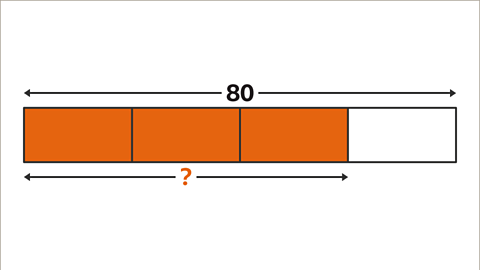
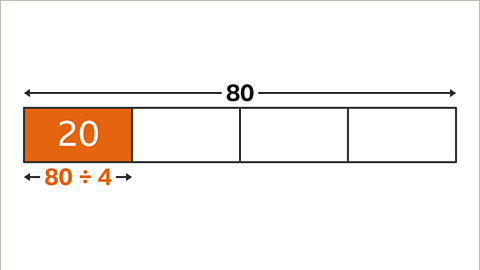

1 of 9
Question
Work out \( \frac{3}{10} \) of 560
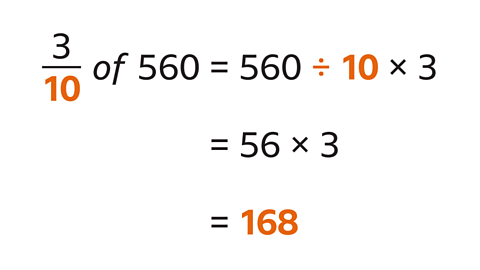
Divide the amount (560) by the denominator (10), then multiply by the numerator (3)
560 ÷ 10 = 56
56 × 3 = 168
\( \frac{3}{10} \)of 560 is 168
How to find the amount from a given fraction
To find the original amount from a fraction of that amount:
- Divide by the numerator to find the A fraction that has 1 as the numerator and whose denominator is a non-zero integer, such as ½ and ⅓ (one part).
- Multiply by the denominator to find the original amount (the whole).
Examples
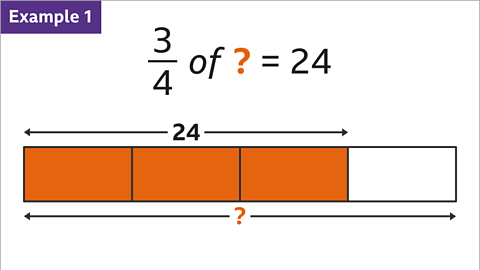
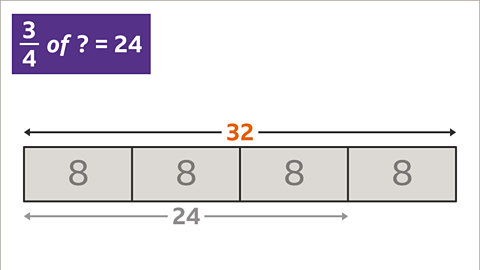
Image caption, 3⁄4 of a number is 24. Find the value of the number.
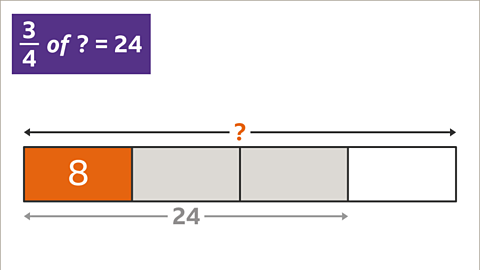
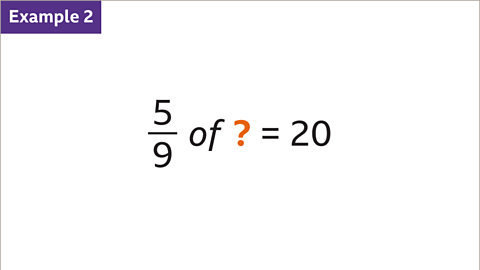
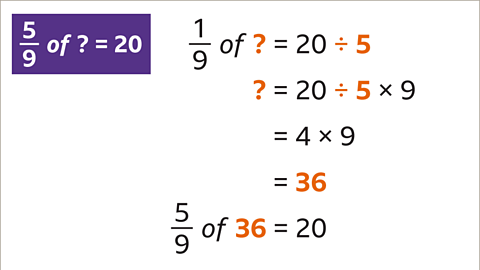
1 of 5
Question
\( \frac{3}{5} \) of a number is 36. What is the number?
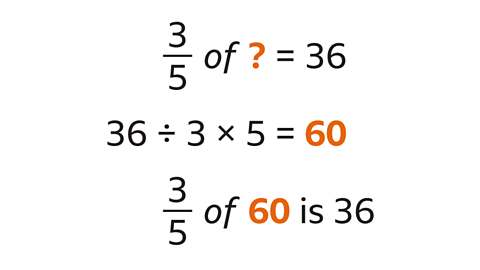
To find the whole from a fractional amount, first divide the amount (36) by the numerator (3)
36 ÷ 3 = 12
This is \( \frac{1}{5} \) of the number. Then multiply by the denominator (5)
12 x 5 = 60
The number is 60
Practise finding a fraction of an amount
Try this quiz to practise finding a fraction of an amount. You may need a pen and paper to solve some of these problems.
Quiz
Real-world maths

Architects use fractions when drawing design plans, such as a floor plan that is\( \frac{1}{50} \)the size of the real building.
For example, if the location of an electrical socket needs to be moved, the distance it moves on the plan uses a calculation that involves finding a fraction of an amount.
For a change made on the design, the architect will have to work out what the real measurement is to ensure accuracy in the actual building.
Revise for your exams with BBC Bitesize
Get ready for the GCSEs with quizzes, past papers, flashcards, podcasts and more resources!

More on Fractions
Find out more by working through a topic
- count11 of 14
- count12 of 14

- count13 of 14
- count14 of 14