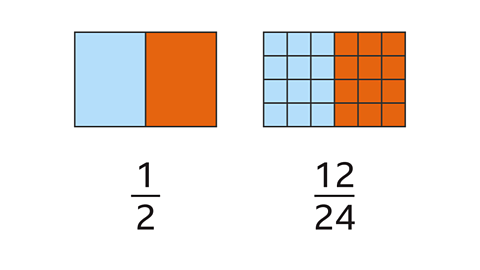
Key points
- Fractions expressed as A fraction expressed as the number of parts per hundred and recorded using the notation % can be easier to understand.
- Expressing a fraction as a percentage means the same as converting a fraction to a percentage.
- Percent means per hundred or out of 100. The percentage symbol % is a shorthand representation of this.
- Knowing how to find A fraction with the same value as another., recognising A whole number that will divide into a selected number with no remainder. and An integer that is in the multiplication table of a specific number. Eg, 20 is a multiple of ten because 20 is in the ten times table., and understanding division are useful when converting fractions to percentages without a calculator.
- To change a fraction to a percentage, you can divide the Number written at the top of a fraction. The numerator is the number of parts used. Eg, for 1⁄3, the numerator is 1 by the Number written on the bottom of a fraction. The denominator is the number of equal parts. Eg, for 1⁄3, the denominator is 3 then multiply the result by 100. Alternatively, you can multiply the numerator by 100 first then divide the result by the denominator of the fraction.
Converting fractions to percentages using a denominator of 100
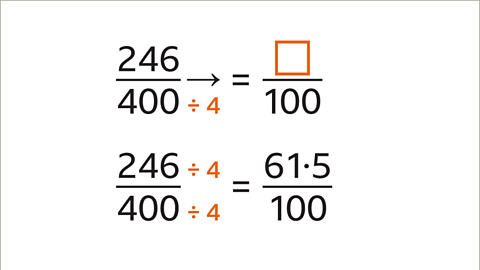
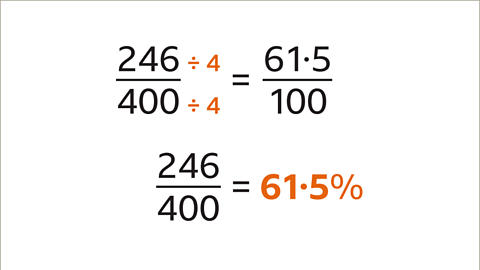
- Write an A fraction with the same value as another. with 100 as the denominator.
- The numerator of the equivalent fraction is the percentage. Write this number followed by the percentage symbol %
This method is ideal when the denominator of the fraction is a factor or a multiple of 100.
Examples
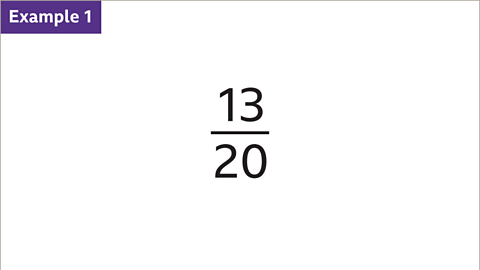
Image caption, Convert 13⁄20 to a percentage.
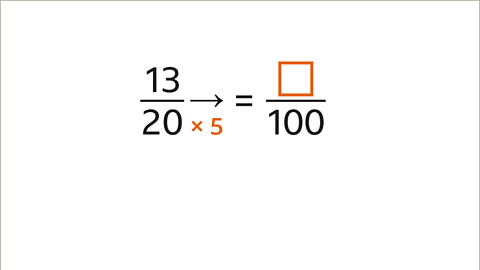
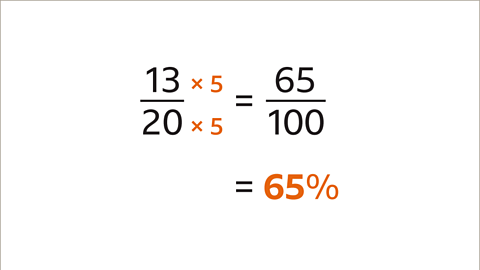
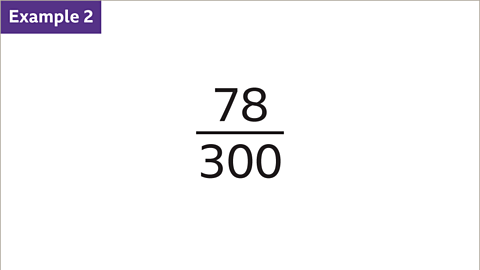
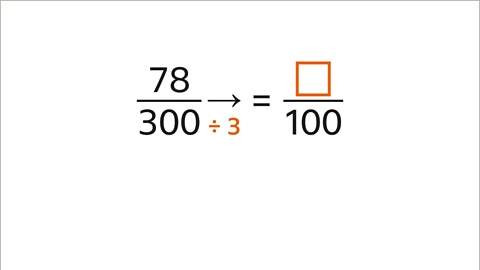
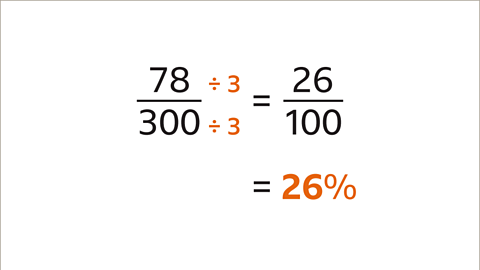
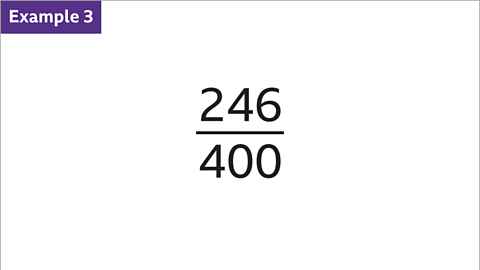
1 of 9
Question
Convert \( \frac{18}{25} \) to a percentage.
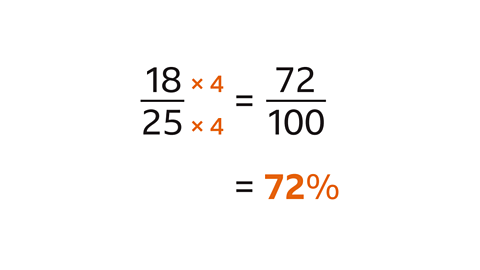
The denominator (25) is a factor of 100
25 x 4 = 100. Write an equivalent fraction with 100 as the denominator.
\( \frac{18}{25} \) is equivalent to \( \frac{72}{100} \)
This is 72%
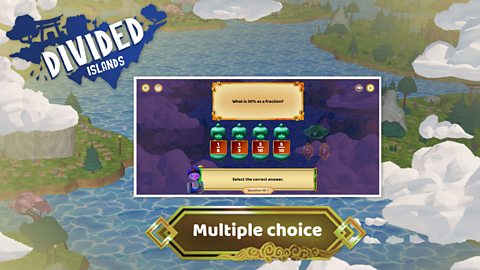
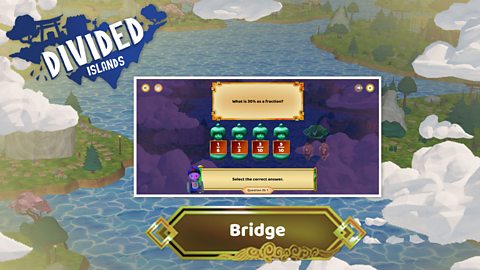
Game - Equivalent fractions and percentages
Have a go at these puzzles on equivalent fractions and percentages from our Divided Islands maths game.
Play the full Divided Islands game.
Convert a fraction to a percentage by multiplying by 100
To convert a fraction to a percentage by multiplying by 100, choose your preferred process order:
Either:
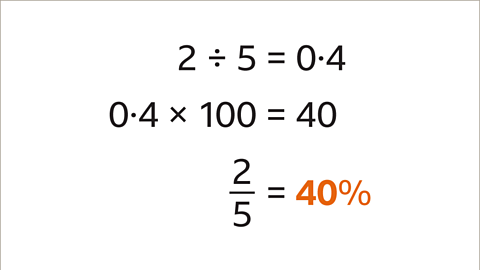
- Divide the numerator by the denominator
- Multiply the result by 100
Or:
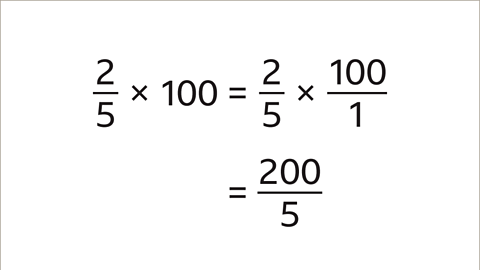
- Multiply by 100
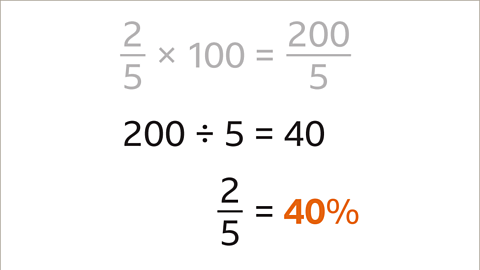
- Divide the result by the denominator
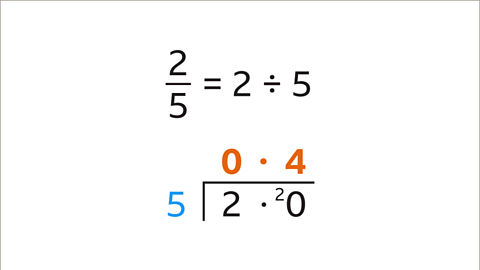
Write the answer followed by the percentage symbol %. You may use short division (the bus stop method) when dividing by the denominator.
Examples
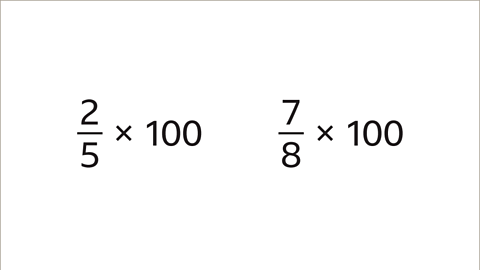
Image caption, Fractions can be converted to percentages by multiplying by 100
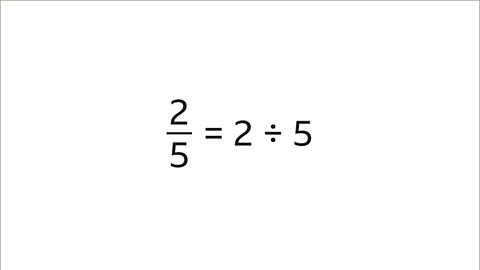

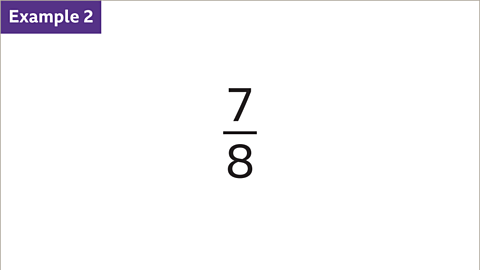
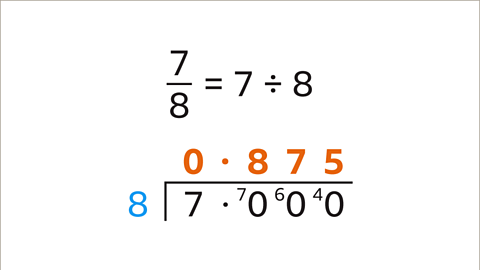
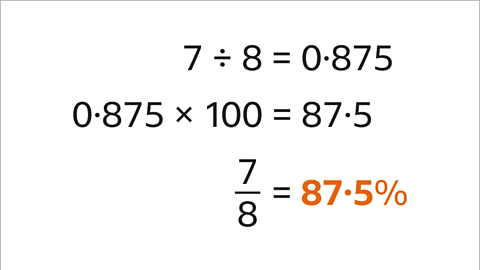
1 of 10
Question
Convert \( \frac{3}{8} \) to a percentage.
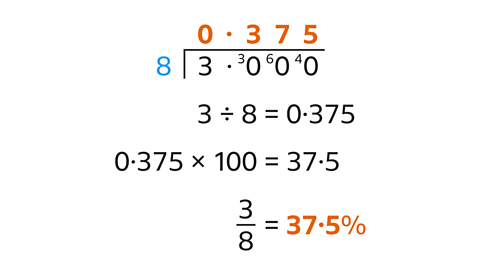
To convert \( \frac{3}{8} \) to a percentage, divide 3 by 8 and then multiply by 100
3 ÷ 8 = 0∙375
0∙375 x 100 = 37∙5
\( \frac{3}{8} \) is 37∙5%
Game - Converting fractions into percentages
Practise your converting fractions to percentages skills further with these puzzles from our Divided Islands game.
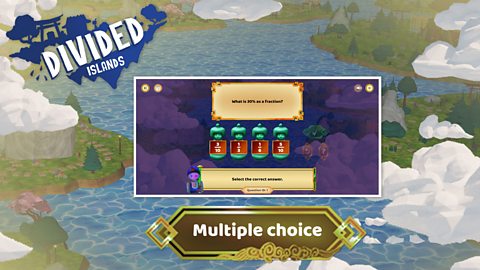
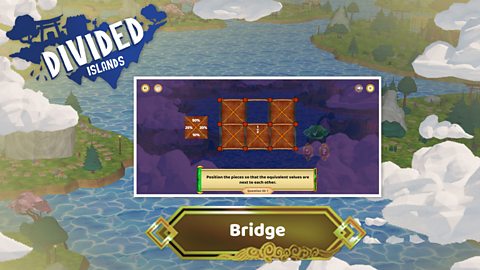
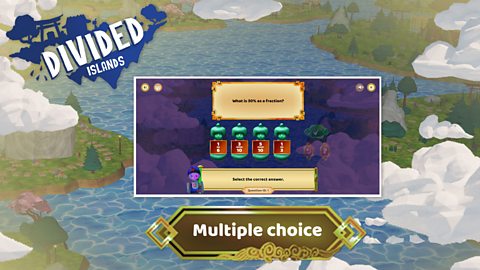
Play the full Divided Islands game.
Practise converting fractions to percentages
Try this quiz to practise converting fractions to percentages. You may need a pen and paper for some of the questions.
Quiz
Real-world maths
Expressing fractions as percentages is often preferred as they can be easier to understand.

Test results are often out of different totals. When taking tests such as the driving theory test, the pass rate may be recorded as a percentage. Eg, the score to pass is \( \frac{43}{50} \) which is 86%.
Play Sudoku with BBC Bitesize!
Every weekday we release brand new easy, medium and hard Sudoku puzzles. Perfect for testing your skill with numbers and logic.
More on Fractions
Find out more by working through a topic
- count13 of 14
- count14 of 14
- count1 of 14

- count2 of 14