What are secondary sources?
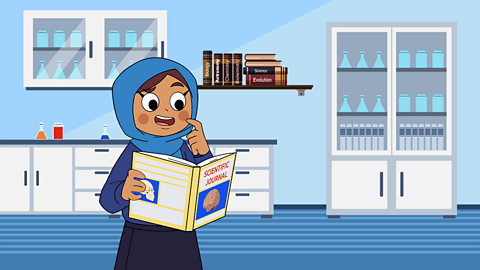
Some things are difficult to research yourself.
If you have ever needed to find out information about a topic from the past such as Charles Darwin's discoveries, or about somewhere it is almost impossible to visit, like the Moon for example, it is likely to be information provided by a secondary source.
A secondary source is information written about an experiment, discovery, or topic that someone else investigated.
It is not the original research but it explains or summarises what others have found.
Watch: Secondary sources of information
Fran: What causes climate change?
I am obviously not the first person to ask this question.
Lots of people have conducted research about climate change already and what I can do is use that information as a starting point. I can look in books, on websites, I can watch a documentary on the subject or I can read articles.
Now, all of these sources of information are known as secondary sources.
That means that someone has already put them together from primary source material, and a primary source material is the first-hand account of the original event.
The data you collect from your own investigations would be a primary source.
Secondary sources are helpful to you when you want to gather the existing knowledge about a subject, they can help you know what is already out there.
But you've got to be careful.
Remember that person who created the secondary source?
They could be anyone!
So, make sure that they know what they're on about.
Check out their qualifications.
Also look at when the source was published or produced, and you can often find that on the thing itself.
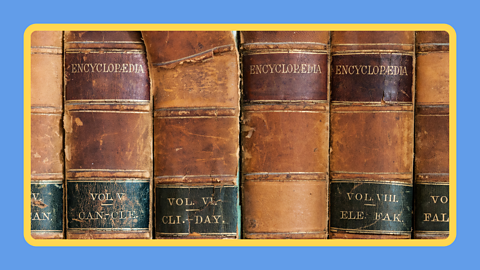
So here, this book was published in 1888.
And something written more than a hundred years ago might not have the most up to date information.
You can also look at the reputation of the source, are they known for being reliable or do they often get things a little wrong?
Let's see what my investigator is learning about secondary sources.
Child: I'm going to do some research to see if the weather is affected by climate change, so I'll have to use secondary sources.
Encyclopaedias are a good secondary source.
I'll start with a general search.
Let's try 'weather and climate'.
I can look online at webpages, but I need to be sure that the source is reliable.
Check to see if the company has an About Me page, but you can't always believe what they say about themselves, you should always check what other people say about them.
Fran: Good work there!
So remember, secondary sources are good for gathering research on a subject, but always make sure that you check the source is reliable, up to date and has a good reputation before you start basing your theories and ideas around it.
Fascinating facts
Encyclopaedias have been written for around 2,000 years,. The first encyclopaedia was written in the 1st century AD by the Roman statesman Pliny the Elder.
Secondary sources can also include archive news footage and old newspapers.
Primary sources are first-hand perspectives by someone who was there or was witness to something.
Biographies are a good example of a secondary source. They are books written about a particular person and authored by somebody else.
Autobiographies, which are written by a person about themselves, can still be secondary sources when used for wider subjects.
The physicist Albert Einstein used Sir Isaac Newton’s theories on gravity as a secondary source to develop his famous theory of relativity.
There are around 40,000 science journals published annually. These journals cover all fields of science and include findings by scientists from around the world.
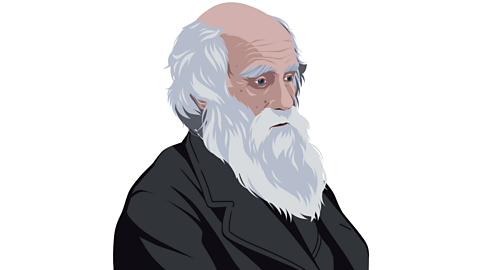
Sir Charles Darwin's 'The Origin of Species' (1859) is the best-selling science book in history. Darwin’s pioneering theories of evolution changed the way we view the animal world.
Examples of secondary sources in science
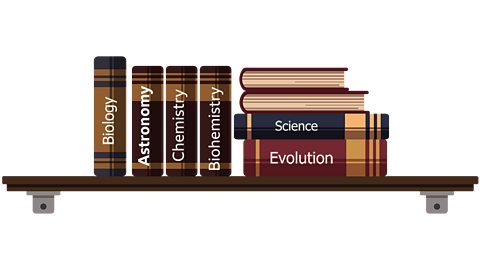
- Science textbooks
These are books used in school that explain scientific ideas like how plants grow or how the Earth orbits the Sun. The information inside of these books is based on other scientists' research. - Science articles or reviews
These are written by scientists or writers who study lots of original research and then explain it in simpler terms. - Encyclopaedias
These provide summaries of scientific topics like 'How volcanoes work' or 'The life cycle of a star' using information from many different studies. - Documentaries
Films or shows that explain things like space, animals or the environment are based on research conducted by other scientists.
Slideshow: Secondary sources

Image caption, Science textbooks and articles
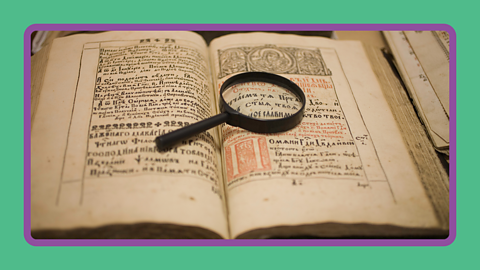
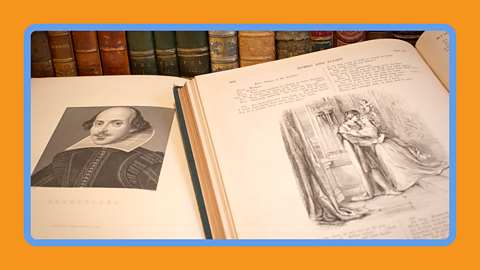
Science textbooks are books that explain important scientific ideas. Science articles (or reviews) are written by scientists and other writers who study lots of original research and then explain an idea in simple terms.

1 of 5
Remember
While secondary sources are extremely helpful in understanding a topic, it's important to verify the information by checking different secondary sources of information.
If the range of secondary sources all say the same thing then you know it must be accurate.
If it is possible, use primary sources to obtain the most accurate and first-hand information.
How are secondary sources used in science?
Secondary sources help students and the public understand complicated scientific ideas by explaining them in simpler terms.
They often summarise different research studies to give an overview of what scientists have learned about a topic.
By using secondary sources, we can reduce the need to conduct dangerous or difficult experiments.
Important words
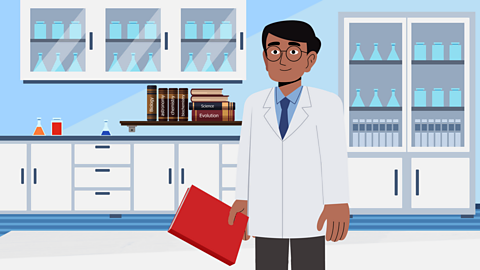
Encyclopaedias - Encyclopaedias are books or online resources that provide summaries of scientific topic along with many other subjects.
Experiments - Scientific procedures, often in a laboratory, that produce results.
First-hand - From personal experience or witnessed by someone.
Research - Finding information about a topic from various sources.
Secondary source - Information written about an experiment, discovery, or topic that someone else conducted.
Verify - To check the truth about a piece of information.
Activities
Activity 1 – Take the quiz
Activity 2 – Conduct research with secondary sources
Think about a scientific question or theory you would like to investigate.
Think of a question that you cannot answer yourself, so that you will need secondary sources of information. If you are stuck, why not think about something in space (like ‘What is a black hole?’).
Find all the evidence you can to support or refute an idea of your own.
Use secondary sources of information to find out the answer.
How will you ensure you find scientifically correct information and not fake news?
Start by looking at evidence you trust – such as BBC Bitesize, or textbooks that you use at home.
Activity 3 – List secondary sources of information
New game! Horrible Science: Stinky Space. game
Join Pipette on her epic mission and learn some revolting facts about space along the way.
More on Working scientifically
Find out more by working through a topic
- count8 of 10
- count9 of 10
- count10 of 10
- count1 of 10