Types of scientific equipment
Scientific equipment is anything that a scientist would use in a science test or experiment.
It is important that you use the correct equipment in your scientific test or experiment. You could use:
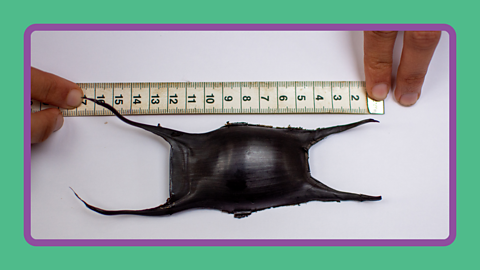
- a tape measure to measure lengths
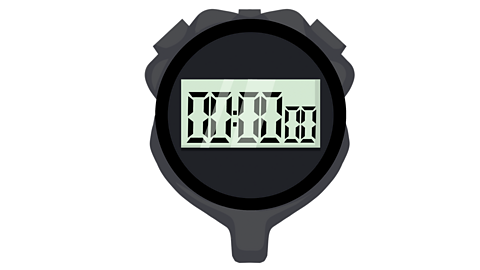
- a stopwatch for measuring time
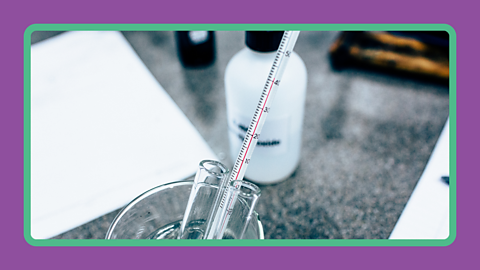
- a thermometer for measuring temperature
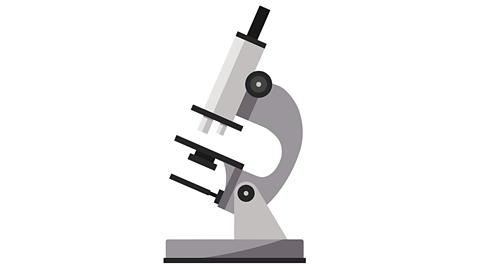
- a microscope for viewing objects too small to see with our eyes.
- a data logger for collecting and recording data over a length of time.
You can use these to gather scientific information. Which is pretty important for a scientist!
Watch: Using scientific equipment
Fran: Scientific experiments answer important questions and tell us more about our world.
So, it's important that the experiments are accurate and precise.
And we've got lots of tools to help us.
Choosing the right one is key to getting the right results.
Here we are investigating how the distance of a light source from an object affects the size of the shadow.
And we are measuring distance, so we will need a ruler if the distance is short, or a tape measure if the distance is a bit bigger.
With this experiment we're investigating how different liquids react in water.
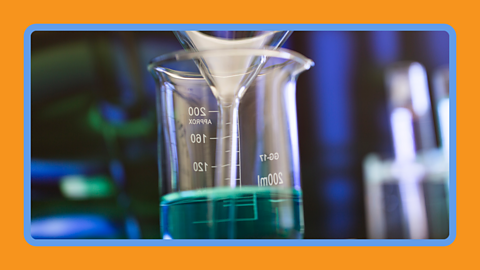
We use a measuring cylinder to measure out our water.
Then we use one of these, a pipette, to add a small amount of our variable liquid, in this case I'm going to be adding oil to the water.
Do you see how the oil stays separate from the water.
Look, it doesn't mix at all.
So, let's find out what scientific equipment my investigator is using.
Child: We're investigating which of these ice lollies melt the quickest.
So we're using one of these: a thermometer.
It measures in degrees Celsius, so we can be really accurate.
We can use this stop clock to make sure we measure them every ten minutes.
I'm going to wrap each of the lollies in a different material, and we're not going to put any material on this one.
Before we start… a prediction!
I predict the lolly in bubble wrap will melt the quickest because it's thick like a blanket.
Let's see if I'm right.
So that's been 10 minutes, so I'm going to check the temperatures now.
We're at 40 minutes which means it's the end of the experiment.
So, it looks like the bubble wrap and the tin foil are the best materials for keeping an ice lolly cold.
Fran: Now remember when we're recording what we find the units that we use are:
Degrees Celsius for temperature.
Metres, centimetres and millimetres for distance.
Litres and millilitres for liquids.
And hours, minutes and seconds for time.
Measurements and units
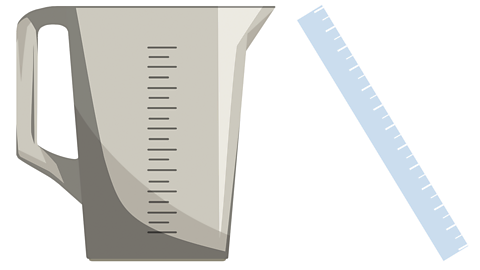
Most scientific measurements are measured in standard units. These can sometimes be very large or very small depending on the measurement being taken.
The standard unit of distance is metres, although we use lots of different units from millimetres to kilometres.
The standard unit of time is seconds, although we use lots of different units from milliseconds to years.
It is important to choose the equipment and the units of measurement that are the most appropriate for your test or investigation. You would not measure the length of a school play ground in millimetres, or the time it takes to do homework in years!
Watch: Using scientific equipment
Understand how to use equipment, measure and record your results with this clip.
LITTLE KID: Groowwwww!!!
NARRATOR: Molly, should we help him record if the sunflowers will grow taller in the sun than in the shade?
Let’s observe them over a month - using scientific equipment to measure the height!
We just need the right equipment!
Not a stopwatch, that’s for measuring time…
or a thermometer, that’s for temperature…
or a microscope, that’s for examining things closely…
Aha, a measuring tape, that can be used to measure the height!
So we take a measurement now…
…and another measurement a month later.
LITTLE KID: WOW!!!..
NARRATOR: I think it’s safe to say that the sun certainly helps plants grow.
LITTLE KID: Oww!
Remember
Wherever you use scientific equipment, it's always important to use it safely!
Scientific equipment
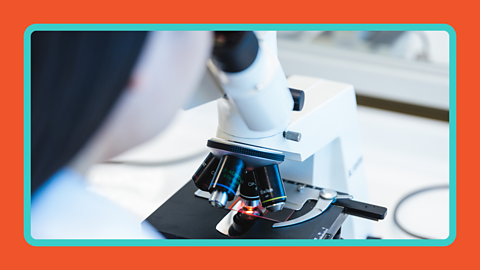
Image caption, Microscope
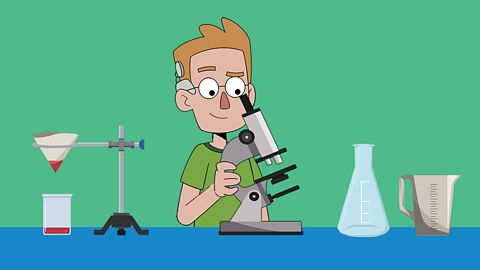
Microscopes are used for viewing objects that are too small to see with just our eyes. This can include microscopic organisms like bacteria, or the structure of rocks and seeds.
1 of 5
Did you know?
It is not known for sure who invented the very first microscope but the Dutch spectacle maker Zacharias Janssen is known to have made one around the year 1595. These early microscopes could magnify an object up to 3 and 9 times the size of the original specimen.
The English scientist Robert Hooke used a microscope to draw pictures which he collected in his 1665 book Micrographia. These drawings included things that many people had never seen up close before, like the cells of a plant, the eyes of a housefly and the body of a flea.
Important words
Data logger – A piece of science equipment that records data over time.
Microscope – A piece of scientific equipment used to enlarge our view of tiny things, like bacteria or plant cells.
Tape measure – A device that measures length or height, usually showing metres, centimetres, millimetres and inches.
Thermometer – A device used to measure temperature. Temperature is measured in degrees Celsius, but some thermometers also have Fahrenheit.
Scientist – Someone who studies and becomes an expert in any of the natural sciences.
Stopwatch – A device used to measure time in seconds, minutes and hours.
Activities
Activity 1 – Identifying scientific equipment
Activity 2 – Scientific equipment quiz
Activity 3 – Match the scientific equipment
New game! Horrible Science: Stinky Space. game
Join Pipette on her epic mission and learn some revolting facts about space along the way.
More on Working scientifically
Find out more by working through a topic
- count3 of 10
- count4 of 10
- count6 of 10