Sharing discoveries
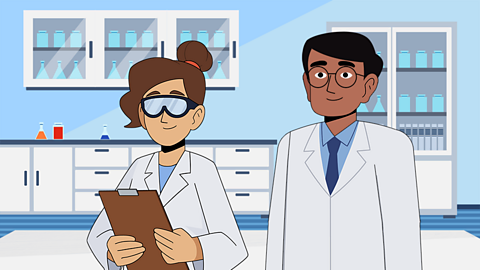
Experiments allow scientists to collect results in the form of data.
When scientists make discoveries, they don't keep them to themselves!
They share their findings and use them to make the world better.
Watch: How do scientists present their findings?
Child: So how can understanding air resistance help us in the real world?
Let's make some parachutes.
I'm going to test two different sizes to find the best one for keeping an egg safe.
I predict that the larger the parachute the slower it will fall, and the better it will protect the egg.
But let's see if I'm right.
Time to test it.
Ready… go!
That egg's completely broken.
Go!
I need to understand these findings: time for a graph.
The eggs didn't break in the larger parachute, but they did break in the smaller parachute.
So, I can see here, the bigger the parachute, the slower the egg fell, and that helped protect the egg.
Fran: Nice work and an important investigation!
Your findings hold the answers to your scientific questions.
Graphs, charts and written reports will help you understand and learn from what you find.
Presenting findings
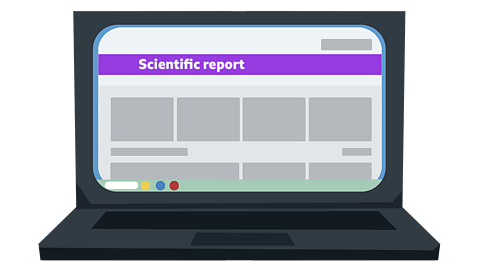
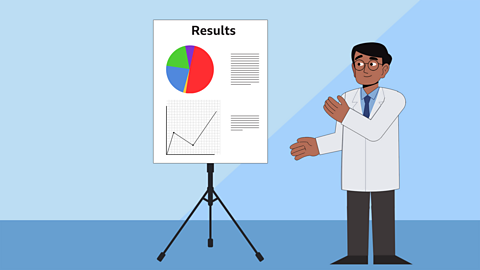
Scientists might present their findings in words by writing a scientific report. This report will explain what they studied, how they carried out the experiment and what they discovered. They may read their findings at a special meeting called a conference.
They may present observations through the use of photos or drawings and creating posters with the key information about their discoveries.
Sharing their findings allows scientists to tell the public about their work and creates opportunities for scientists to collaborate with other scientists. In this way, scientists share knowledge, learn from each other and make even more exciting discoveries.
Some famous scientists
Gregor Mendel (1822-1884) was an Austrian-Czech biologist known as the ‘father of genetics’, Mendel conducted experiments using pea plants to measure the inherited traits that were passed down between reproducing plants and their offspring.
Ivan Pavlov (1849-1936) was a Russian physiologist who conducted famous experiments with dogs to observe conditioning. He was able to influence a dog's behaviour using food.
Sir Alexander Fleming (1881-1955) was a Scottish physician and microbiologist. In 1928 Fleming discovered a mould that fought against bacteria and killed it. This led to the development of the world's first antibiotic which he named penicillin.
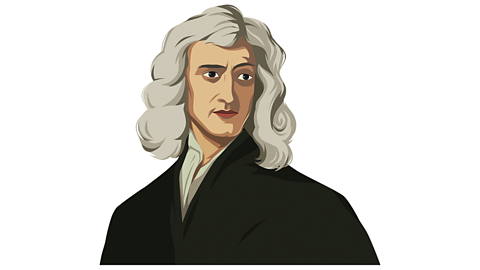
The physicist Albert Einstein used Sir Isaac Newton’s existing theories of gravity to develop his own famous theory of relativity which Einstein first published in 1905.
Watch: How do scientists use their findings?
Fran: Scientists study the world around us.
They carry out experiments, they make observations, and they test their theories.
They analyse their findings and sometimes those findings confirm our ideas about the world.
And sometimes they can change them.
Hundreds of years ago people thought the speed at which an object falls was directly related to its mass.
But there was a scientist named Galileo, and he had a theory that this was wrong.
The story goes that Galileo dropped two cannon balls but with different masses - so one heavy, and one light - from the Tower of Pisa.
Both balls landed at pretty much the same time, proving that the mass of an object had less of an effect on the rate of fall than people thought.
Galileo said he proved that the force which we now call gravity acts on objects at the same rate regardless of their mass.
So, I have two balls. I have this metal one, which is very heavy, and I have this tennis ball, which is light.
I'm going to drop these at the same time and let's see what happens.
We can see that the two balls fall at a similar rate, but if we dropped two objects that are a different mass and a different shape, like this feather and this heavy ball, then let's see what happens.
Ah, they don't fall at the same rate.
And this tell us that there is another force at work and that is air resistance.

Fascinating facts
There are around 30,000 science journals, publishing findings by scientists from around the world.
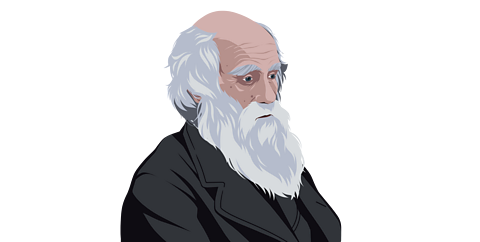
Sir Charles Darwin's (1809 - 1882) 'The Origin of Species' (1859) is the best selling science book in history. Darwin's pioneering theories of evolution changed the way we see the natural world and the place of humans in it.
The International Space Station (ISS) has a working laboratory, so that astronauts can conduct science experiments and report their findings from orbit.
A scientific investigation usually starts with a question, or what the scientist wants to discover.
The investigation
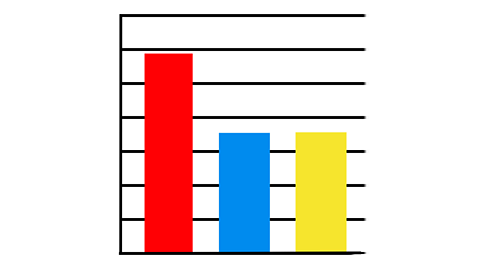
When carrying out scientific experiments, scientists begin by making predictions as to what the results may be. Once the results are obtained, scientists can see if their predictions were correct.
When scientists carry out experiments, they collect data (results). Scientists commonly present their data (results) in tables, charts or graphs to make the information easier to understand and interpret.
They then write a summary of their findings, which is called a conclusion. Part of being a good scientist is the need to consider how you could improve your experiment next time.
In the evaluation, scientists consider what went well and what the areas of improvements are. They may make suggestions for what further investigations might need to be carried out.
Slideshow: From experiment to discovery
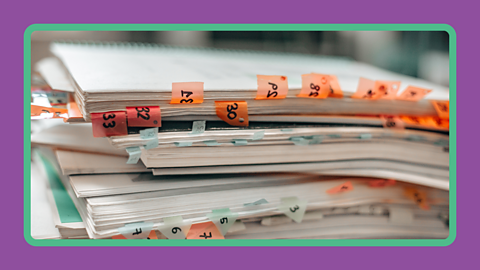
Image caption, Predictions
When scientists carry out scientific experiments, they often begin by making predictions as to what the results may be.
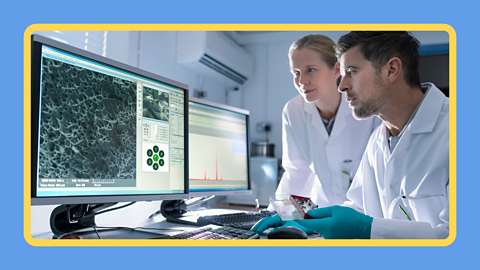


1 of 4
Did you know?
The world’s oldest scientific journal, Philosophical Transactions, is over 350 years old.
It has published scientific findings by many famous scientists over the years, including Charles Darwin, Mary Somerville, Dorothy Hodgkin, Alan Turing and Stephen Hawking.
Philosophical Transactions was first published by the Royal Society in London, in 1665. A new edition is still printed every two weeks, and is also available for scientists to read online.
What do scientists do with their findings?
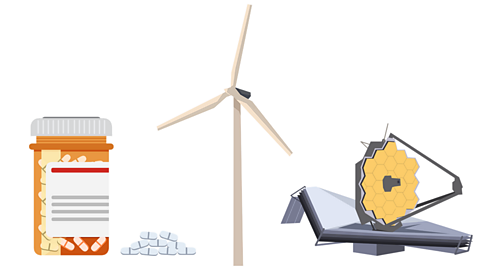
Help solve problems
Many discoveries are used to solve real world problems. For example, scientists might use their findings to create new medicines, make cleaner energy or improve technology. Their work can also help protect the environment, find new ways to grow food, or keep people safe from diseases.
Inspire more research
Discoveries often lead to more questions! When a scientist finds something new, it can inspire others to conduct more experiments and make even bigger discoveries.
Education
Scientists' findings are also used in schools and universities. Teachers and lecturers use scientific findings to help students learn about the world and how things work.
By sharing their findings, scientists help improve lives, inspire more research and make sure everyone benefits from their discoveries.
Important words
Conclusion – A conclusion is a clear summary of what has been found out during a scientific investigation.
Conference – A special meeting where scientists meet and present their findings.
Data – Any information that results from experiments, tests and research.
Evaluation – In an evaluation, scientists consider what went well in an experiment and what areas of there are for improvement. They may also make suggestions for what further investigations could be carried out.
Experiments – Scientific procedures, often in a laboratory, that produce results.
Findings – Also known as results, findings are the information and data received at the end of a test or experiment.
Interpret – To explain the results of a scientific test or experiment.
Predictions – Using your understanding to say what you think will happen in an experiment.
Scientific report – A way of presenting your results and conclusions, reports can be published in journals or by an institution.
Scientists – Scientists are people who are experts in an area of science.
Activities
Activity 1 – Fill in the gaps
Activity 2 – Take the quiz
Activity 3 – Create a leaflet
Think about all the different ways you could record your findings when carrying out a scientific investigation.
Create a fact file or leaflet explaining to others the different ways you could record your findings. Try to include a diagram and an explanation for each one.
Activity 4 – Melting ice cubes experiment

Imagine you are going to carry out an experiment to see where in your house an ice cube melts fastest.
Remember :
- To identify your key question.
- How will you make sure your experiment is a fair test?
- Before you start, don’t forget to write a prediction.
- Do the experiment and collect your results.
- How will you present and interpret them?
- Finally, evaluate your experiment.
If you decide to do this activity, don’t forget to ask a responsible adult to help you.
New game! Horrible Science: Stinky Space. game
Join Pipette on her epic mission and learn some revolting facts about space along the way.
More on Working scientifically
Find out more by working through a topic
- count7 of 10
- count8 of 10
- count9 of 10
- count10 of 10