Key points
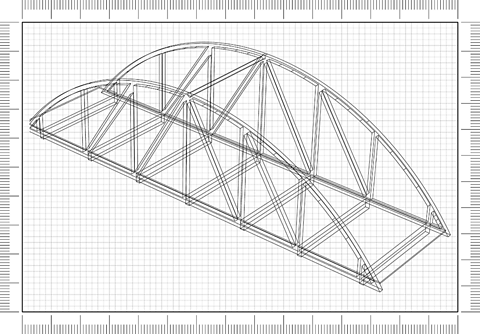
Scale drawings represent real objects with accurate lengths reduced or enlarged by a given The ratio of corresponding edge lengths, drawing to real life..
An accurate drawing, or model, of a representation of a physical object in which all lengths in the drawing are in the same ratio to corresponding lengths in the actual object. are commonly seen as smaller representations of large objects including buildings, gardens and vehicles. Scale drawings may also be a larger representation of small objects such as parts for a watch or a medical instrument.
Scales are expressed in A part-to-part comparison. form comparing a length on a diagram to the corresponding real length. In a scale drawing, all dimensions have been reduced by the same proportion and measurements are most often in centimetres and millimetres. For example, 1 cm on a scale drawing representing 1 metre in real life is a scale of 1 : 100
When writing and using scales, understanding conversion between units, simplifying ratios and solving ratio and proportion problems can help.
Many scales are written as A ratio in the form 1 : n or n : 1:
1 : n informs the user that one unit on the scale drawing represents a certain number (n) units in real life. For example, a scale of 1 : 500 means that 1 cm on the scale drawing represents 500 cm in real life.
n : 1 informs the user that a certain number (n) of units on the scale drawing represents one unit in real life. For example, a scale of 200 : 1 means that 200 mm on the scale drawing represents 1 mm in real life.
How to write a scale as a ratio
To write a scale as a ratio:
Write the length on the scale drawing first, then the corresponding length on the real object.
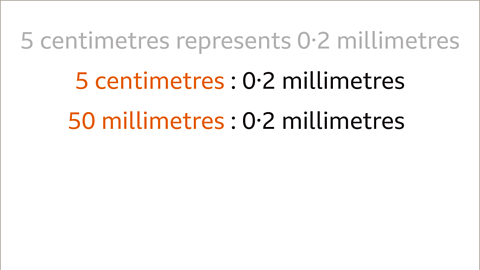
Convert the lengths to be in the same, smaller units.
Write the ratio without the units.
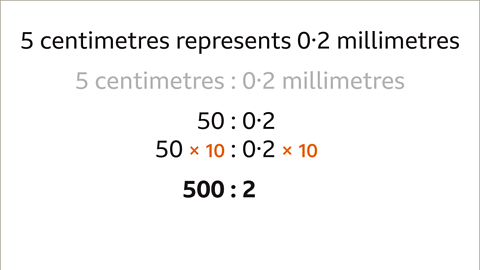
If one or both values are decimals, multiply both values by a power of ten to ensure they are both Integers are numbers with no fraction or decimal part. They can be positive, negative or zero. 42, 8, and 10000 are examples of integers. values.
Simplify the ratio by dividing both values by their The largest factor that will divide into the selected numbers. Eg, 10 is the highest common factor of 30 and 20. Highest common factor is written as HCF. .
Examples
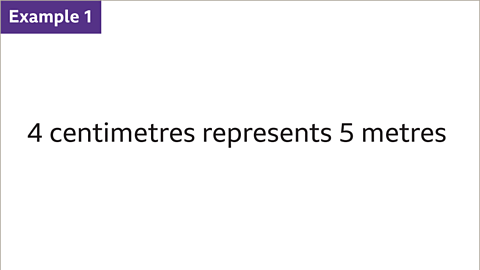
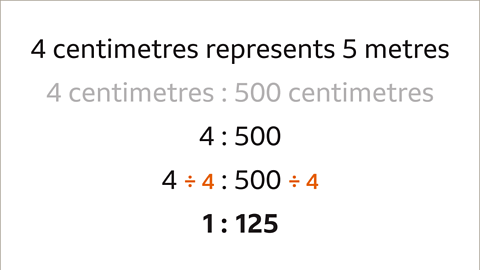
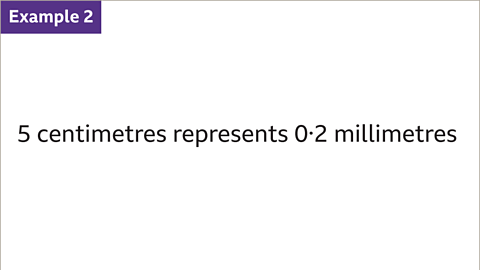
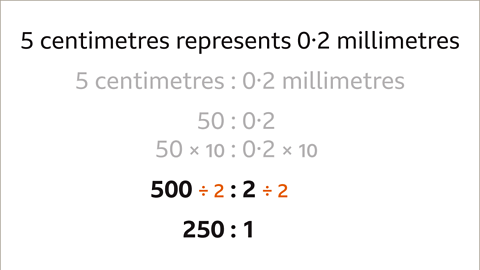
Image caption, The scale drawing length of 4 centimetres represents the corresponding length of 5 metres on the real object. Work out the scale that has been used and write it in its simplest form.
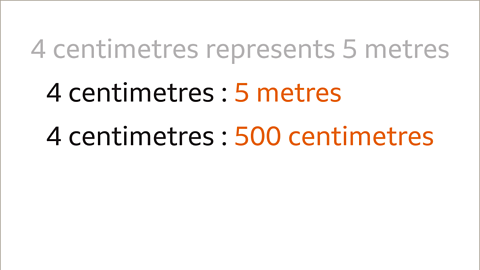
1 of 7
Question
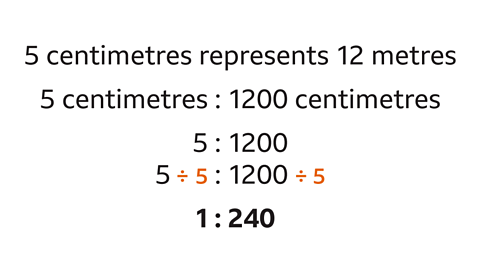
Write the scale of 5 centimetres represents 12 metres as a ratio in its simplest form.
Convert the lengths to be in the same, smaller units (centimetres).
12 metres is 1200 centimetres.
Write the ratio without the units, 5 : 1200
Simplify the ratio by dividing both values by their HCF (5).
The simplified ratio is 1 : 240
Using a scale to find measurements for a scale drawing
To find the lengths on a scale diagram that is smaller than the real object:
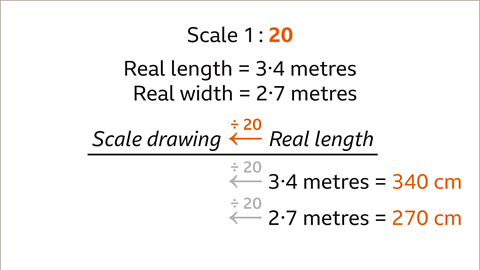
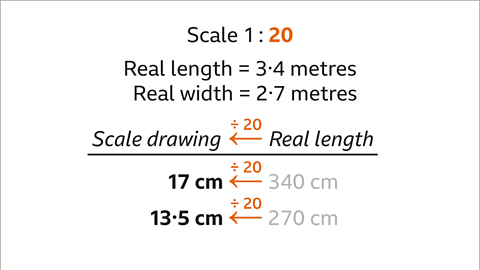
Write the scale as a unitary ratio in the form 1 : n.
Convert each real length to centimetres.
Divide each real length by the scale (n).
To find the lengths on a scale diagram that is larger than the real object:
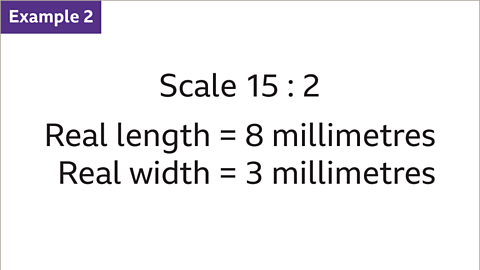
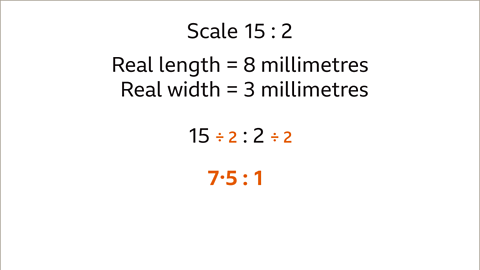
Write the scale as a unitary ratio in the form n : 1
Multiply each real length by the scale (n).
Convert each real length to centimetres, if appropriate.
Examples
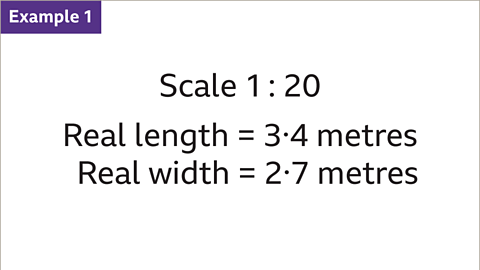
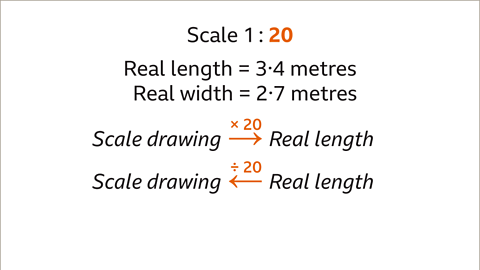
Image caption, Use a scale of 1 : 20 to find the measurements for a scale drawing of a bedroom. The floorplan of the bedroom measures 3∙4 metres by 2∙7 metres.
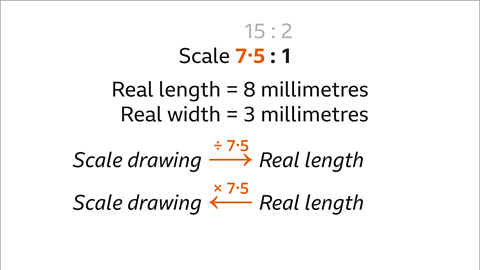
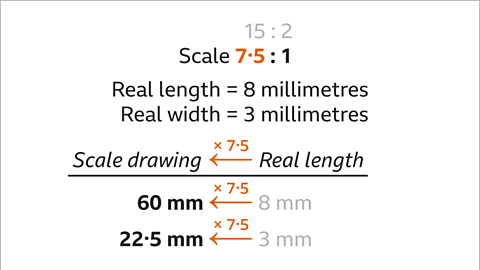
1 of 8
Question
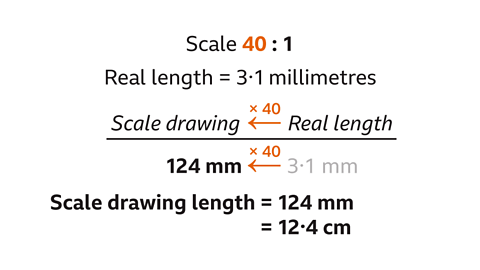
A scale drawing of a small insect is drawn using a scale of 40 : 1. What length on the drawing is used if the insect is 3∙1 millimetres long?
The scale is already written as a unitary ratio (40 : 1). The real length multiplied by 40 gives the scaled length.
Multiply the length (3∙1 mm) by the scale (40). This gives 124 mm.
The length on the scale drawing is 124 millimetres, which is the same as 12∙4 centimetres.
Using a scale to find real lengths
To find the actual lengths from a scale diagram, where the object is larger:
Write the scale as a unitary ratio in the form 1 : n.
Multiply each scaled length by the scale (n).
Convert the units, if appropriate.
To find the actual lengths from a scale diagram, where the object is smaller:
Write the scale as a unitary ratio in the form n : 1
Divide each scaled length by the scale (n).
Convert the units, if appropriate.
Examples
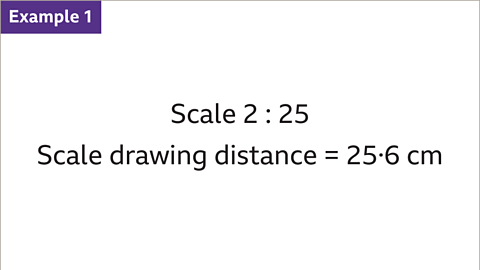
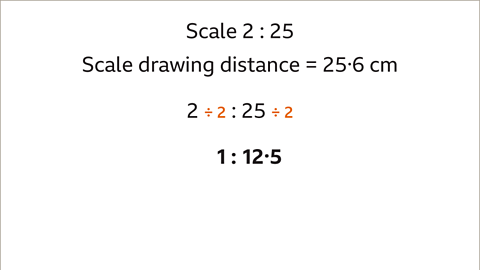
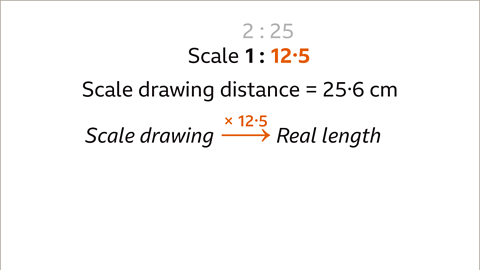
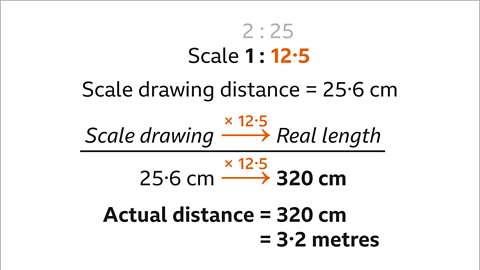
Image caption, A scale drawing with the scale of 2 : 25 gives the distance between a pair of wall sockets as 25∙6 centimetres. Find the actual distance between the sockets in metres.
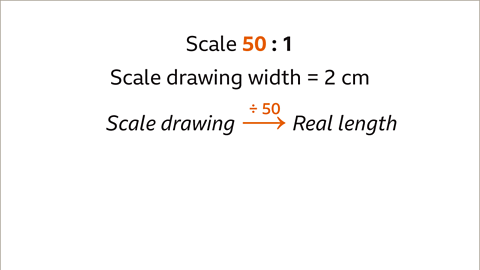
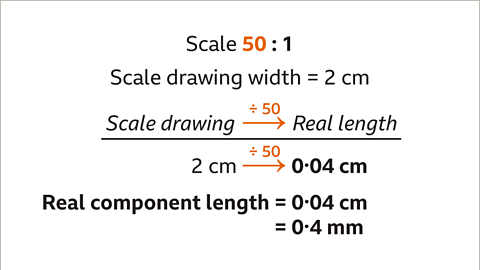
1 of 7
Question
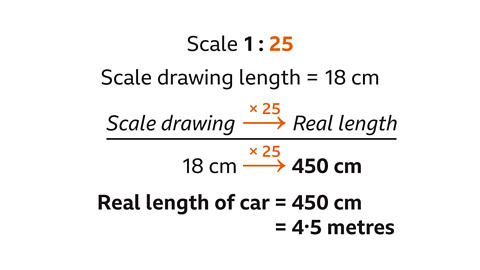
A scale drawing of a car uses the scale 1 : 25. The length of the car on the drawing is 18 cm. How long is the actual car?
The scale is a unitary ratio (1 : 25).
Multiply the scaled length by the scale (25). 18 × 25 = 450
The actual length of the car is 450 cm. This is the same as 4∙5 metres.
Practise using scale drawings
Quiz
Practise using scale drawings in this quiz. You may need a pen and paper to complete these questions.
Real-world maths

Scale drawings are used by designers to plan and adjust details before actual production so that all problems can be addressed.
CAD (computer- aided design) relies heavily on scaling software, interpreted by automotive, structural and civil engineers. A scale drawing of a car has the same shape as the real car that it represents but a different size.
People searching for a house to buy can access floorplans of properties and see a scale drawing that enables them to get a feel for the layout of the house. They may plan what furniture to buy that will fit in each room.
Play Sudoku with BBC Bitesize!
Every weekday we release brand new easy, medium and hard Sudoku puzzles. Perfect for testing your skill with numbers and logic.

More on Ratio
Find out more by working through a topic
- count5 of 5
- count1 of 5
- count2 of 5
- count3 of 5