Key points
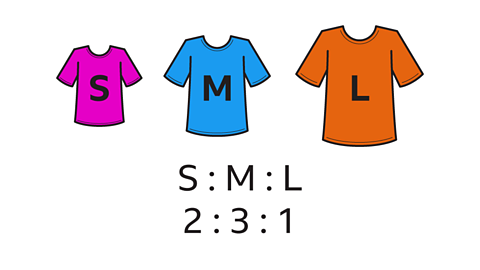
A part-to-part comparison. problems take different forms, which may include:
linking ratios and The result of one integer divided by another. It is written with one integer above the other with a horizontal line between them. The denominator must not be 0
part-part problems - where the value of one part of the ratio is given and the value of another ratio part has to be found
part-whole problems - where the value of one part of the ratio is given and the value of the whole has to be found
comparison problems - where the ratio and the difference between the values is given
problems where values change, giving a new ratio
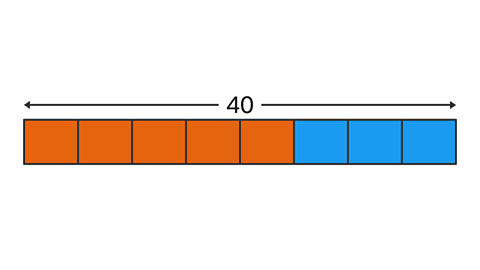
In order to solve ratio problems, an understanding of the structure of the problem is needed. A One or more rectangular bars drawn to represent information. may help to clarify this.
An understanding of equivalent ratios and simplifying ratios, as well as division in a given ratio is needed to solve ratio problems.
Solving problems involving ratios and fractions
To solve a problem involving ratios and fractions, you may be given the A part-to-part comparison. or the The result of one integer divided by another. It is written with one integer above the other with a horizontal line between them. The denominator must not be 0.
When given the ratio:
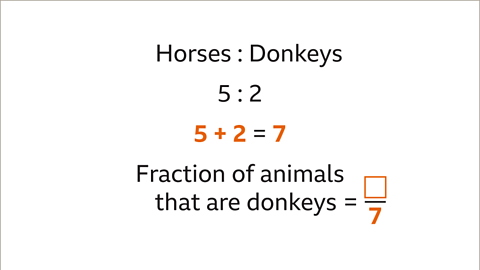
Add the ratio parts together to find the Number written on the bottom of a fraction. The denominator is the number of equal parts. Eg, for 1⁄3, the denominator is 3 of the fraction.
The Number written at the top of a fraction. The numerator is the number of parts used. Eg, for 1⁄3, the numerator is 1 of the fraction is the ratio part that is the focus of the question.
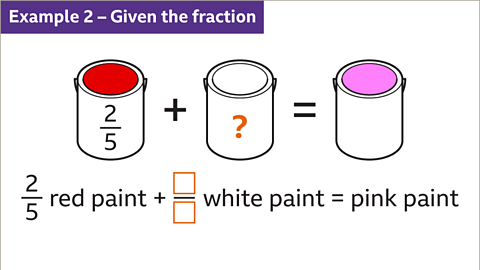
When given the fraction:
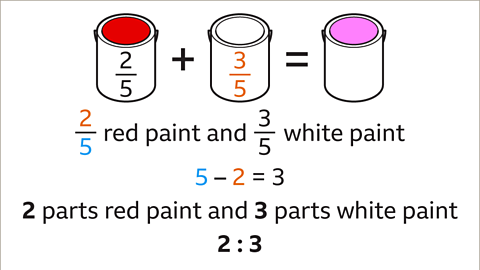
- The numerator of the fraction gives one of the ratio parts.
- Find the other ratio part by subtracting the numerator from the denominator.
- Write the ratio in the correct order.
Examples
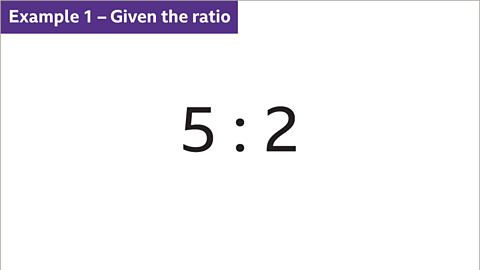
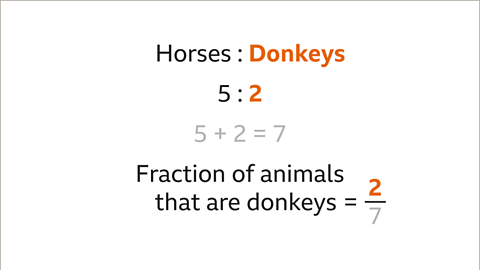
Image caption, The ratio of horses to donkeys at an animal sanctuary is 5 : 2. What fraction of the animals are donkeys?
1 of 5
Question
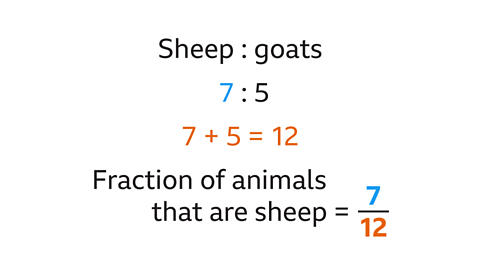
A farm has sheep and goats in the ratio 7 : 5 (sheep : goats). What fraction of the animals are sheep?
Add the ratio parts (7 and 5) to find the denominator of the fraction.
7 + 5 = 12. The denominator is 12
The numerator of the fraction is the ratio part that is the focus of the question (sheep). The numerator is 7
The fraction of animals that are sheep is \( \frac{7}{12} \)
Solving part-part and part-whole ratio problems
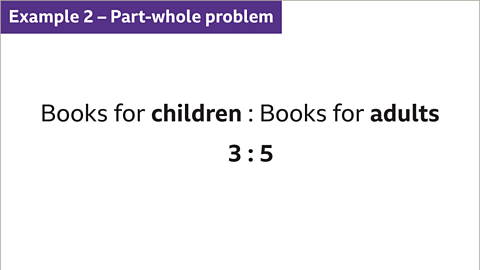
A part-part ratio problem is where the value of one part of the ratio is given and the value of another ratio part has to be found. A part-whole problem is where the value of one part of the ratio is given and the value of the whole has to be found.
Given a ratio and the value of one part of the ratio, find the value of another ratio part or the value of the whole.
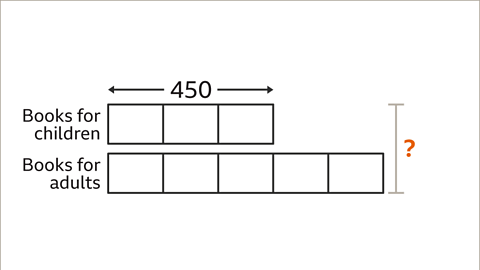
Draw a One or more rectangular bars drawn to represent information. split into the total number of parts. Label with the given information to represent the problem.
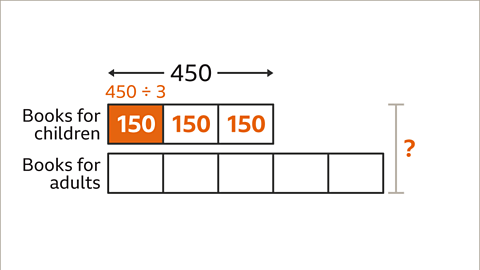
Find the value of one part by dividing the given value by the associated number of parts.
To find the value of another ratio part in a part-part problem, multiply the value of one part by the number of parts asked for.
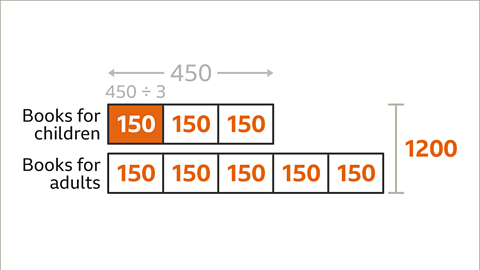
To find the whole in a part-whole problem, multiply the value of one part by the total number of parts.
Examples
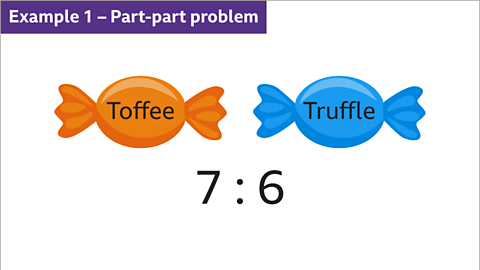
Image caption, A box contains toffees and truffles in the ratio 7 : 6. There are 24 truffles. How many toffees are there?
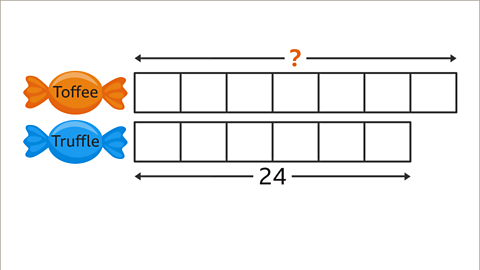
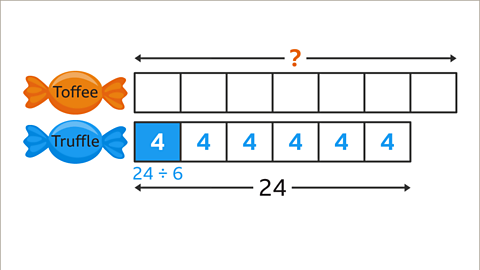
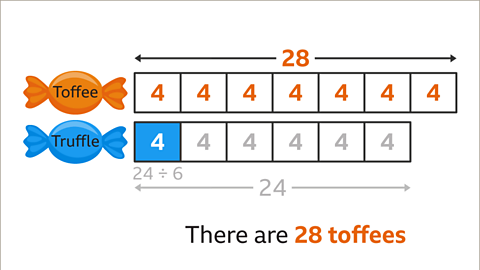
1 of 8
Question
The ratio of desserts to pizzas in a supermarket freezer is 4 : 3
There are a total of 620 desserts.
How many pizzas are in the freezer?
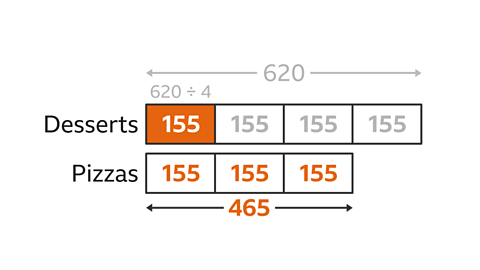
Draw a bar model to illustrate the problem. The ratio of desserts to pizzas is 4 : 3. Draw 4 parts for desserts and 3 parts for pizzas.
Label it to illustrate the problem. Label the dessert bar with 620. To find the number of pizzas in the freezer, work out the value of one part.
To find the value of one part, divide the share for desserts (620) by the number of parts (4). 620 ÷ 4 = 155. The value of one part is 155
Multiply the value of one part (155) by the number of parts asked for: pizzas (3). 155 x 3 = 465
The number of pizzas in the freezer is 465
Solving ratio problems involving comparisons
Some ratio problems involve a comparison between values. The comparison is the value difference between two parts of the ratio.
Given a ratio and a comparison between values:
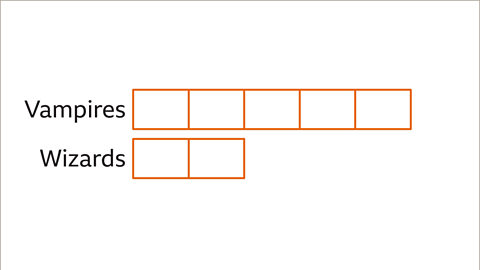
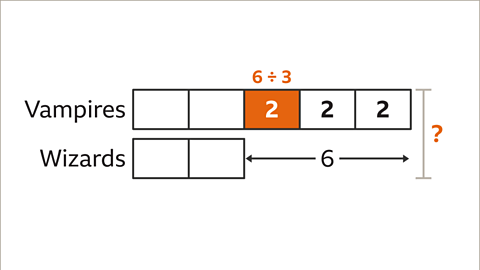
Draw a bar model to illustrate the problem.
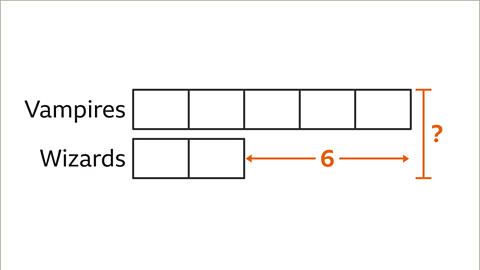
Label the given information.
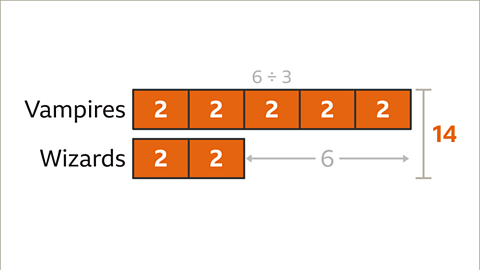
Find the value of one part by dividing the comparison value by the number of parts given.
Multiply the value of one part by the number of parts of the object of the question.
Examples
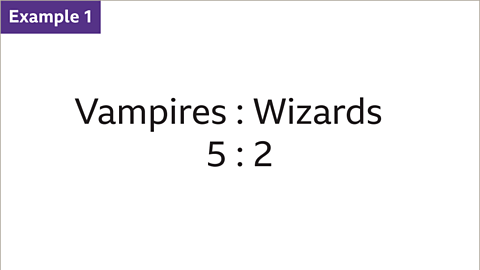
Image caption, Everyone at a fancy dress party is dressed up as either a vampire or a wizard. The ratio of people dressed as vampires to wizards is 5 : 2. If there are 6 more vampires than wizards, how many people are at the party?
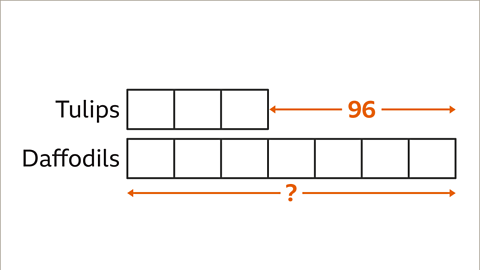
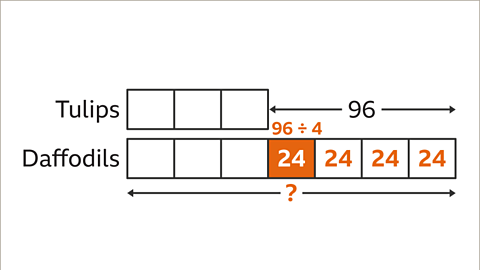
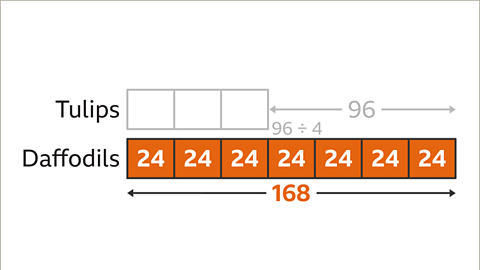
1 of 10
Question
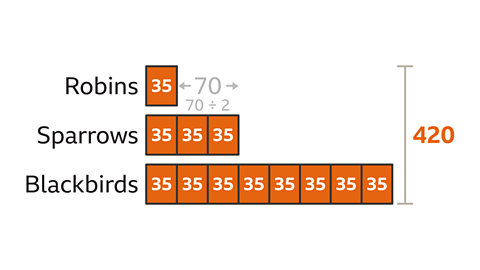
The ratio of the number of robins to sparrows to blackbirds in a survey of garden birds is 1 : 3 : 8 (robins : sparrows : blackbirds)
There were 70 fewer robins than sparrows. How many birds were observed in this survey?
Draw a bar model to illustrate the problem. The ratio of robins to sparrows to blackbirds is 1 : 3 : 8. There is 1 part for robins, 3 for sparrows and 8 for blackbirds.
Label the given information. There are 70 fewer robins than sparrows. This is the difference between the robins bar and the sparrows bar. To find the total number of birds in the survey, the value of one part needs to be found.
To find the value of one part, divide the difference value (70) by the number of parts that make up the difference (2). 70 ÷ 2 = 35. The value of one part is 35
Multiply the value of one part (35) by the number of parts asked for (all the parts, 12). 35 x 12 = 420
Solving ratio problems with changing amounts
Given a ratio and total amount, find the new changing amounts and find the new ratio:
A total amount and ratio is given. Draw a bar model to illustrate this starting information.
Divide the total amount in the initial ratio.
- Find the value of one part by dividing the total amount by the sum of the parts.
- Multiply the value of one part by the number of parts for each share of the ratio.
Adjust the shared amounts according to the given information in the question.
Write the new amounts as a ratio and simplify, if necessary, by dividing the parts by their The largest factor that will divide into the selected numbers. Eg, 10 is the highest common factor of 30 and 20. Highest common factor is written as HCF. (HCF).
In this example, you need to be able to divide in a given ratio and simplify ratios.
Example
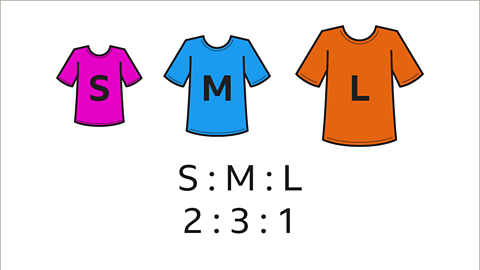
Image caption, A market stall has 60 T-shirts. The ratio of small, medium and large T-shirts being sold on the stall is 2 : 3 : 1. The stallholder sells 26 medium and 2 large T-shirts. What is the ratio of small, medium and large T-shirts now?
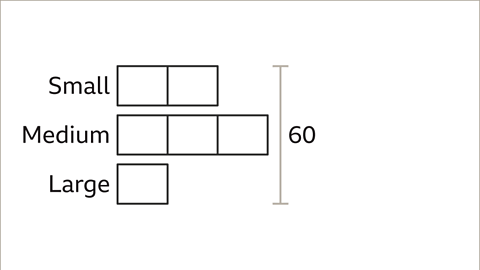
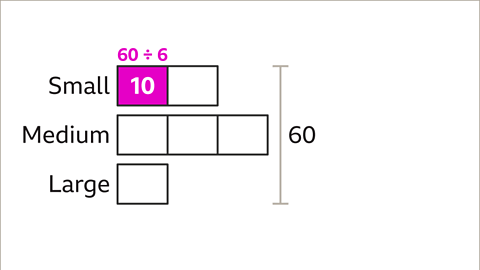
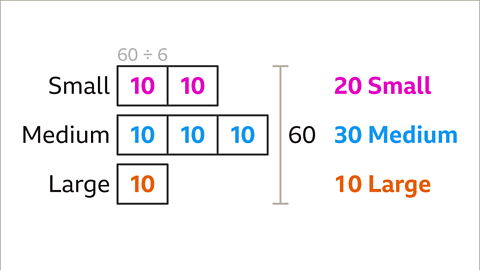
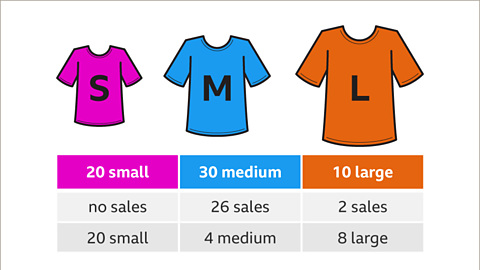
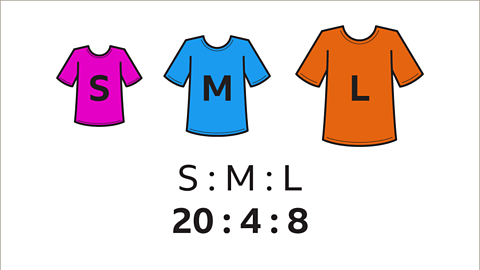
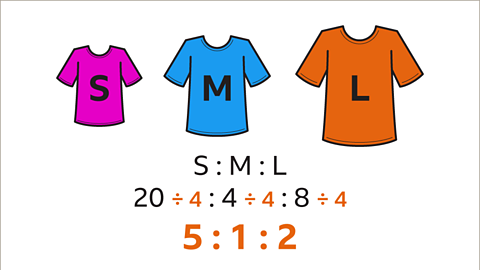
1 of 7
Question
There are 55 big cats in a safari park.
The ratio of lions to tigers is 3 : 2
12 lion cubs and 5 tiger cubs are born. What is the ratio of lions to tigers now?
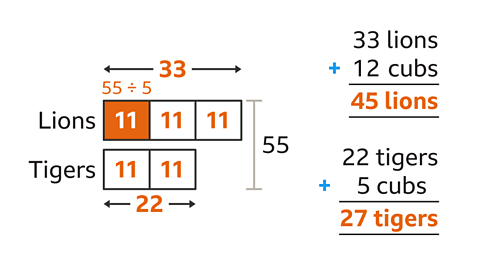
A total amount and ratio is given. Draw a bar model to illustrate this starting information. Draw 3 parts for lions and 2 parts for tigers, with a total of 55
Divide the total number of big cats (55) in the ratio 3 : 2. To find the value of one part, divide the amount (55) by the total number of parts (5). 55 ÷ 5 = 11. The value of one part is 11. Multiply one part by the number of parts for each big cat. There are 11 × 3 = 33 lions. There are 11 × 2 = 22 tigers.
Adjust the shared amounts according to given information in the question. After the cubs have been born there are 33 + 12 = 45 lions and 22 + 5 = 27 tigers.
Write the new shares as a ratio and simplify. The new ratio of lions to tigers is 45 : 27. This ratio can be simplified by finding the HCF of 45 and 27. This is 9. Divide each ratio share by 9. The ratio simplifies to 5 : 3
The ratio of lions to tigers is now 5 : 3
Game - Comparing ratios, fractions and percentages
Try out these comparing ratios, fractions and percentages puzzles from our maths game Divided Islands.


Play the full Divided Islands game.
Practise solving ratio problems
Quiz
Practise solving ratio problems in this quiz. You may need a pen and paper to complete these questions.
Real-world maths

Ratio problems occur in many different contexts.
Successful cookery relies on the ratio of the ingredients used. For example:
To make meringues, you need a ratio of 2 parts sugar to 1 part egg white.
To make Yorkshire puddings, you need equal amounts of egg, flour and milk (and a pinch of salt). The ratio of egg, flour and milk is 1 : 1 : 1
In construction, fencing companies use a fixed ratio of concrete mix to water to secure fence posts. For a given amount of concrete mix, the amount of water needed is worked out. This is a part-to-part ratio problem.
Play Sudoku with BBC Bitesize!
Every weekday we release brand new easy, medium and hard Sudoku puzzles. Perfect for testing your skill with numbers and logic.

More on Ratio
Find out more by working through a topic
- count4 of 5
- count5 of 5
- count1 of 5
- count2 of 5