How do you work scientifically?
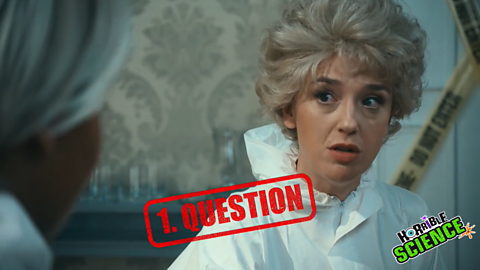
When working scientifically and before we carry out an experiment, it is good to think about what things might happen and why.
There are three things you need to consider when starting a scientific investigation:
You need to ask a question about what you want to find out.
Think of a hypothesis, which is a suggestion to the solution of the problem.
Make a prediction , which is a scientific guess based on what we already know about what will happen when the hypothesis is tested.
Once you've carried out your experiment, you can use your data to present your results and write a conclusion to sum up what you have found out.
Watch: Theory, Law and Order
Find out what skills you need to solve a scientific investigation.
Jenkins: I'm so excited to be a forensic scientist and learn from the best.
Boss: Not as glamorous as you might think. I mean, that is one of the most grotesque dead bodies I've ever seen.
Mrs Black: I beg your pardon?
Jenkins: It's her husband who died, boss.
Boss: Ah, erm… I'm sorry for your face. I mean, your loss. OK Jenkins, to crack this case, we need to work scientifically. So we need to start with a question.
Jenkins: What killed him?
Boss: Yes, and I have a hypothesis.
Jenkins: And what is it?
Boss: It's a suggestion of what might be the solution to the problem.
Jenkins: No, I know that. I mean, what is YOUR hypothesis?
Boss: Well, um, he was poisoned, possibly using a vial of blue liquid like the one that suspicious looking chambermaid is holding.
Chambermaid: Who me? I'm just cleaning up.
Jenkins: Should we hold her for questioning?
Boss: Shh. No. We can't just go around arresting people because they're holding a possible murder weapon at a murder scene, Jenkins. We have a method to follow. Now we have our hypothesis, we're going to make a prediction,
Jenkins: And that is?
Boss: Scientific guess based on the things we know about what will happen when the hypothesis is tested.
Jenkins: I meant what is YOUR prediction?
Boss: Oh well, I predict if we test the blue liquid oozing from the victim's mouth, we'll find traces of poison that matched the vial of liquid that the chambermaid just hid behind the fruit bowl before she started crawling towards the window.
Chambermaid: Ignore me. So many fingerprints on this floor.
Boss: Stop right there!
You've dropped your copy of How To Poison People Beginner's Guide To Poisoning People With Poison.
Chambermaid: Merci. I was looking for this.
Boss: Okay Jenkins, we're going to test our hypothesis and see if the result matches our prediction. You do the mouth, I'll do the bottle.
If both cotton buds turn pink, we'll have proof we were right.
Chambermaid: Oh no, they've got me.
Boss: So we should have a result in around… er… 12 to 14 minutes.
Mrs Black: That long?
Chambermaid: So long suckers!
(smashing window)
Chambermaid (off screen) YOU'LL NEVER GET ME NOW!
Jenkins: The liquid from his mouth matches the liquid from the bottle. Your prediction was right. Mr Black was poisoned. So what's the conclusion?
Boss: It's a summary of what we've learned.
Jenkins: I mean, what is YOUR conclusion, based on the evidence?
Boss: The suspicious looking chambermaid with the poison and the book about how to poison people, must be the poisoner.
It's always the ones you least expect.
How do scientists measure things?
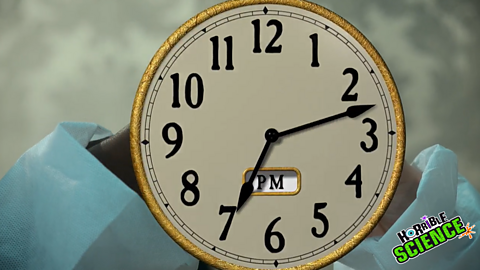
When working scientifically, scientists will measure things.
This can include working out how heavy things are, how long something is, or the amount of time it takes for something to happen.
Scientists will use a range of equipment.
To measure temperature, they use a thermometer.
To measure length, they will use a ruler.
To measure how long it takes for something to happen, they will use a timer.
To measure weight of something, they will use scales.
It’s very important to use units such as grams (g), centimetres (cm), seconds, minutes, or hours.
This is to make sure your results are accurate and easy to understand.
Horrible Science fact
Sir Francis Bacon is often credited with being the first person to talk about the scientific method in 1620.
You can learn more about him here.
Quiz: Hypothesis - Theory, Law and Order
How to use Horrible Science in the classroom
If you're looking to bring energy, humour and curriculum-aligned content into your science lessons, Horrible Science might just be your new secret weapon.

More on Horrible Science
Find out more by working through a topic
- count21 of 22
- count22 of 22
- count1 of 22