Who was Francis Bacon?

Francis Bacon was born in 1561 in London.
He believed that science was key to technological progress.
He developed a way of working scientifically called the Baconian Method. He believed in careful observation and reasoning to help build true knowledge.
Horrible Science fact
Francis Bacon was one of the first people to start working scientifically and testing things, rather than just announcing his ideas were definitely true because he thought he was a clever clogs.
You can learn more about how to work scientifically here.
Video
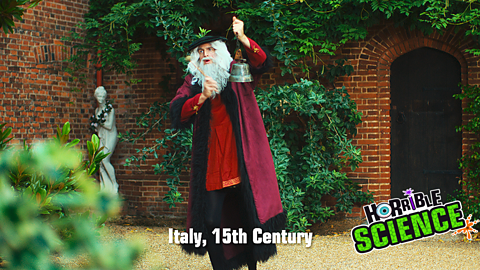
Find out if snow can really preserve food with Francis Bacon in this clip.
DR WITHERBORNE: Hope this party has food. The meat last week was too salty wasn’t it? it’s the way it’s preserved, stops it from going off. Nothing we can do about it.
FRANCIS: Aha! Or is there? Dr Witherborne, you’re a genius. Read that.
DR WITHERBORNE: Fnow reserve poo’d?
FRANCIS: Snow preserves food.
DR WITHERBORNE: It definitely says poo’d.
FRANCIS: Carriage, makes it very hard to write. I believe that snow could preserve food just as well as salt. Why? Keeping it cold.
DR WITHERBORNE: Well, if a great thinking like Francis Bacon thinks it’s true, then it must be.
FRANCIS: No! That’s the old way of thinking! A theory isn’t true just because someone clever says it is.
DR WITHERBORNE: What? Then how do we know something’s true?
FRANCIS: By testing the theory, see if it works in the real world! It’s called experimentation heard of it? I must stuff a chicken with snow to prove my theory works!
DR WITHERBORNE: But maybe tomorrow, you know after the party.
FRANCIS: No, it’s snowing now. It’s time for science.
BRING ME A CHICKEN!
DR WITHERBORNE: He’s a smart guy, I’m sure he knows what he’s doing.
FRANCIS: G-g-good evening. I am the great Francis Bacon. I demand you give me a raw chicken, immediately!
COTTAGE WIFE: It’s Francis Bacon and he needs a chicken dear!
COTTAGE HUSBAND: Ah right, then we better get him one.
COTTAGE WIFE: Hungry are you dear?
FRANCIS: No, but I shall be in a week!
COTTAGE WIFE: That chicken will have gone off by next week!
FRANCIS: Aha, but I p-predict that this snow will perfectly preserve the chicken and stop it from going off.
COTTAGE WIFE: It’d better, or you’ll be on the toilet for a month!
FRANCIS: Very good, thank you!
COTTAGE HUSBAND: Won’t he get cold out there stuffing that chicken with snow?
COTTAGE WIFE: He’s a smart man, I’m sure he knows what he’s doing!
DR WITHERBORNE: Hello Francis, how are you feeling?
FRANCIS: Fantastic! My experiment succeeded excellently well, take a bite! The snow preserved the raw chicken to perfection. My theory was correct.
DR WITHERBORNE: Are you sure you’re okay?
FRANCIS: Oh no, on a personal level this has been a complete disaster for me. Yeah, I’ve caught a terrible chill from the cold. But I proved my point, that chicken is good to eat now even days later. In fact maybe I am feeling a bit better, who’s up for a chicken sandwich.
DR WITHERBORNE: Oh, such a shame, the snow saved the chicken, bit it couldn’t save the Bacon.
How can food be preserved?

When food is preserved it can last longer and prevent germs entering the food.
Francis Bacon's theory about using the snow to preserve the chicken was correct. The colder temperature helped to preserve the chicken as is helped slow down or stop the growth of germs.
Today, we can use a freezer or fridge to help us preserve our food and make it last longer - much easier than waiting for it to snow!
Other ways to preserve food
Salt - Salt is still used today to preserve food. The salt draws out the water in the food and stops the germs from growing. This is done either by rubbing salt onto the food or mixing salt with water to make brine for food to be stored in.
Canning and vacuum packing - Storing food in cans or vacuum packed bags which are both airtight containers and help to stop germs growing.
Drying - Removing water from the food can prevent the germs from growing. People have used the sun to dry out fruit, vegetables and meat for centuries.
Fermentation - This process is used to preserve cheese, yoghurts and vegetables.
Quiz: Francis Bacon
How to use Horrible Science in the classroom
If you're looking to bring energy, humour and curriculum-aligned content into your science lessons, Horrible Science might just be your new secret weapon.

More on Horrible Science
Find out more by working through a topic
- count1 of 22
- count2 of 22
- count3 of 22
- count4 of 22