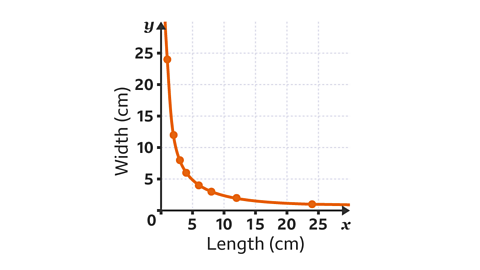
Key points

If two quantities are inversely proportional, one increases as the other decreases at the same rate. If one quantity doubles, the other one halves. For example, more workers on a job would reduce the time to complete the task. They are inversely proportional.
Two variables multiply to give a fixed product. When one variable doubles, the other halves. is written using the Used to signify that one variable is proportional to another. For example the number of chocolate bars (b) is directly proportional to their cost (C) can be written as b ∝ C .. For example, if two A quantity that can take on a range of values. \(x\) and \(y\) are inversely proportional to each other, then this statement can be represented as \(x\) ∝ \( \frac{1}{y} \)
When the proportionality symbol (∝) is replaced with an equals sign (=), the equation is \(x = k y\). The constant value (often written as \(k\)) relates to the amounts that increase or decrease at the same rate.
Inverse proportion problems can be solved by using the The fixed value of the product of two inversely proportional variables. For example, two people working for 9 hours and three people working for 6 hours will work the same total of hours (2 × 9 = 18 and 3 × 6 =18).. This is the fixed product of each pair of variables. The constant of proportionality is divided by the known quantity to find the missing quantity.
How to decide whether two variables are inversely proportional
To decide if two A quantity that can take on a range of values. are inversely proportional, check for the following:
As one quantity increases, the other quantity decreases in the same proportion.
As one quantity decreases, the other quantity increases in the same proportion.
The quantities have a fixed The result of multiplying one number by another, eg the product of 4 and 5 is 20 since 4 × 5 = 20. This is known as the The fixed value of the product of two inversely proportional variables. For example, two people working for 9 hours and three people working for 6 hours will work the same total of hours (2 × 9 = 18 and 3 × 6 =18)..
Examples
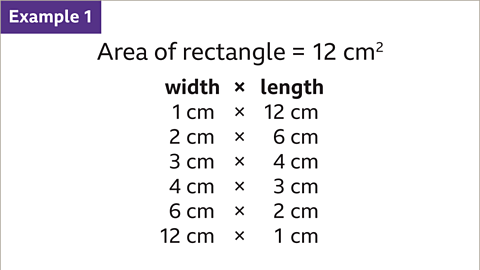
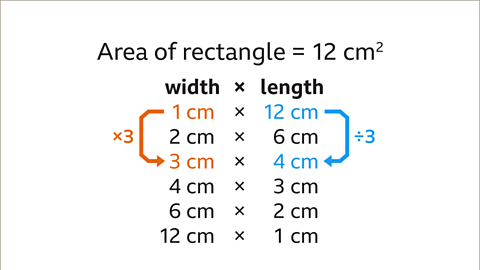
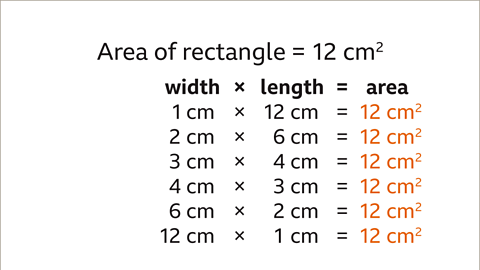
Image caption, Explain why the width and length of rectangles with a fixed area of 12 cm² are inversely proportional.
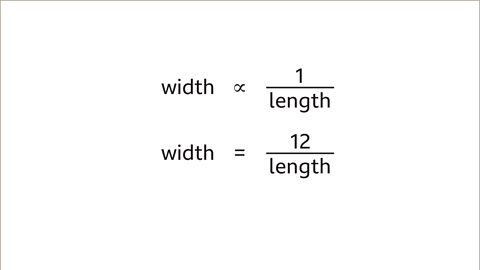
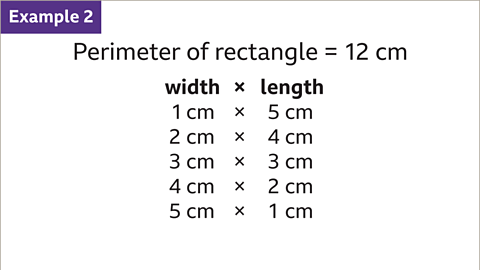
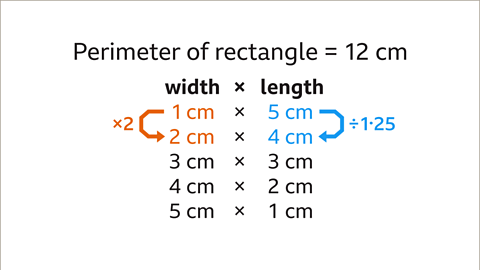
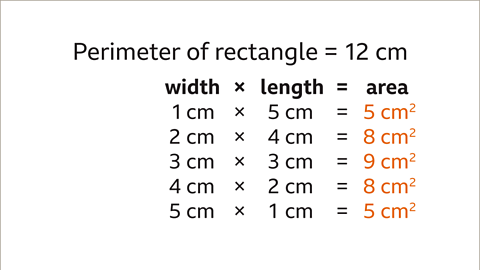
1 of 7
Question
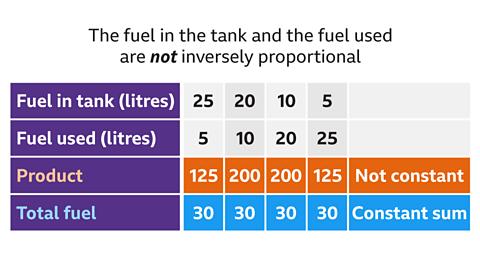
Explain why the amount of fuel in a tank and the amount of fuel used are not inversely proportional.
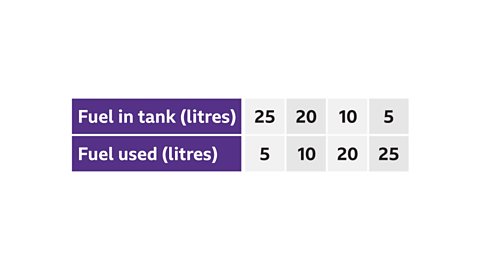
When the amount of fuel in the tank halves from 10 litres to 5 litres, the amount of fuel goes from 20 litres to 25 litres.This is × 1۰25, not double.
Two quantities are inversely proportional if the quantities have a fixed product. This means every pair of values must give the same product to be inversely proportional.
While the fuel in the tank and the fuel used adds up to a fixed amount (otherwise known as a constant sum), this is not the same as a fixed product. This means the fuel in the tank and fuel used are not inversely proportional.
Solving inverse proportion problems using multiplicative reasoning
Working flexibly with the concepts, strategies and representations of multiplication (and division) as they occur in a wide range of contexts. involves using multiplication and division to find other values. To use this method:
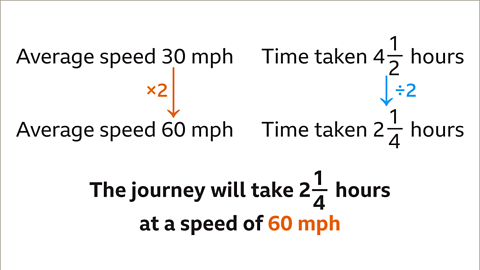
Look for multiplicative links. Find a multiplication relationship (number of times greater) or division relationship (number of times smaller).
Repeat the same multiplication or division on the other A quantity that can take on a range of values. .
Examples
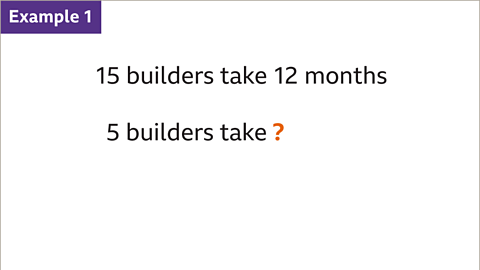
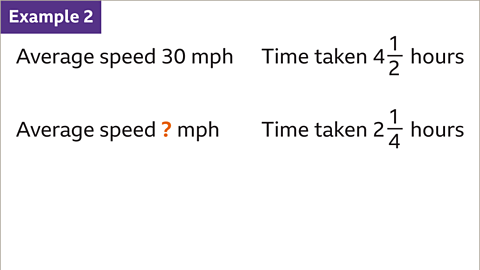
Image caption, The number of builders and the time they take to build houses are inversely proportional. It takes 15 builders 12 months to build the houses. How long would it take 5 builders to build the houses?
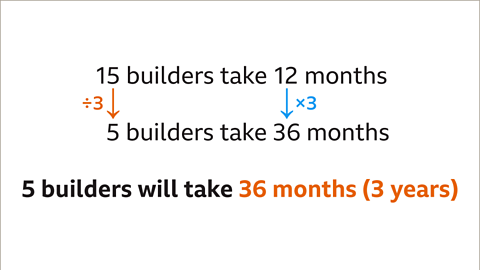
1 of 4
Question
5 workers would take 108 hours to complete a job. The firm wants to complete the job in a shorter time. How long will the job take to complete if they have 9 workers?
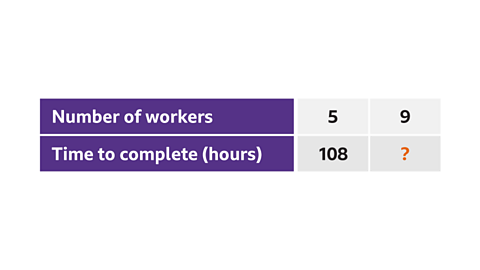
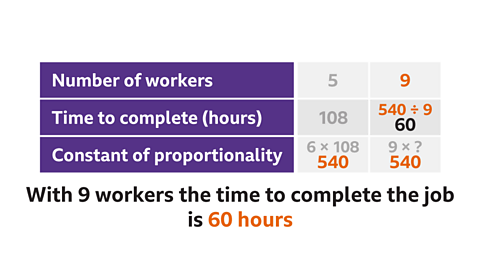
- Find the constant of proportionality by multiplying the given pair of quantities: number of workers (5) multiplied by hours to completion (108).
5 × 108 = 540
The constant of proportionality is 540, which is the total number of hours it will take for the workers to complete the job.
- Divide the constant of proportionality (the total worker-hours, 540) by the known quantity (number of workers, 9) to find the missing quantity.
540 ÷ 9 = 60
With 9 workers the job can be completed in 60 hours.
Solving inverse proportion problems: constant of proportionality
Two variables multiply to give a fixed product. When one variable doubles, the other halves. problems can be solved by using the The fixed value of the product of two inversely proportional variables. For example, two people working for 9 hours and three people working for 6 hours will work the same total of hours (2 × 9 = 18 and 3 × 6 =18).. This is the fixed product of each pair of variables.
Constant of proportionality method:
Find the value of the constant of proportionality by multiplying a given pair of variables.
Divide the constant of proportionality by the known quantity to find the missing quantity.
Examples
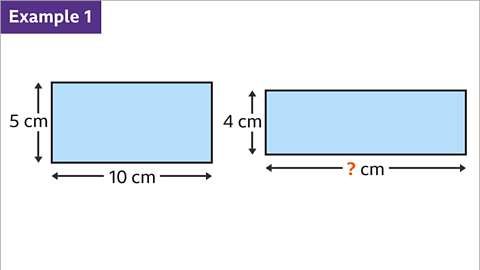
Image caption, The rectangles have equal areas. The width and length of rectangles with equal areas are inversely proportional. Find the missing length.
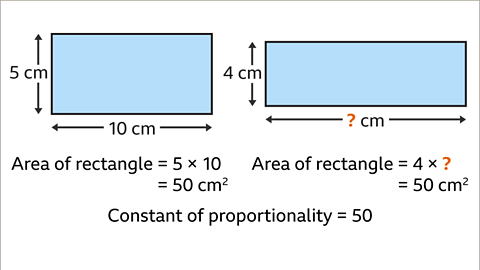
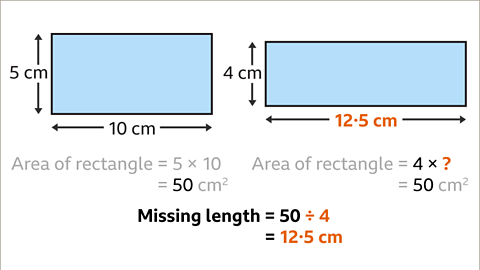
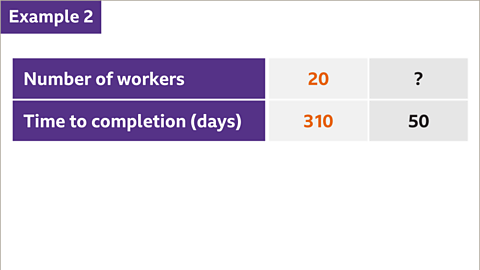
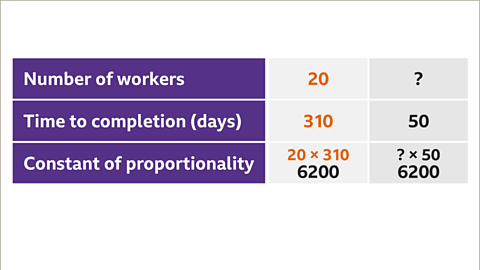
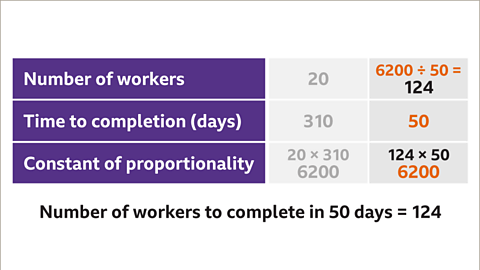
1 of 6
Question
Two rectangles have equal areas. The width of the rectangles are inversely proportional to their lengths. Given that one rectangle measures 600 mm by 15 mm and the second rectangle has one side length of 100 mm, find the width of its other side.
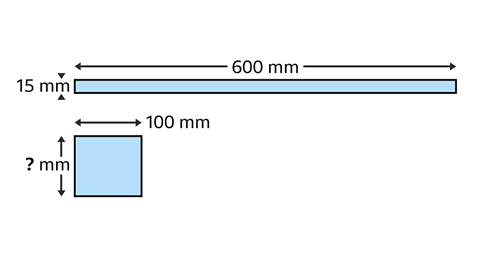
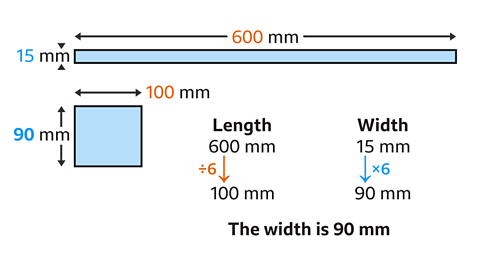
The widths of the rectangles are inversely proportional to their lengths.
600 mm has been divided by 6 to give 100 mm.
The inverse of dividing by 6 is multiplying by 6
15 mm is multiplied by 6
15 × 6 = 90
The width of the second rectangle is 90 mm.
Practise ratio and inverse proportion
Practise ratio and inverse proportion with this quiz. You may need a pen and paper to help you work things out.
Quiz
Real-world maths

Inverse proportion may be used by a construction company. The more builders, the faster a building project will be completed.
More workers also means more costs, but when a builder has to meet a set deadline they will employ more people to complete the job on time. This is so that they do not have to pay a penalty for completing the job late.
Play Sudoku with BBC Bitesize!
Every weekday we release brand new easy, medium and hard Sudoku puzzles. Perfect for testing your skill with numbers and logic.

More on Direct and inverse proportion
Find out more by working through a topic
- count4 of 4
- count1 of 4