What are forces?
A force is a push or a pull. For example, when you push open a door you must apply a force to the door. You also must apply a force to pull open a drawer.
You cannot see a force but often you can see what it does. When a force is exerted on an object, it can:
- make it start moving
- make it speed up (acceleration)
- make it slow down (deceleration / retardation)
- make it stop moving
- change its direction
- change its shape (for example, an elastic band gets longer if you pull it)
Forces can be contact forces, where objects must touch each other to exert a force. These include:
- friction
- tension (for example, the pull of a stretched rubber band trying to return to its original length)
- reaction force (for example, the upward force on your feet when you stand on the ground)
Other forces are non-contact forces, where objects do not have to touch each other. These include:
- gravity
- magnetism
- forces between charged particles
Measuring forces
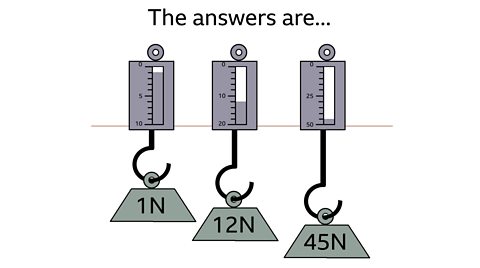
A newton spring balance, also called a newton meter, is used to measure forces.It contains a spring connected to a metal hook. The spring stretches when a force is applied to the hook. The bigger the force applied, the longer the spring stretches and the bigger the reading.
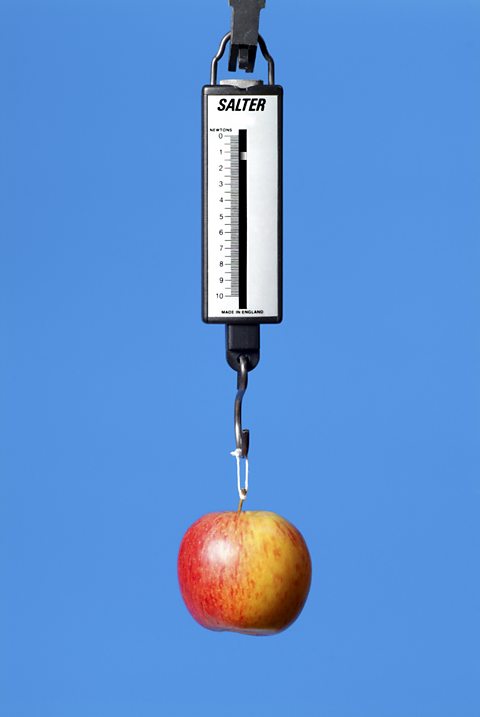
The newton spring balance reads 1N.
One newton is the force needed to lift an average sized apple up from the ground.
The unit of force is called the newton, and it has the symbol N. The newton was named for Sir Isaac Newton, the famous English physicist and mathematician. He is most famous for his three laws of motion which resulted in his explanation of the force of gravity.
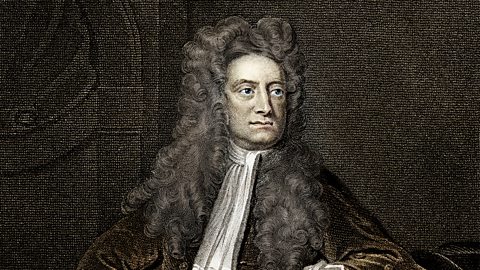
Find out more about Sir Isaac Newton here:
(http://teach.files.bbci.co.uk/terrificscientific/SirIsaacNewtonContentPack.pdf "More on Sir Isaac Newton")
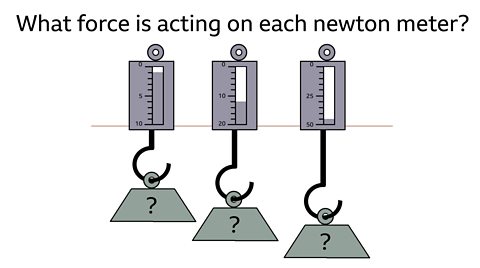
Question
Balanced forces
When two forces acting on an object are equal in size but act in opposite directions, we say that they are balanced forces. The forces simply cancel each other out, and the overall effect is just the same as if no force was acting on the object.The overall force acting on the object is called the resultant force. If the forces are balanced, the resultant force is zero.If the forces on an object are balanced this is what happens:
- a stationary object stays still
- a moving object continues to move at the same constant speed and in the same direction
Remember that an object will keep moving, even if the forces acting on it are balanced or there are no forces acting on it.
Force diagrams
We can show the forces acting on an object using a force diagram like the one above. In a force diagram, an arrow represents each force. The arrow shows:
- the size of the force (the longer the arrow, the bigger the force)
- the direction in which the force acts
The arrow should be labelled with the name of the force and its size in newtons.
In the diagram above the forward thrust from the engine is balanced by the air resistance or drag. The resultant force is zero. Since the resultant force acting on this moving car is zero it will continue to move at a constant speed in the same direction.
Here are some other examples of situations involving balanced forces.
Hanging objects
The forces on this hanging crate are equal in size but act in opposite directions. The weight pulls down and the tension in the rope pulls up. The resultant force acting on the crate is zero.
Floating in water
Objects float in water when their weight is balanced by the upthrust from the water. The object will sink until the weight of the water it pushes out of the way is the same as the weight of the object. The resultant force on the boat is zero.
Standing on the ground
When an object rests on a surface such as the ground or a tabletop, the upwards reaction force from them balances its weight. The ground or table pushes up against the object. The reaction force is what you feel in your feet as you stand still. Without this balancing force you would sink into the ground or the book would sink through the table.
The 5 N weight of the book acting downwards is balanced by the 5N reaction force from the table acting upwards on the book. The resultant force acting on the book is zero.
Unbalanced forces
When two forces acting on an object are not equal in size, we say that they are unbalanced. The resultant force is no longer zero.If the forces on an object are unbalanced, this is what happens:
- a stationary object starts to move in the direction of the resultant force
- a moving object changes speed and/or direction in the direction of the resultant force
In the example below, the resultant force is the difference between the two forces:Resultant force = 100 – 60 = 40 NResultant force = 40 N to the right
The change in the motion of an object depends upon:
- the size of the resultant force
- the direction of the resultant force
The greater the resultant force, the greater the change in the motion of the object.Whether a moving object speeds up, or slows down, depends on the direction of the resultant force:
- the object speeds up if the resultant force acts in the direction of movement
- the object slows down if the resultant force acts opposite to the direction of movement
The car in the diagram below is moving to the left when unbalanced forces of 4000 N and 1000 N act on it.
The resultant force acting on the car = 4000 – 1000 = 3000 N to the left.Since the car was already moving to the left, the resultant force acting to the left will cause it to speed up or accelerate to the left.
The car continues to move to the left. The thrust from the engine remains 4000 N but brakes are applied and the total backward force is now 7000 N.
The resultant force acting on the car = 7000 – 4000 = 3000 N to the right
Since the car was moving to the left, the resultant force acting to the right will cause it to slow down or decelerate while continuing to move to the left, until it stops.
Summary: Forces
- A force is a push or a pull
- Force is measured with a newton spring balance
- Force is measured in newtons, N
- Forces can be contact e.g. friction
- Forces can be non-contact e.g. gravity
- The force needed to lift an apple upwards is approximately 1 N
- Resultant force is the overall force acting on an object
Frictional forces
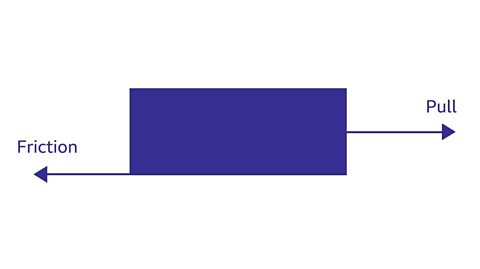
Friction is a force which always acts to oppose the motion of an object.Friction always acts to stop an object from starting to move or to slow down a moving object. It can be a help or a hinderance.
Helpful frictional forces
Friction can be useful. For example:
- friction between our shoes and the floor help us walk and stop us from slipping
- friction between tyres and the road stop cars from skidding
- friction between the brakes and wheel help bikes and cars to slow down
- friction between our hands warms them when we rub them together
- friction between a pencil lead and paper lets us write and draw
Frictional forces are much smaller on smooth surfaces than on rough surfaces, which is why we slide on ice but not on concrete.
Unhelpful frictional forces
Friction can also be unhelpful. If you do not lubricate your bike regularly with oil, the friction in the chain and axles increases. Your bike will be noisy and difficult to pedal. If a door hinge squeaks, the noise is a result of friction. A fried egg sticks to a pan because of friction.When there is a lot of friction between moving parts, energy is transferred to the surroundings, as heat energy. Rubbing your hands together quickly heats them up. In trying to overcome the friction between our hands some kinetic energy is converted to heat energy which warms them up.
Air resistance
Friction caused by air is called air resistance or drag.
Bikes, cars and other moving objects experience air resistance as they move through the air. Air resistance is caused by the frictional force of air against the vehicle. The faster the vehicle moves, the bigger the air resistance becomes. The top speed of a vehicle is reached when the force from the cyclist or thrust from the engine is balanced by air resistance.
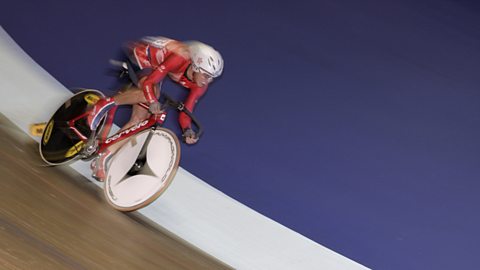
Racing cyclists crouch down low on their bikes to reduce the air resistance on them. This helps them to cycle faster. They also wear streamlined helmets. These have special, smooth shapes that allow the air to flow over the cyclist more easily.
Modern vehicles are also streamlined. Their smooth shapes make the air resistance smaller, which allows them to travel further on the same amount of fuel.
Ways of increasing friction include:
- grit on icy roads
- tread on car tyres
- grooves on the soles of shoes
- gymnasts apply powdered chalk to their hands or grips so that they do not slip
- studs on football boots

Ways of reducing friction
| Method | How it helps | Example |
|---|---|---|
| Lubricate with oil or grease | Makes the surfaces smoother | Bicycle chain, frying pan, baking tray |
| Polishing | Makes the surfaces smoother | Bowling alley, ice in front of a curling stone |
| Streamlining | Smooth shape allows air to flow around an object more easily | Crouched racing cyclist, smooth, tapered helmet, high speed racing cars, jet aircraft |
| Cushion of air between surfaces | Separates the surfaces | Hovercraft, air track, air hockey |
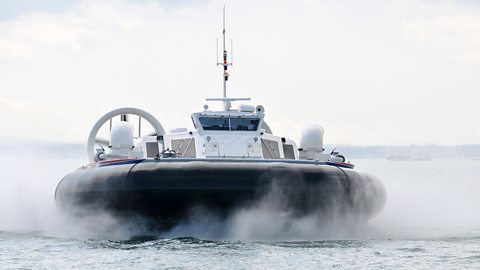
The hovercraft was invented by Sir Christopher Cockerell, who, in coming up with the design,experimented with vacuum cleaner tubes and empty cat food and coffee tins. The air cushion separates the hovercraft from the water surface, reducing friction
What causes friction?
A surface may appear to be smooth, but when examined under a microscope, surfaces appear rough with many bumps and hollows. Friction is caused in part by the tiny bumps and hollows on surfaces as they rub against each other. The bumps on one surface interlock with the hollows on the other making it hard for the surfaces to slip over each other.
This explains why polishing and lubricating surfaces reduces friction. Polishing helps to flatten out the bumps and hollows, while oil or grease helps to lift the top surface off the bottom surface by filling the gaps in between. As a result, the surfaces move over each other more easily.
Friction is also due to attraction between molecules making up the two surfaces, so that there is friction between even extremely smooth surfaces. When the surfaces move, the molecules need to be torn away from each other and we experience this as friction.
Investigating friction
This is an example of a common experiment used to investigate friction and should help you understand how to work scientifically.
To investigate the frictional forces on a mass being pulled down a slope of different steepness.
Method
- Set up the apparatus as shown in the diagram.
- Pull the mass along the ramp using the newton spring balance.
- Record the force that is needed to make the mass start to move (this will be more than the force to pull it along once it is moving).
- Increase the height of the ramp to 10 cm to make the gradient steeper.
- Measure the force and record results.
- Repeat by moving the ramp up in 10 cm intervals until 50 cm is reached.
Variables
- The independent variable is the height of the ramp (changing the height changes the gradient).
- The dependent variable is the force needed to make the mass start to move.
- Controlled variables include using the same mass, newton spring balance and ramp surface.
Risks
Care must be taken with masses.
Expected results
| Height of ramp / cm | Force needed / N |
|---|---|
| 10 | 21 |
| 20 | 16 |
| 30 | 10 |
| 40 | 5 |
| 50 | 2 |
What the results mean
The force needed to make the mass start to move reduced as the ramp became steeper (the gradient increased). The force of friction decreases when the ramp gets steeper.
Remember
- Your measurements are accurate if they are close to their true value.
- Your measurements are precise if they are similar when completed again.
- Your experiment is repeatable if you get precise measurements when it is repeated.
- Your experiment is reproducible if others get precise measurements when they repeat it.
Friction and our joints
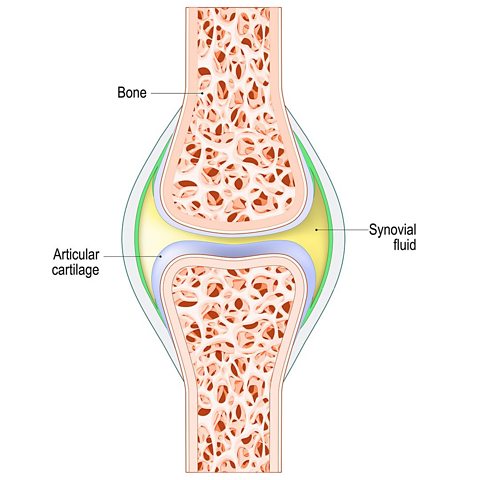
A joint is a point in the body where two or more bones connect so that we can have moving body parts. The adult human body contains 206 bones and approximately 300 joints. Friction between the bones in a joint could be a big problem, but the body has ways of limiting the harmful effects.
Synovial fluid acts as a lubricant to decrease friction between bone surfaces in the majority of our joints, for example, shoulders, knees, knuckles and elbows. It is a very thin layer of a slippery, sticky joint fluid, and it separates and lubricates the bone surfaces. A healthy knee joint has about 4 ml, slightly less than a teaspoon, of synovial fluid.
In addition, where the bones meet to form the joint, the bones' surfaces are covered with a thin layer of strong, smooth cartilage. This acts with the synovial fluid to reduce friction and to stop the bone ends wearing away over time.
Summary: Friction
- Friction is a force which always acts to oppose the motion of an object
- Friction can be helpful – it helps us walk
- Friction can be a hinderance – it wears down the soles of shoes
- Friction caused by air is called air resistance or drag
- Friction can be reduced by lubricating, polishing, reducing surface area, streamlining and separating surfaces with a cushion of air
Gravity
Gravity is the force of attraction which acts between all objects that have mass.
It is an invisible force, pulling all objects with mass toward each other. The Earth's gravity is what keeps you on the ground and what makes things fall.
The size of the force of gravity between two objects depends on two things:
- the mass of each object - the bigger the mass the bigger the force gravity
- the distance between the objects - the smaller the distance between the objects the bigger the force gravity. Gravity gets weaker as distance increases
Although every object (including you!) has a gravitational pull, it is only really seen in action if one of the objects is really, really massive. The Earth, for example, is big enough to have sufficient gravity to pull you down and to hold the Moon in its orbit. The Sun is massive enough to keep the planets in orbit.

Albert Einstein described gravity as a curve in space that wraps around an object—such as a star or a planet. The more massive the object, the greater the curve in space. If another object is nearby, it is pulled into the curve.
Gravity is everywhere
The force of gravity acts across the entire universe.
- Gravity holds the planets in orbit around the Sun.
- Gravity keeps the moon in orbit around Earth.
- Gravity holds down our atmosphere and the air we need to breath.
- The gravitational pull of the moon pulls the water in seas and oceans towards it, causing the tides – you can find out more about the tides here.
- Gravity causes stars and planets to form by pulling together the material from which they are made.
- Gravity not only pulls on mass but also on light.
- Black holes have so much mass in such a small volume that their gravity is strong enough to keep everything, including light from escaping. Since no light escapes, they cannot be seen and that is why they are called black holes.
The gravitational force always pulls towards the centre of any object. So, we are always pulled by gravity towards the centre of the Earth.
The force of gravity between an object and the Earth isn’t quite the same everywhere on Earth.
The force of gravity on the top of a mountain is slightly less strong than at the bottom.
The distance from the centre of the Earth is greater on top of the mountain and gravity gets weaker as distance increases. So, the force of gravity is slightly less on top of Slieve Donard than at the bottom.
Also, gravity is slightly stronger over places with more mass underground than over places with less mass.
Gravity quiz
Find out how much you know in the quick science quiz!
Weight and mass
In everyday life, the terms mass and weight are interchangeable. We often talk about the weight of something when we actually mean its mass. In physics mass and weight do not mean the same and scientists are very clear about the difference.
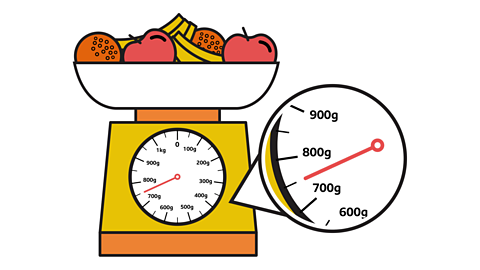
- Mass is a measure of the amount of matter in an object.
- The more matter an object contains, the greater its mass.
- Mass is measured in kilograms (kg).
- Mass is measured using scales or a top pan balance.
- Mass depends on the size of the atoms that make up a substance.
- The mass of an object is the same everywhere – a 5 kg mass doesn’t lose any matter if it is taken to the moon and so it has a mass of 5kg on the moon, in space and on the Earth.
- Weight is the size of the force of gravity acting on an object.
- Weight is a force and so is measured in newtons (N).
- Weight is measured using a newton spring balance.
- The weight of an object is not the same everywhere because the size of the force of gravity is not the same everywhere – the force of gravity is less on the moon than on the Earth, so, the weight of the object is less on the moon than on the Earth.
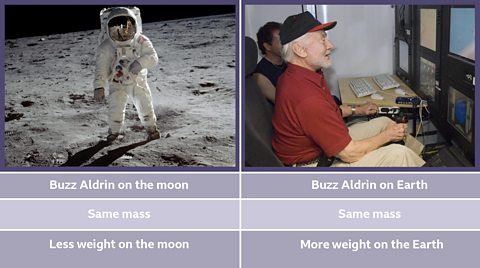
Mass is the same everywhere in the universe.Weight changes from place to place as the strength of gravity changes
Is there a link between weight and mass?
Use a spring balance to measure the weight of different masses. Record your results in a suitable table. Use your results to plot a graph of weigh in N on the y-axis against mass in kg on the x-axis.
Results
| Mass in g | Mass in kg | Weight in N |
|---|---|---|
| 100 | 0.1 | 1 |
| 200 | 0.2 | 2 |
| 300 | 0.3 | 3 |
| 400 | 0.4 | 4 |
| 500 | 0.5 | 5 |
| 600 | 0.6 | 6 |
| 700 | 0.7 | 7 |
| 800 | 0.8 | 8 |
| 900 | 0.9 | 9 |
| 1000 | 1.0 | 10 |
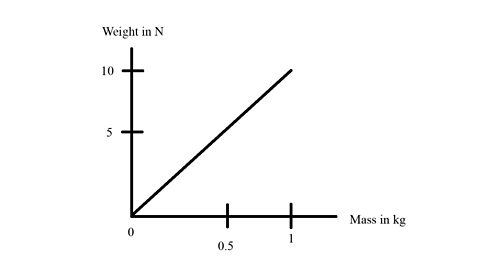
Conclusion
From the results it is clear that on Earth the weight in N is ten times the mass in kg.
10 N/kg is the strength of gravity on the surface of Earth. The proper name for this is the gravitational field strength. The letter used to represent gravitational field strength is g. It is the force of gravity on a mass of 1 kg.
Gravitational field strength, g = 10 N/kg.
On the moon, the gravitational field strength, g = 1.6 N/kg.
Calculating weight
The equation to calculate weight in newtons is:
Weight = mass x gravitational field strength
W = mg
W = weight in N
m = mass in kg
g = gravitational field strength, 10 N/kg (on theEarth’s surface)
Remember the mass must be in kg!
This equation can be rearranged to calculate mass, m:
m = \(\frac{W}{g}\)
or gravitational field strength, g:
g = \(\frac{W}{m}\)
Example
Find the weight of a person on Earth if they have a mass of 52 kg (g = 10 N/kg).
Answer
W = mg
W = ?
m = 52 kg
g = gravitational field strength, g = 10 N/kg
W = 52 x 10
W = 520 N
The weight of the person is 520 N.
Example
A school bag has a weight of 43 N. Calculate the mass of the bag (g = 10 N/kg).
Answer
m = ?
W = 43 N
g = gravitational field strength, g = 10 N/kg
m = \(\frac{W}{g}\)
m = 43 ÷ 10
m = 4.3 kg
The mass of the bag is 4.3 kg.
Example
A girl has a mass of 45 kg on Earth.
- Find her weight on the Earth, where g = 10 N/kg
- Find her weight on the Moon, where g = 1.6 N/kg
- What is her mass on the moon?
Answer
- On the Earth
W = mg
W = ?
m = 45 kg
g = gravitational field strength g = 10 N/kg
W = 45 x 10
W = 450 N
The weight of the girl on the Earth is 450 N
- On the Moon
W = mg
W = ?
m = 45 kg
g = gravitational field strength g = 1.6 N/kg
W = 45 x 1.6
W = 72 N
The weight of the girl on the Moon is 72 N.
- The mass of the girl is the same on the Earth and the Moon because the amount of matter in the girl is the same in both places. The girl's mass on the moon is 45 kg.
Now try these:
Question
Calculate the weight of a person on Earth if they have a mass of 60 kg (g = 10 N/kg)
W = mg
W = ?
m = 60 kg
g = gravitational field strength g = 10 N/kg
W = 60 x 10
W = 600 N
The weight of the person is 600 N.
Question
What is the mass of a person who weighs 120 N on the Moon (g = 1.6 N/kg)?
m = ?W = 120 Ng = gravitational field strength g = 1.6 N/kg
m = \(\frac{W}{g}\)
m = 120 ÷ 1.6
m = 75 kg
The mass of the person on the Moon is 75 kg
If you travelled to another planet, it's not just extra-terrestrials you might have to contend with, you might also weigh twice as much as you would on earth. Now, it might sound a bit strange, but finding out about how our weight would change on different planets of the solar system, is linked to understanding how forces act.
And I've come to the fairground to find out more.
Gravity is a force. It attracts objects with mass towards each other.
In space, it might look like there's no gravity, but astronauts are weightless because they're in orbit, so they're constantly falling towards the earth.
The weight of something depends on its mass and the gravitational field strength.
Weight is measured in Newtons and mass is measured in kilograms. Weight is a force. And it's caused by the pull of gravity acting on a mass. Mass is the amount of matter in an object. Unlike weight, it's not a force.
An object's mass has the same value anywhere in the universe. On other planets, our mass stays the same, but our weight would change. That's because the gravitational force region on different planets is different.
Some of my mates have come down to help me show you what I mean. It's not the warmest of days here on Earth, but I'm not one to let a bit of cold get in the way of a science demo.
Guys, do you have any idea what it would be like to be on another planet and what it would feel like, what you'd weigh?
ALL: No.
Well, this ride will give us some idea of that. Let's give it a go.
So we are presently, currently on planet Earth. Let's do a visit to Jupiter.
OK. Yeah, ready, ready.
Oh, no, I'm scared!
YELLING
LAUGHTER
YELLING
We are still alive.
Whoo!
Right, so what part of that ride felt the lightest?
At the top. It made your stomach go funny, dizzy. Dizzy stomach. Dizzy stomach!
And when did you feel the heaviest?
As it, kind of, came to the bottom. A little bounce.
Wicked! You see, that ride is like actually being on other planets.
When you was at the top and at the lightest, it's like being on a planet with less gravity, like Mercury. But when you was at the bottom on that bouncy part where you felt a bit heavier, well, that heavy feeling, that's like being on a bigger planet. For example, like Jupiter.
Except you wouldn't just be feeling like that when you hit the bottom, you'd just always feel like that.
Being on a ride like this is the closest you can really get to actually being on another planet.
LAUGHTER. Yeah!
Because we know that our mass is constant, it must be the gravitational forces that make our weight change. On Earth, the force of gravity on a one-kilogram mass is ten Newtons.
So, if my mass is 70 kilograms, then the force of gravity on me makes my weight 700 Newtons. As the chair and I fall, I'm pressing less on the chair and appear lighter.
Similar to astronauts in the space station. This would be the same feeling on Mercury. There, the force of gravity on a one-kilogram mass is just four Newtons. So, if my mass is 70 kilograms, then the force of gravity on me makes me weigh about 280 Newtons.
That's like me weighing as much as your family dog.
BARKING
At the bottom of the ride when it starts to slow down, the forces were unbalanced and I felt much heavier. This would be the same feeling on Jupiter. There, the force of gravity on a one-kilogram mass is 25 Newtons.
So, if my mass is 70 kilograms, then the force of gravity on me makes my weight about 1,750 Newtons. This is like weighing as much as a gorilla. So, the greater the mass of the object,the stronger the force of gravity.
That's why you'd weigh more on Jupiter. Gravity also keeps planets and moons in orbit. We know the gravitational pull of an object is determined by its mass. This can also help us make sense of the movement of the whole solar system.
All the planets and moons in the solar system spin around a central point. A bit like me on this roundabout.The object with the greatest mass sits at the centre and its gravitational pull attracts other objects into an orbit around it.
And that's why every planet in our solar system orbits the Sun. It's all down to gravity.
Summary
Gravity is the force of attraction which acts between all objects that have mass
Einstein described gravity as a curve in space that wraps around an object
The size of the force of gravity between two objects depends on the mass of each object and their distance apart
Mass is a measure of the amount of matter in an object
Mass is measured in kg using scales or a top pan balance
Weight is the size of the force of gravity acting on an object
Weight is measured in newtons, N, using a newton spring balance
Gravitational field strength, g, is the force of gravity on a mass of 1 kg
On Earth g = 10 N/kg
Mass is the same everywhere in the universe. Weight changes from place to place as the gravitational field strength changes
W = mg
Deformation
Materials and objects, such as springs, change shape when a force is exerted on them.
- Stretching happens when the material or object is pulled and increases in length - for instance, when someone uses chest expanders, the pull on both ends stretches the springs and makes them longer.
- compression happens when the material or object is squashed and decreases in length, for instance, when you sit down on an armchair, the downward push compresses the springs in the seat and makes them shorter
A change in shape like this is called deformation. In general, the greater the force exerted, the greater the deformation. This is why an elastic band gets longer the harder you pull it, and why a rubber ball squashes more the harder you squeeze it.
Remember that if you pull or squeeze too hard, the object may not return to its original size and shape afterwards, and it may even snap.
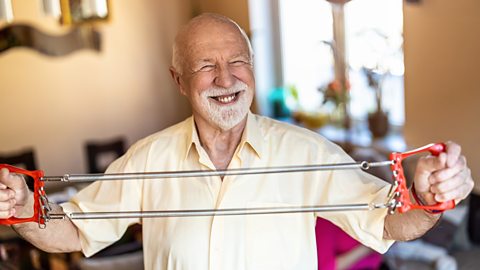
To measure the extension of a spring you need to take two readings:
- The original length of the spring
- The final length of the spring
Extension = final length – original length
For example: if a spring has a length of 30 cm and is then stretched to a length of 55 cm:
Original length = 30 cmFinal length = 55 cmExtension = final length – original length
Extension = 55 – 30 = 25 cm
Investigating stretching force and extension
You will need:
- a steel spring
- a 100 g mass hanger
- 12 x 100 g masses
- a retort stand
- a boss and clamp
- a C clamp
- a metre rule
- an s-hook
- a pointer
- safety goggles
- a slotted base
- Set up apparatus as shown in the diagram. Use a slotted base to secure the metre stick and make sure that it is vertical.
- Attach the mass hanger s-hook and pointer to the lower end of the spring. The pointer should just touch the metre rule.
- Read the pointer value from the metre rule. Record this length in a suitable table. This is the initial length of the spring for zero mass. We can neglect the mass of the hanger.
- Add a 100g slotted mass to the hanger. Record the mass in kg in the table.
- Calculate the stretching force (this is the weight of the masses and can be calculated using W = m x g). Record in the table.
- Read the new position of the pointer on metre rule. This is the stretched length of the spring. Record this length in the table.
- Calculate: extension = stretched length – original length.
- Repeat the procedure by adding 100g masses in steps of 100g up to 1 000g. Record the new stretched length each time by reading the position of the pointer on the metre rule. Subtract the original length from the new stretched length to calculate each extension.
Results
Original length of spring = cm.
| Mass in kg | Stretching force in N | Stretched length in cm | Extension in cm |
|---|---|---|---|
| 0.1 | 1 | ||
| 0.2 | 2 | ||
| 0.3 | 3 | ||
| 0.4 | 4 | ||
| 0.5 | 5 | ||
| 0.6 | 6 | ||
| 0.7 | 7 | ||
| 0.8 | 8 | ||
| 0.9 | 9 | ||
| 1.0 | 10 | ||
| 1.1 | 11 | ||
| 1.2 | 12 |
Graph
Plot a graph of stretching force, F in N on the y-axis, against extension, e in cm on the x-axis.Join the points with a line of best fit.The graph should be a straight line that passes through the origin (0,0), and then curve towards the end. The diagram shows an example of this.
Conclusion
We can see from the graph that as the stretching force increases the extension of the spring also increases.In fact, since the line of best fit is a straight line through the origin, up to a certain point, we can be even more precise.
We can say that the stretching force, F, is directly proportional to the extension, e, up to a limit known as the limit of proportionality. In other words one becomes larger or smaller when the other becomes larger or smaller until we reach a certain point. This law was named after the famous scientist Robert Hooke, who in 1676, stated a similar relationship between force and extension of a spring
Hooke’s law states that: The extension of a spring is directly proportional to the force applied, provided that the limit of proportionality is not exceeded.
This means that:
- if the stretching force applied is doubled, the extension doubles-if the stretching force applied is tripled, the extension triples
- if the stretching force applied is halved, the extension halves
- if no force is applied, there is no extension
- once you go beyond the limit of proportionality, stretching force and extension are no longer directly proportional
Question
A stretching force of 2 N produces an extension of 2.6 cm. If a stretching force of 4 N does not stretch the spring beyond the limit of proportionality what will be the new extension?
From Hooke’s law: stretching force is directly proportional to the extension.The stretching force is doubled from 2 N to 4 N, and so the extension will be doubled.The new extension = 2 x 2.6 = 5.2 cm
Summary: Hooke’s law
- Stretching happens when a material or object is pulled and increases in length
- Compression happens when a material or object is squashed and decreases in length
- Extension = final length – original length
- Hooke’s law states that: the extension of a spring is directly proportional to the force applied, provided that the limit of proportionality is not exceeded.
- If you double the stretching force, the extension doubles if obeying Hooke’s law
Pressure
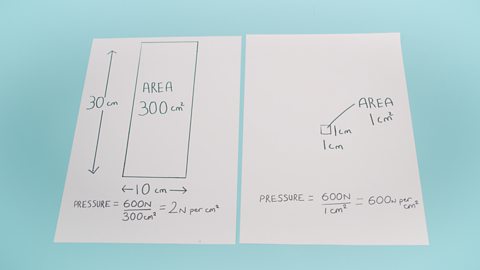
Solids, liquids and gases can all exert pressure, but what does pressure mean? In Physics, pressure is a measure of how much force is acting on a certain area.
Pressure is defined as the force acting on 1 cm² or 1 m²
Pressure =\(\frac{Force}{Area}\)
P=\(\frac{F}{A}\)
Question
A force of 20 N acts over an area of 4 cm². Calculate the pressure.
Pressure =\(\frac{Force}{Area}\)
Pressure =\(\frac{20}{4}\)
= 5 N/cm²The pressure is 5 N/cm²
What does a pressure of 5 N/cm² mean?It means that the force acting on an area of 1 cm² is 5 N
10 N/cm² is a higher pressure than 5 N/cm² because the force acting on an area of 1 cm² is 10 N.
Using pressure
If you walk through snow, you usually sink into it. This is because your shoes have a small surface area. Your weight is concentrated into a small area, so the pressure on the snow is high. However, you will not sink so far into the snow if you are on skis. This is because your weight is spread out over a greater surface area, so the pressure on the snow is low.
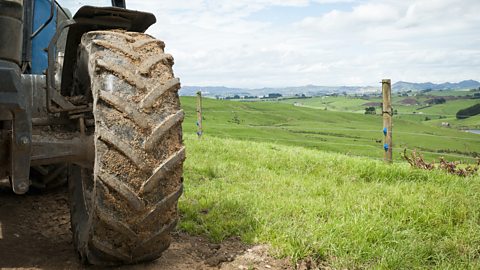
Tractor tyres are wide so that they do not sink into muddy fields. The wide tyres have a large surface area spreading out the weight of the tractor and reducing the pressure on the ground. For the same reason, diggers are fitted with caterpillar tracks.
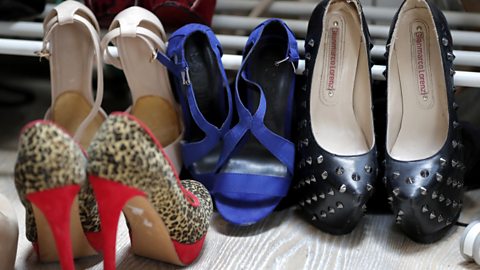
High heel shoes can damage wooden floors. The weight of the person wearing them is concentrated into the very small surface area at the heel, and so the pressure on the floor is large. This can cause the heel to sink into the surface of the wooden floor, damaging it. For the same reason, it hurts more if a person steps on someone’s foot in high heels than if they are wearing flat shoes.
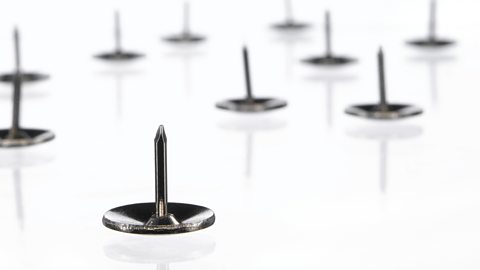
Footballers need to get a good grip on the ground. They use boots with studs in them. The studs have a small area to make the pressure large enough to dig into the surface. That way they have better grip and will not slip.
A sharp knife cuts easily because the small surface area of the blade creates a large pressure. The blade of a blunt knife has a larger surface area and so the pressure is much smaller, for the same amount of cutting force.

Have a go

Image caption, Click to see a step-by-step slideshow.

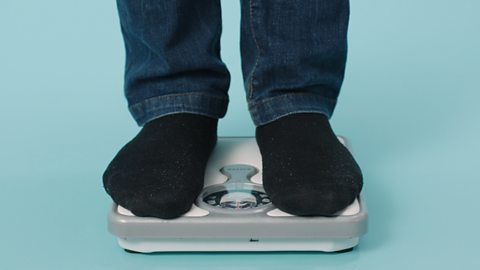

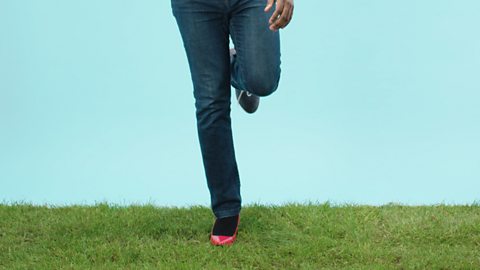
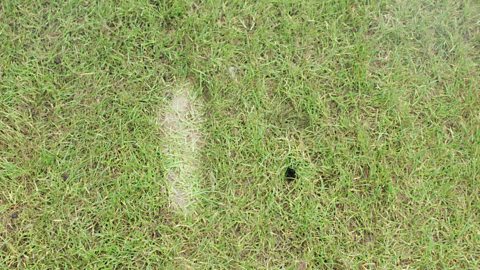
1 of 7
A force can be a push or a pull. When a force is exerted on an object it can change the object's speed, direction of movement or shape.
Pressure is a measure of how much force is acting upon an area.
Pressure can be found using the equation pressure = force / area. Therefore, a force acting over a smaller area will create more pressure.
Speed
The speed of an object tells you how far it travels in a certain time. For instance, if the speed of a car is 30 miles per hour you know it will travel 30 miles in an hour. In physics, we normally measure the distance in meters or kilometres, the time in seconds or hours and the speed in m/s or km/h
Speed is defined as the distance travel in one second.
Speed =\(\frac{Distance}{Time}\)
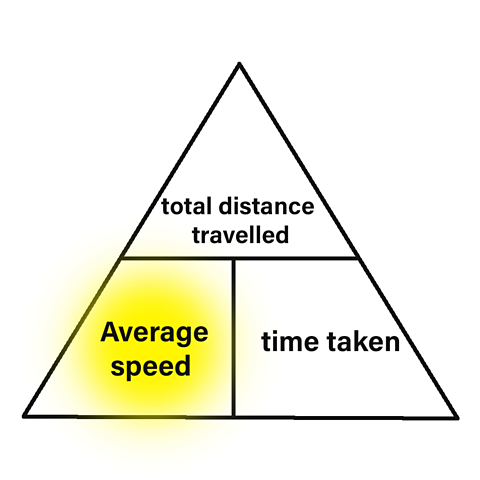
Average speed is calculated using the formula:
Average speed =\(\frac{total~distance~travelled}{time~taken}\)
Speed is measured in m/s or km/h
A car travelled 2 km in 100 s. Calculate its average speed.
The first thing to do is to convert the distance in km to m. There are 1000m in a km.
2 km = 2 x 1000 m = 2000 m
Average speed =\(\frac{total~distance~travelled}{time~taken}\)
Average speed =\(\frac{2000}{100}\)= 20 m/s
The average speed of the car is 20 m/s
The speed limit on a road is 13.4 m/s (30 mph). Calculate the distance traveled by car in 2 s at this speed.
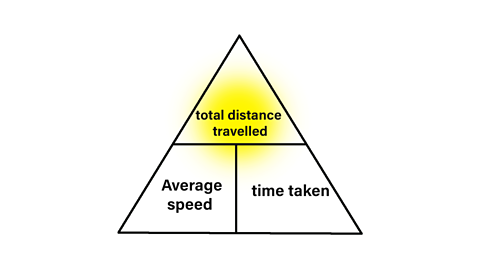
Average speed =\(\frac{total~distance~travelled}{time~taken}\)
Rearranging this to make total distance travelled the subject gives:
total distance travelled = average speed x time taken
total distance travelled = 13.4 x 2= 26.8 m
The distance travelled by the car is 26.8 m.
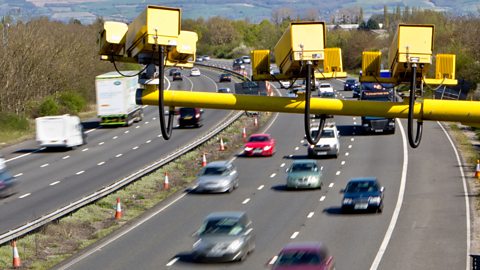
Average speed cameras
Average speed cameras are usually mounted on roadside gantries at regular intervals of over 200 metres. The system requires at least two cameras linked together. When a car passes the first camera, an image of its number plate is taken and used to identify the car when it passes subsequent cameras. As the car passes along the route, the time taken to pass between the cameras is recorded. Since the distance between the cameras is known and the time taken is measured, the speed of the car can be calculated by a computer. If the speed exceeds the limit, the vehicle details are submitted for a fine or prosecution.
Calculate the time taken for the car to travel 50 m at a speed of 13.4 m/s.
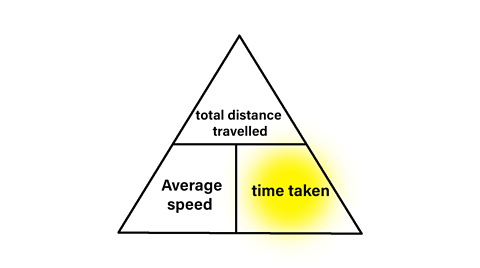
Average speed =\(\frac{total~distance~travelled}{time~taken}\)
Rearranging this to make time taken the subject gives:
time taken =\(\frac{total~distance~travelled}{average~speed}\)
time taken = \(\frac{50}{13.4}\)
= 3.7 sThe time taken to travel 50 m is 3.7 s.
Typical speeds
When people walk, run or travel in a car their speed will change. They may speed up, slow down or pause for traffic.Some typical values for average speed in metres per second (m/s) include:
| Method of travel | Typical average speed m/s |
|---|---|
| Walking | 1.5 |
| Running | 3 |
| Cycling | 6 |
| Car | 13 - 30 |
| Train | 50 |
| Aeroplane | 250 |
It is not only moving objects that have varying speed. The speed of the wind and the speed of sound also vary. A typical value for the speed of sound in air is 340 m/s. A light breeze moves at perhaps 3 m/s, but a gale would be more than 20 m/s.
An experiment to measure walking speed
You will need:
- a 20 m measuring tape or trundle wheel
- a stopwatch
- two marker cones
Method
- Select a level piece of ground that is firm underfoot - a playground or hockey pitch would be ideal
- Using the measuring tape or trundle wheel, accurately measure a distance of 80 m. Place a marker cone at both ends and record the distance in a suitable table
- Start walking a little before passing the first marker
- Start your stopwatch when you pass the first cone and continue walking at a steady speed in a straight line
- Stop your stopwatch when you pass the second marker and record the time in the table
- Repeat this procedure, walking in the opposite direction
- Repeat twice more in both directions
- Calculate the average time taken
- Calculate your average walking speed over the 80 m using:
Average speed =\(\frac{total~distance~travelled}{time~taken}\)
Distance-time graphs
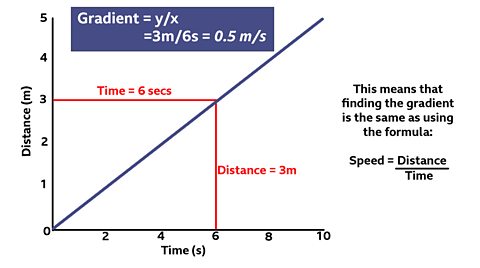
Distance-time graphs show how the distance travelled by a moving object changes with time.
In a distance-time graph:
- distance travelled is plotted on the vertical (y) axis
- time taken is plotted on the horizontal (x) axis
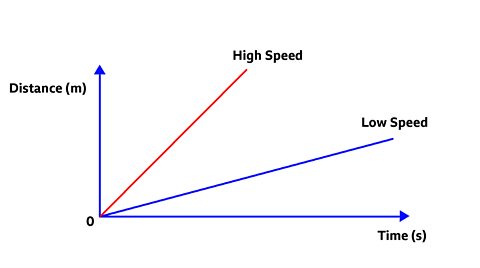
The gradient of the line is equal to the change in y divided by the change in x. For a distance – time graph this is distance divided by time. This means finding the gradient is the same as calculating speed. In other words:
- The gradient of a distance – time graph equals speed
From the distance-time graph below, calculate the speed represented by the green line between6 s and 10 s.
Speed = \(\frac{gradient~of~a~distance}{time~graph}\)=\(\frac{7~-~6}{10~-~6}\)= \(\frac{1}{4}\)= 0.25 m/s
The speed represented by the green line is 0.25 m/s.
Question
From the distance-time graph below, calculate the speed represented by the red line between 0 s and 2 s.
Speed = \(\frac{gradient~of~a~distance}{time~graph}\)= \(\frac{10~-~0}{2~-~0}\)= 5 m/s
The speed represented by the red line is 5 m/s.
Question
From the distance-time graph below, calculate the average speed represented by the green line over the whole journey between 0 s and 10 s.
Average speed = \(\frac{total~distance~travelled}{time~taken}\)
Average speed = \(\frac{7}{10}\)= 0.7 m/s
The average speed represented by the green line is 0.7 m/s
Summary: Speed
- Speed is defined as the distance travel in one second.
- Speed = \(\frac{distance}{time}\)
- Average speed = \(\frac{total~distance~travelled}{time~taken}\)
- Speed is measured in m/s or km/h
- The gradient of a distance – time graph equals speed
- The steeper the line of a distance – time graph, the greater the gradient and so, the greater the speed
More on Physics
Find out more by working through a topic
- count7 of 8

- count8 of 8

- count1 of 8
- count2 of 8