Waves and sound
And ready… ok!
Welcome to Science World!
Most people have been to the seaside. So, as well as seaweed, driftwood, crabs and crunchy sandwiches, you’ll be aware of waves.
Sometimes you’re paddling in them. Sometimes you’re surfing in them. In the sea, waves never stop.
But once more, waves don’t happen just in the sea. What’s going on? Where are they coming from? Where are they going? I don’t know.
So, today we’re going to ask the question – What are waves?
Welcome to Wave World!
The job of waves is to transfer energy from one place to another. We can see them clearly in water, but they’re also in the air, in space, under your feet and in your ears and eyes. Waves are everywhere.
There are two types of waves, transverse waves and longitudinal waves.
A transverse wave is one in which the vibrations of the particles are at right angles to the direction in which the energy of the wave travels.
A water wave is transverse. A boat on the sea bobs up and down, as a wave passes but doesn’t move forwards. Other examples include light waves, radio waves and x-rays.
A longitudinal wave is one in which the vibrations of the particles are parallel to the direction in which the energy of the wave travels.
Image standing in a closely spaced queue of people and gently rocking backwards and forwards. The energy passes along the queue and each person gradually rocks backwards and forwards.
Other examples include sound waves and ultrasound waves.
Ok, that’ll do for in here. See you back at base.
So, remember, waves transfer energy and can be longitudinal or transverse.
It’s time for me to transfer a bit of energy now and wave goodbye.
See you next time in Science World!
What do waves do?
Waves are all around us. It’s normal to think of waves in the sea but waves are also in the air, in space, under your feet and in your ears and eyes. They are everywhere.
So, what do waves do, what is their purpose?
All waves do the same thing. They carry energy.
A wave transfers energy from one place to another.
Examples of waves include: water waves, sound waves, light waves, radio waves, microwaves, x-rays, ultrasound waves and seismic waves from an earthquake.
Types of wave
When a wave passes through matter like air or water, the particles vibrate up and down or backwards and forwards. They only move a short distance either side of their rest position and do not pass along the whole length of the wave. The energy of the wave is passed along its entire length from vibrating particle to vibrating particle.
There are two types of wave – transverse waves and longitudinal waves
Watch the GB surfing team demonstrate the different types of wave
JON CHASE: What is a wave? Well, obviously, that's a wave. And that's a wave. In fact, the waves just keep on coming. When we talk about a wave, this is what people normally think about. Or maybe this as well.But actually, there's waves all over this beach other than the water.
JON CHASE:You can hear the waves via sound waves, and you can see what's happening via light waves. Actually, I'd probably say we're living in a wave world. This is Croyde in Devon, the training base of Surfing GB, our international team. I'm with some of the best young surfers in the country, to find out what waves are all about. Is anybody able to tell me what a wave is?
STORM WALL: Movement of energy in the water.
JON CHASE: Movement of energy in the water?
STORM WALL: Yeah.
JON CHASE: And you ride that energy home?
STORM WALL: Yeah.
JON CHASE: What does it feel like to ride such a big wave?
WILL BAILEY: There's a lot of water moving around when the waves are bigger, so you kind of feel a bit vulnerable.
JON CHASE : Yep.
WILL BAILEY : And you definitely get put in your place a couple of times, held down.
JON CHASE: You can see what's happening in the wave by watching the surfers waiting for the next big one. While they're waiting, the surfers only move up and down while the wave passes under them. That means the water they're floating in moves vertically up and down, while the wave travels horizontally towards the shore. There are two types of wave, and my friends here from the surf club are going to help us demonstrate. So first up, a Mexican wave.
CHILDREN: Whoo!
JON CHASE: Ooh, and again. Whoo!
CHILDREN: Whoo!
JON CHASE: If you look at just one person, they aren't going anywhere. It's the movement of the arms that passes down the line from one person to the next. And when that happens, you've got a wave. Oh, yeah!
JON CHASE: It's just like what happens in sea waves. The water goes up and down but the wave moves forward. Sea waves, light waves and Mexican waves are called transverse waves. The movement of the water particles, or the arms, is at 90 degrees to the direction of travel.
JON CHASE: But there's another sort of wave, and it's really different from the transverse wave. Let's go. Just like the transverse wave, the wave travels forward but the people stay where they are. Only this time, their movement is forward and backward, in the same direction as the wave. Because the movement is along the wave, this is called a longitudinal wave.
JON CHASE: The movement of the people is in the direction of the wave, not at 90 degrees. Sometimes, it's called a pressure wave, and you can see why – the spaces between the people are compressed. In the real world, sound is a longitudinal wave, passing through particles of air. So when you listen to the crashing waves here at Croyde Bay…that's longitudinal waves – sound. And when you watch them, it's thanks to transverse waves – light. But as for surfing, I'm going to leave that to the experts.
JON CHASE: Wouldn't catch me out there. It's too cold!
Transverse waves
A transverse wave is one in which the vibrations of the particles are at right angles to the direction in which the energy of the wave travels.
Demonstrating transverse waves
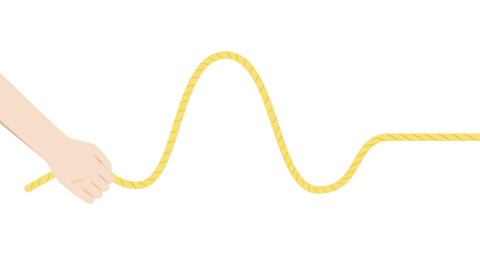
Transverse waves are often demonstrated by moving a rope rapidly up and down

Image caption, 1. A hand holds a length of rope taut

1 of 3
- In the diagram the rope moves up and down, producing peaks and troughs.
- Energy is transferred from left to right at right angles to the hand movement.
- However, none of the particles are transported along a transverse wave.
- The particles move up and down as the wave moves from left to right.
Examples of transverse waves include:
- ripples on the surface of water.
- vibrations in a guitar string.
- a Mexican wave in a sports stadium.
- All the electromagnetic waves – eg light waves, microwaves, radio waves, x-rays.
- S type earthquake waves.
One way of remembering that an S type earthquake wave is a transverse is that an S looks like a transverse wave on its side.
A transverse wave: the particles do not move along the wave. Each moves a short distance up and down, at right angles to the flow of energy which is from left to right.
Longitudinal waves
A longitudinal wave is one in which the vibrations of the particles are parallel to the direction in which the energy of the wave travels.
Demonstrating longitudinal waves
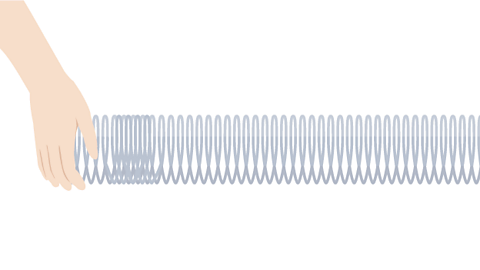
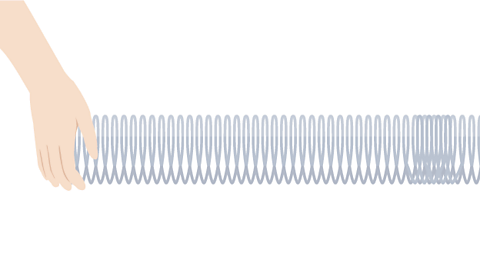
A longitudinal wave can be demonstrated using a slinky. The hand is moved quickly backwards and forwards causing a longitudinal wave to travel from left to right along the slinky.
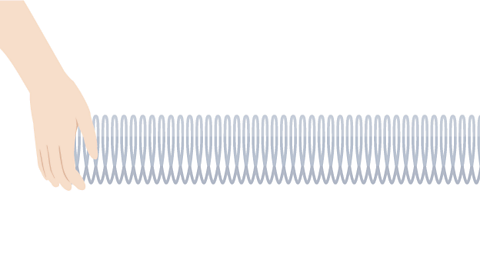
Image caption, 1. An outstretched slinky spring
1 of 3
Each individual coil of the slinky moves backwards and forwards either side of its rest position. However, none of the coils are moved along the length of the slinky. They just move backwards and forwards parallel to the direction in which the energy flows.
If you look closely, you can see regions being where the coils are closer together than normal. This is called a compression. On either side of a compression there is a region where the coils are further apart than normal. This is called a rarefaction.
- compressions are regions of high pressure where the particles of the wave are closer together than normal.
- rarefactions are regions of low pressure where the particles of the wave are further apart than normal.
Examples of longitudinal waves include:
- sound waves
- ultrasound waves
- P type earthquake waves
One way to remember that a sound wave is a longitudinal wave is to highlight the o in both words:
lOngitudinal wave – sOund wave
Parts of a wave
Some important terms:
- rest position – the position of a particle when a wave isn’t present.
- peak - the highest point above the rest position.
- trough - the lowest point below the rest position.
- amplitude - the maximum distance of a point of a wave from its rest position.
- wavelength λ – the distance between two peaks or two troughs. One wavelength is the distance a wave moves forward in one complete vibration. Wavelength is a distance and so it is measured in meters, m. The symbol for wavelength is the Greek letter lambda, λ.
- period T - the time taken for one complete vibration of the wave. It is the time taken for one complete wave to pass by – i.e. the time from one peak to pass until the next or from one trough to pass by until the next. Period is a time and so it is measured in seconds, s.
- frequency f - the number of vibrations in one second. This is the same as the number of waves passing a point each second. Frequency is measured in hertz, Hz. A frequency of 50 Hz means there are 50 vibrations every second or 50 waves pass by every second.
Summary: waves
- A wave carries energy from one place to another.
- Transverse wave: vibrations are at right angles to the direction the energy flows.
- Longitudinal wave: vibrations are at parallel to the direction the energy flows.
- lOngitudinal wave – sOund wave.
- Transverse wave – light wave, ripples on water, radio waves, microwaves.
- Wavelength λ – the distance between two peaks or two troughs (m).
- Period T - the time taken for one complete vibration of the wave (s).
- Frequency f - the number of vibrations in one second (Hz).
Seismic waves
Seismic waves are produced by earthquakes in the Earth’s crust. They travel through the ground and can cause damage to structures on the Earth’s surface, as well as tsunamis.
Properties of seismic waves
There are two types of seismic waves:
- P-waves, which are longitudinal waves.
- S-waves, which are transverse waves (remember an s looks like a transverse wave on its side).
P-waves and S-waves have different properties. The table summarises these properties.
| P-waves | S-waves | |
|---|---|---|
| Type of wave | longitudinal | transverse |
| Relative speed | faster | slower |
| Can travel through | solids and liquids | solids only |
P-waves or primary-waves are the first to be felt or detected because they move faster.
S-waves or secondary-waves are felt or detected second.
S-waves are not detected on the opposite side of the Earth. Since s-waves cannot travel through a liquid this tells us that the mantle is solid, but the outer core must be liquid.
More on Physics
Find out more by working through a topic
- count2 of 8

- count3 of 8
- count4 of 8
- count5 of 8