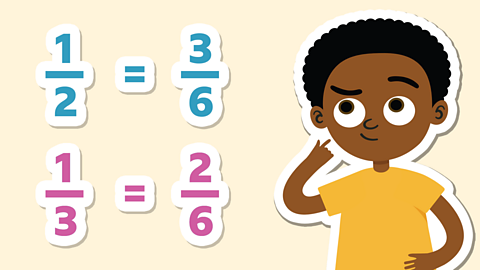
What is a fraction?
A fraction is part of a whole that has been divided into equal parts.
Fractions represent more than 0 but less than 1.
Fractions are written with two numbers, one on top of the other, separated by a division line.
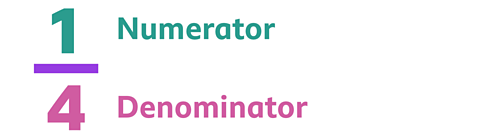
The top number is called the numerator. It shows how many parts you have.
The bottom number is called the denominator. It shows the total number of equal parts the whole is divided into.
Activity: What is a fraction?
Complete this interactive activity to understand what fractions are. Then put your knowledge to the test.
Unit fractions
When working with fractions it is important to know how many equal parts the whole has been divided into.
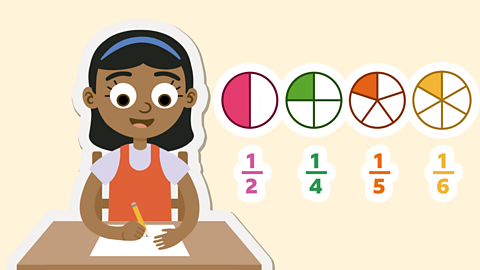
These shapes all have one part shaded.
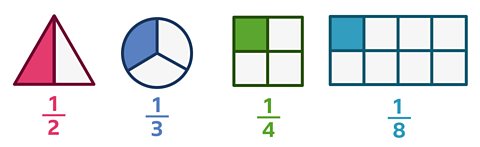
They are unit fractions. Unit fractions all have a numerator of 1.
The shapes have all been divided into different equal parts, so have different denominators.
Non-unit fractions
Non-unit fractions have a numerator that is more than 1, but less than the denominator.
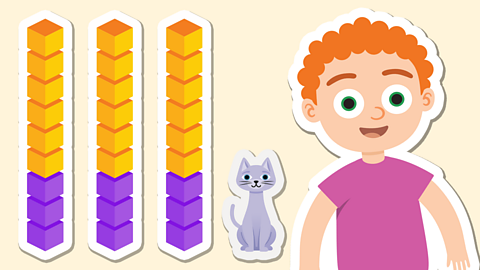
Below is a set of 9 hair beads. The set is the whole, so the denominator is 9.

There are 2 yellow beads in the set, so \(\frac {2} {9}\) of the beads are yellow.
There are 3 red beads in the set, so\(\frac {3} {9}\) of the beads are red.
There are 4 pink beads in the set, \(\frac {4} {9}\) of the beads are pink.
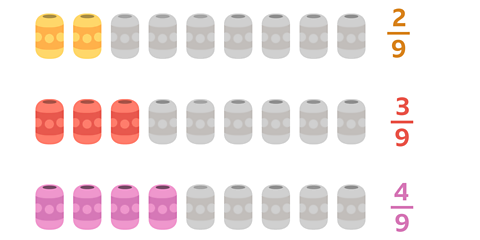
These are all examples of non-unit fractions.
Example 1
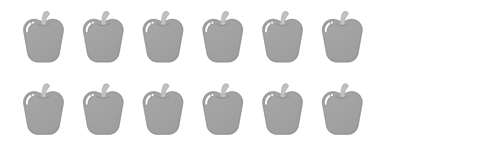
Eva has 12 apples.
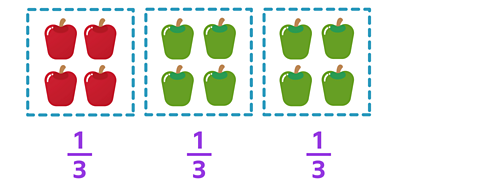
If \(\frac {1} {3}\) of the apples are red. How many red apples does she have?
✓She has 4 red apples.
If the 12 apples are sorted into 3 sets there will be 4 in each set.
\(\frac {1} {3}\) of 12 is 4.
Example 2
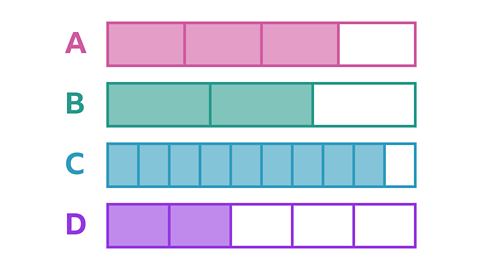
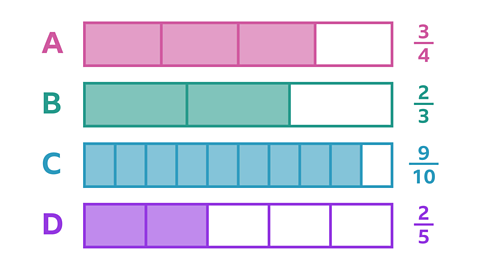
What fractions do these bar models represent?
To find the denominator, count how many parts the whole has been divided into.
To find the numerator, count how many parts are shaded.
✓ Here are the answers:
- A represents \(\frac {3} {4}\).
- B represents \(\frac {2} {3}\).
- C represents \(\frac {9} {10}\).
- D represents \(\frac {2} {5}\).
Example 3

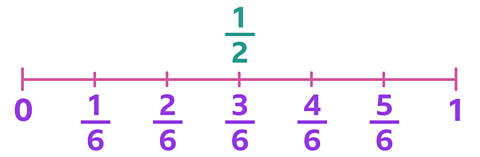
Which fractions would you put on this number line?
✓ The fractions would be \(\frac {1} {6}\), \(\frac {2} {6}\), \(\frac {3} {6}\), \(\frac {4} {6}\), \(\frac {5} {6}\), \(\frac {6} {6}\).
Did you spot that the number line was divided into sixths?
Remember, \(\frac {3} {6}\) is the same, or equivalent to \(\frac {1} {2}\).
Play Guardians: Defenders of Mathematica to get ready for SATs. game
In this game, use the times tables and more maths skills to defeat monsters and reclaim the Kingdom.
More on Fractions
Find out more by working through a topic
- count2 of 17
- count3 of 17
- count4 of 17
- count5 of 17