Overview of The Red Door by Iain Crichton Smith
- The Red Door is a short story by Iain Crichton Smith.
- The main character is Murdo, an unmarried man who lives in a small village.
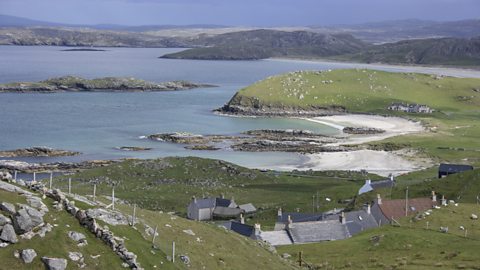
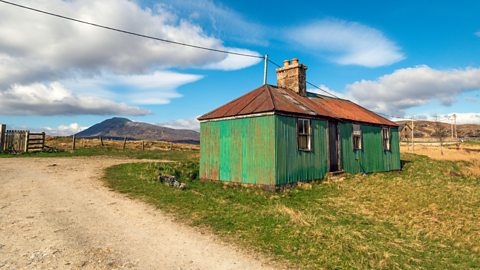
- Crichton Smith doesn't specify the precise location, but the reader can deduce from references to peat, porridge, and the sea that this village the story is set in is on the coast somewhere in the Highlands and Islands of Scotland.
- Murdo wakes up on the morning after Hallowe'en and finds his front door has been painted red. This leads him to question his life and place in the village. He grows to suspect that the door was painted by Mary, a single woman who seems different from the other villagers. The story ends with Murdo going and knocking on Mary's door.
This story has themes of:
- the individual vs social conformity
- the restrictive nature of village life
What is the plot of The Red Door?
Murdo is a A man who is not and never has been married.. The morning after Hallowe'en, he finds that his formerly green front door has been repainted red. He is puzzled as to why anybody would do such a thing.
He recollects the previous evening, and remembers giving treats to the children of the village, who had worn beautifully painted Hallowe'en masks.
As the story continues, more of Murdo’s character is revealed. He is well liked because he conforms to the codes and expectations of the village:
- he doesn’t gossip
- he reads the same newspaper as the other villagers (The Daily Record)
- he participates in the same routines
However, the newly painted door awakens something in Murdo, and he begins to question the quality of his life. He notes that no other house has a red door. He wonders if he may even be thrown out the village, now that he is different.
He reflects on his one attempt at romance with a local spinster who lived with her "grossly religious" mother. The relationship ended after she served him a meal of cocoa and salt herring, a diet he refers to as so "ferocious" that he:
could not look forward to its repetition with tranquillity
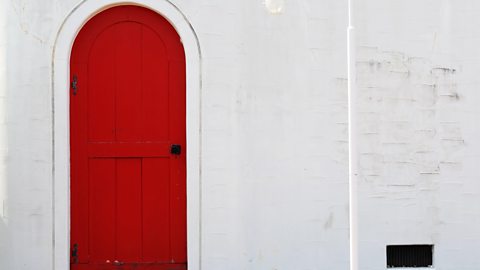 Image source, Akihito Yokoyama / Alamy
 Murdo gazes at the door as though he was viewing a priceless piece of art:
As he stared at the door he felt strange flutterings within him
He notes the almost loving way the door had been painted. Gradually a link between the door and a local spinster named Mary is formed.
Like the door, Mary’s clothes are often red. She has been known to paint fantastically creative masks for the children and she often likes to walk in the village at night.
Mary is different from the rest of the villagers. Unlike Murdo, she has never sought their approval or tried to conform. She reads books and writes poetry and is distant from the others.
Her intellect has led her to be considered odd. Murdo himself had a less than ideal experience of schooling. He struggled to speak with other children, was too clumsy to take part in school sports and was poor academically. However, unlike the other villagers, he is impressed by Mary’s creativity and love of literature.
As the village begins to wake, Murdo realises that he has never really been himself. Instead he has:
always sought to hide among other people.
He reconsiders his place in the village. Gradually a sense of excitement builds in him. After eating his breakfast, he steps out of his newly painted door once more. He makes his way towards Mary’s house. The story ends with him knocking purposefully on her door.
Image source, Akihito Yokoyama / Alamy Who are the main characters in The Red Door?
Murdo
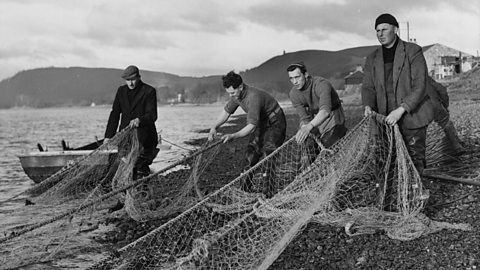
Murdo is a 46 year old A man who is not and never has been married.. Aside from a brief spell on board a fishing boat, he has spent his entire adult life "working on the land in a dull concentrated manner". Initially Murdo is depicted as no more remarkable than any of his neighbours. He lacks confidence, lives alone in frugal self sufficiency and has
never in his life done anything unusual.
Murdo’s entire existence stems from his desire to conform and fit in. He carefully sticks to all the unspoken codes and rules of the village, even down the reading the same newspaper and wearing the same clothes. It emerges that Murdo is unmarried as a result of shyness and a lack of eligible women in the village, rather than through choice. He
had never brought himself to propose marriage to anyone
The "one romance in his life", to a "spinster in the village", came to nothing because of a meal she prepared for him. Murdo realised that this "ferocious" meal of salt herring was an indication that a marriage with this woman would be as unpleasant and joyless as the food she prepared. He receded back to the familiarity and security of his bachelorhood.
Despite Murdo’s outwardly ordinary façade, it becomes evident that he has hidden dreams and aspirations. The newly painted door leads Murdo to confront and acknowledge the poverty of his lifestyle.
He is lonely and unlike his neighbours, feels increasingly repressed and suffocated in this stultifying community where "there were times he felt that there was more to life" than the village could provide.
He demonstrates romantic sensibilities that suggest he is different from the other villagers. He admits feeling particularly unsettled and unfulfilled:
on summer nights when the harvest moon was in the sky… and the earth was painted with an unearthly glow and the sea was like a strange volume which none could read except by means of the imagination.
These words are sensitive, intuitive and poetic. They reveal Murdo’s hidden depths while simultaneously implying that he is much more in tune with the unconventional Mary than with anyone else in his community.
As Murdo finally confronts the unfulfilling nature of his life, he experiences an epiphany revealing that:
I have always sought to hide among other people. I agree to whatever anybody tells me to do. If they think I should go to church, I go to church. If they want me to cut peats for them, I do. I have never… been myself.
This moment of clarity provokes him into action and he even admits his hatred of his fisherman’s jersey and wellington boots, affronted by their lack of "elegance".
I have always worn these things because everybody else does. I have never had the courage to wear what I wanted to wear, for example a coloured waistcoat and a coloured jacket.
Murdo is no longer content to conform and fit in. As he admires the door he becomes increasingly aware of a building attraction for Mary. Even his realisation that the newly painted door could be provocative and might even result in him being hunted out of the village doesn’t discourage Murdo from his new course. He begins to questions his own identity, asking:
if he were a true villager would he like the door so much?
In the uplifting and optimistic conclusion, a transformed Murdo knocks on Mary’s door. This symbolises the beginning of a new and much more enriching chapter of his life where he is finally free from the shackles of conformity.
The villagers
We never meet Mary or the other villagers in the story but their characters are revealed through the narrative.
The villagers represent the negative, closed-minded attitudes that Crichton Smith often associates with small, rural communities. These communities seem to thrive on maintaining the status quo and a set of unspoken codes and values that must be adhered to.
The fact that a red door could stand out so significantly in the village, gives an idea of how dull and unremarkable this society is:
Never in the history of the village had there been a red door before. For that matter he couldn't remember seeing even a blue door himself, though he had heard of the existence of one.
Being different is frowned upon in the village. Murdo is right to be concerned about how the rest of the village might react to his newly painted red door which he realises "certainly singled him out".
All his life he has felt it necessary to be "as like the other villagers as possible".
In Murdo, Crichton Smith emphasises the repression and lack of fulfilment in conforming to these rigid routines. As Murdo considers their reaction to the door he notes:
It was true that the villagers when they woke would see it and perhaps even make fun of it, and would advise him to repaint it. They might not even want him in the village if he insisted on having a red door. Still they could all have red doors if they wanted to. Or they could hunt him out of the village.
In these lines we really understand the extent to which Murdo has been influenced by the small-mindedness of the villagers. In never being allowed to pursue his own dreams and ambitions, he has assimilated into the village. This has been at great personal cost.
Crichton Smith uses the village to reflect larger society, which can often conflict with the desires of the individual.
In the end, Murdo’s decision to leave the door red symbolises that he has found the impetus and strength to break with this suffocating society. He is ready to live a life where he can be himself.
On a wider level, Murdo represents the everyman, and the perpetual struggle that all of us face between conforming to society and finding an existence that is personally fulfilling.
Mary

We can infer from the clues in the story that Mary is responsible for Murdo’s newly painted red door:
- she is often seen wearing red
- she is creative in the way that she paints the children’s masks at Hallowe'en
- she writes poetry
- unlike the rest of the villagers, she takes night time strolls through the village
Her decision to paint the door leads to Murdo’s transformation. The story is narrated from Murdo’s perspective but we can assume that in him, Mary recognised a kindred spirit. In painting the door, she is trying to prompt him into action.
Mary represents those of us who choose not to conform to the small minded attitudes so prevalent in other villagers. Mary is unpopular because she "never gossiped" and was misunderstood because she had "read many books". Again Crichton Smith is highlighting the insular attitudes of the villagers, since being educated and not gossiping would generally be considered positive traits.
Mary’s spinsterhood also marks her out as different since it would be unusual in such societies to remain unmarried through choice. These differences mean that she will never be accepted by the village. However, in contrast to Murdo, she has never sought their approval or tried to fit in:
…she made no concessions to anybody. She seemed to be saying, You can take me or leave me… she was proud and distant. She had a world of her own.
Mary's example helps Murdo realise that he no longer has to conform. Mary’s choice of red, both for the door and her own clothes is hugely An action, speech or gesture that stands for a much greater meaning.. It shows her breaking from the village. Most doors in the village are painted in the greens and blues of the drab landscape. They represent the limited imaginations of the villagers.
Red is associated with passion and anger. These are qualities we can see in Mary. As well as being creative she is rumoured to have sudden bursts of rage. In contrast, Murdo associates red with the colour of wine and blood. He drank none of the former and only saw the latter while repairing a fence or working with wood when a nail would prick his finger.
The red door and Mary represent pleasure and passion. These are features missing from Murdo's life. But there is potential for them to develop.
Video - What is symbolism?
The red door in this story is symbolic of:
- non-conformity and individuality
- pleasure and passion
Learn more about symbolism and how writers use it with this short Higher English video.
What is symbolism? How and why would you use it?
Symbolism
The use of symbols to represent deeper meanings or themes.
Symbols are usually objects which are easy to understand.
What they represent is more complex.
We use symbols every day. Some are universal.
We all know that a red rose symbolises love or romance.
A clock is a symbol of time.
Diamonds can represent wealth or value.
A white flag symbolises surrender or a truce.
Symbolism helps writers illustrate and develop the themes of their story.
If you wanted to explore the theme of death, you might use symbols like:
The colour black
Angel’s wings
or even a skull
These symbols provoke emotions in the reader linked to death, adding depth beyond action or conversation.
In her poem 'Revelation', Liz Lochhead uses symbolism to explore the idea of evil through a young girl’s experience on a farm.
“I remember once being shown the black bull… In the yard outside, oblivious hens picked their way about…”
The black bull, half seen in the darkness, symbolises evil. This evil is a danger to order and calm, which is symbolised by eggs as well as innocent female hens.
“I had always half-known he existed – this antidote and Anti-Christ, his anarchy threatening the eggs”
Once these are established as the symbols of the poem, Lochhead uses them to guide us through the heavy concept of evil versus good.
The next time you explore difficult themes in your writing, why not give symbolism a go?
You might just crack it!
What are the themes in The Red Door?
The individual versus society
Murdo represents the individual, whose desire for acceptance within his community eventually conflicts with his own need to live a more fulfilling life. In trying to conform and fit in with this strict society, Murdo has created a version of himself that, while acceptable to the community, has stifled his own desires and aspirations.
Crichton Smith highlights the dangers of conformity and of an existence limited by fitting in and suppressing individual thoughts and feelings.
The village is a One small version of a larger world, eg a school could be described as a microcosm of society. of larger society. Murdo’s predicament is one which is universal. All of us must sometimes wrestle with our need to be accepted by our peers while also fulfilling the desires of the self.
Mary represents those of us brave enough to never attempt to conform. While the cost is evident in the way she is marginalised by the villagers, ultimately her way of life is depicted as truthful and empowering.
The restrictive nature of village life
Crichton Smith grew up in a rural community not dissimilar to the one described in this story. This influenced his writing, as in his work he was often very critical of the particular oppressive restrictiveness of some aspects of rural, village life. This story employs many of these motifs.
As is demonstrated in The Red Door, he often found life in these communities stifling and oppressive. In Murdo we see the emotional and intellectual isolation of the individual that can be a particular feature of these environments.
To Crichton Smith, village life is a passive experience, lacking in true thoughts and feelings. Murdo "working on the land in a dull concentrated manner" suggests he is going through the motions of existence. The idea that this is a life not fully lived is summed up in the reference to Murdo's parents:
his father and mother dreamed their way towards death.
Comparisons with other short stories by Iain Crichton Smith
There are clear parallels in this story with:
- Mother and Son
- The Painter
- The Existence of the Hermit
All four stories contain criticisms of the insular narrow-mindedness that Crichton Smith often associates with small village life. The expectations of the local community become oppressive and restricting. It also sets up a A direct contrast or division between two things that appear to be opposites in a lot of his work between the individual and the community they live in, where his characters feel unfulfilled or unable to be themselves.
In The Red Door, Murdo feels repressed and ponders:
there were times he felt that there was more to life
There also has to be more to life than the croft and his mother's anger for John, the The chief character in a literary work. in Mother and Son, and the reader hopes that the open door for John at the end of the story is a parallel with Murdo's decision in The Red Door to knock on Mary's door. These doors hopefully mean new beginnings for both of these unhappy characters.
The Painter and The Existence of The Hermit show what happens when the community takes against someone for being different. In The Painter, it is the boy's talent that sets him apart, as Mary's creativity and intellect appear to in The Red Door. Reading and painting aren't activities that seem to be trusted in Crichton Smith's view of the communities he writes about.
In The Existence of The Hermit it is the hermit's unusual lifestyle that marks him as an outsider, and there are similarities between the hermit and Mary. Both are content living their own lives on their own terms, without concern about what the other villagers think.
These stories show what lies at the heart of Murdo's inability to live freely - fear of the judgment of his neighbours. Murdo knows this himself, and so the reader hopes that his decision to knock on Mary's door at the end of the story signals a new beginning for him where he is happier and doesn't feel under pressure to conform.
Revise 'The Red Door' by Iain Crichton Smith
Revise The Red Door and other short stories by Iain Crichton Smith with interactive quizzes and flashcards for Higher English.
Quizzes - Iain Crichton Smith quiz
Test your understanding of Iain Crichton Smith short stories with a series of interactive quizzes for Higher English.

More on Iain Crichton Smith
Find out more by working through a topic
- count5 of 5
- count1 of 5
- count2 of 5
- count3 of 5