Overview of The Painter by Iain Crichton Smith
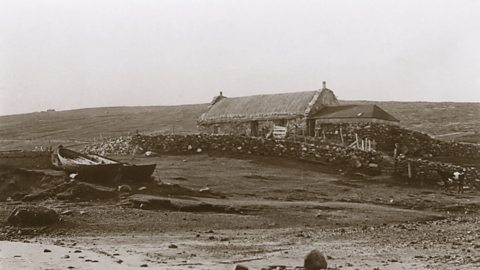
- The Painter is a story by Iain Crichton Smith about a young boy with a talent for painting, who lives in a small rural community.
- The story is told through a A first-person narrative is when the story is told from the point of view of one person using the pronoun 'I'. from one of the villagers.
This short story has themes of:
- illusion versus reality
- the restrictiveness of village life
- individual versus society
What is the plot of The Painter?
The narrator of The Painter begins by describing a local boy in the village who was a talented artist. The villagers were proud of his ability and bought his paintings to hang in their homes.
The boy mostly painted scenes of the landscape and wildlife, although the narrator admits that on occasion the community would have preferred if he depicted their village in a more flattering way. Aside from his artistic talents, the boy was different to the rest of the village because he was both beautiful and sickly, and it was reckoned that he would not live long.
The narrator then introduces another character, Red Roderick, so called because of his red hair. When sober, Red Roderick was a popular and well-liked member of the community. He seemed content and happy with his wife and seven children.
However, when he was drunk, Red Roderick’s character was transformed and he became aggressive and violent. He beat his wife and picked fights. Red Roderick felt he and his wife were due some inheritance from his father-in-law - a man who in his younger days had a reputation for great strength.
The narrator then recounts an incident in which Red Roderick, under the influence of alcohol, confronted his father-in-law with a scythe. As the two men began to fight, the whole village crowded round. The narrator became aware that the young painter had set up his easel and was entirely focused on capturing the image in front of him. The narrator becomes consumed by anger and destroys the painting.
After this incident, the villagers shun the boy and take down his paintings. We learn that once he grew up, the boy left the village and little is known about him.
The story ends with the narrator reflecting that he never regretted his actions. The rest of the villagers believed that he destroyed the painting to protect the reputation of the village. In truth, it was because he was afraid that the boy would capture the look of lust and enjoyment on the faces of both himself and the bystanders as they watched the fight.
Who are the main characters in The Painter?
The narrator
The Painter adopts a A first-person narrative is when the story is told from the point of view of one person using the pronoun ‘I’.. Doing so makes the narrator become part of the story and one of the most important characters.
What is interesting about the narrator is the strong sense of identity he feels with his community. He often uses "us" and "we" to emphasise the feeling of belonging and attachment to his village. There is a clear affection between him and his neighbours.
Despite this, he reveals himself to be an honest, insightful and reliable narrator. He acknowledges early that the villagers would prefer the paintings to be more flattering and he is very open about Red Roderick’s violent character when drunk. In many ways, the narrator sees the village in the same way that William does. The difference between him and William is that he does not reveal what he sees or thinks, while William's paintings expose reality.
During the fight, the narrator does not use the collective "we" or "us" that positions him as being at one with the village as a whole. Instead, he acts independently:
I deliberately came up behind him… I pinioned his arms behind his back… I would have beaten him…I tore the painting into small pieces.
Crichton Smith reminds us that even when we feel a sense of belonging to a community there are times when everyone must follow their own sense of conscience or morality.
What is revealing about the narrator is that he is able to understand why he reacted so violently to the behaviour of the painter. His anger was not, as the villagers believed, due to any misplaced sense of loyalty to the community and its wider reputation. Instead, he acknowledges that, as well as being appalled by the impassiveness of the painter, what he most feared was the painter capturing the image of his own face and that of his neighbours contorted with excitement and lust as they watched the fight.
In doing so he exposes an interesting universal truth about the human condition: that even men whom he considered "decent and law-abiding" were capable of taking such obvious pleasure in watching this display of aggression.
Red Roderick
Red Roderick is a character whose behaviour is entirely changed under the influence of alcohol:
- When sober he is content and behaves generously. He is popular for his generosity and his singing.
- When drunk, he is a violent and aggressive bully.
Despite the fact that, when drunk, Roderick beats his wife and picks fights with others, he is accepted by his community. They are able to look past his failings and focus on his more attractive qualities.
For all his faults, Red Roderick is protected because he mainly adheres to the codes and expectations of the village. His neighbours seem able to accept his behaviour because he is one of them. In contrast, the painter is ostracised and excluded by his neighbours. Despite William's behaviour being neither threatening or violent, it is treated as less acceptable. It seems that it is the fact that William is 'different' that means he is treated more harshly.
William, the painter
From the outset, William is depicted as different from the others in the village. The narrator describes him as a:
sickly, delicate and rather beautiful boy.
These qualities of fragility and beauty are immediately highlighted as being out of place among the hardy, stoic sensibilities of the villagers.
At first they seem to embrace his differences. Pride in his skill as a painter is used to convey the notion that their village had something unique or exotic. However, even in the days when the locals bought his paintings there is a sense that they would have preferred William created more flattering images.
It is true that once or twice he made us uncomfortable for he insisted on painting things as they were, and he made our village less glamorous on the whole than we would have liked it to appear.
Aside from his artistic talents, another quality that makes him stand out is his intelligence. Strangely, the narrator comments that:
many maintained that he wouldn’t live very long, as he was so clever
It seems then, just like the character of Mary in The Red Door, intelligence is viewed as a failing rather than a desirable quality in these communities. While violence, aggression and drunkenness can all be accepted, cleverness is associated with feebleness and illness.
William's paintings expose the truth about the village and its people, rather than the idealised image that they would like to portray. It is for this reason that he is rejected. If the job of any artist in any medium is to hold a mirror up to their society and reflect it honestly, then William should have been celebrated.
What are the themes in The Painter?
Illusion versus reality
The villagers are keen to present an idealised, yet untruthful version of themselves to the outside world, and possibly even to themselves. Even though they occasionally found some of William’s work a little disagreeable, with his "crooked" houses, and "spindly" villagers, they were prepared to overlook this, because "no other village that we knew of had a painter".
Initially, William added value to the village and his precocious talent was something to be admired. However, his quest for truth ultimately conflicted with the need of the villagers and the narrator to protect their slightly deluded perception of themselves, culminating in the painting of the fight being destroyed.
Through the narrator, the story suggests the community is aware of its imperfections and problems but is able to ignore them. Crichton Smith shows a society that may know that its image of itself is an illusion, but chooses to believe in this illusion anyway.
The restrictive nature of village life
This is a recurring theme in Crichton Smith’s work. What is interesting about this story however is that unlike Murdo in The Red Door and John in Mother and Son, the events are recounted not from the isolated individual’s point of view, but from that of one of the villagers.
We could expect Crichton Smith to identify with the artistic, sensitive and intelligent William, who finds the community in which he lives suffocating and oppressive and who ultimately has to leave to find personal fulfilment.
However, in adopting the persona of a villager, he manages to convey the specific lure that village life can have if one is prepared to fit in. William may indeed find enrichment and contentment outside the village. But he sacrifices the sense of belonging and fulfilment that can come from being a part of a small and close-knit community.
The narrator is well aware of the problems in his community, and the shared disturbing reaction to the violence of the fight. Unlike William, he chooses to reject and hide this aspect of the village. He is shown to be a willing participant in maintaining the illusion of appearance, even as it brings restrictions to William's art, and to the thoughts that he himself can express.
The individual versus society
On one level, it is William who best demonstrates this theme. He is immediately singled out as being different to the others in his community. Eventually he has to leave in order to fulfil his potential. For the village, William has to be rejected if they are to maintain their illusory image of themselves.
However, to a lesser degree, the narrator also exposes this conflict. While his neighbours believe he was prompted into action in order to save the reputation of their village, in reality what provoked him was a desire to protect his own sense of identity. He is appalled by the prospect that he too may be captured in the painting with the same expression of "lust and happiness" that he had observed on the faces of his friends.
We are aware that the narrator sees the same flaws that William does. However, he chooses to suppress these thoughts, or at least to not express them, for the sake of village society and his place within it.
Comparisons with other short stories by Iain Crichton Smith
There are clear parallels in this story with:
- Mother and Son
- The Red Door
- The Existence of the Hermit
All four contain criticisms of the insular narrow-mindedness that Crichton Smith often associates with small village life. The expectations of the local community become oppressive and restricting. There is a A direct contrast or division between two things that appear to be opposites in these stories between the individual and the community they live in, where his characters feel unfulfilled or unable to be themselves.
Both The Painter and The Existence of The Hermit show what happens when the community takes against someone for being different - in the case of The Painter, it is the boy's talent and beauty that sets him apart, and in The Existence of The Hermit it is the hermit's unusual lifestyle.
Both are told from the point of view of unnamed narrators who identify so strongly with the community they use the plural pronouns "us" and "we" often. This shows that for some, being a part of the community is a positive thing.
The cautionary tale is when any of the apparent 'rules' about conforming are broken. In both stories, the non-conforming character has to leave, unable to be themselves in such an oppressive environment. To an extent, each narrator is shown to be aware of the issues in their community but each chooses to overlook or ignore them.
In The Red Door and Mother and Son, the The main characters. are not outcast in the community and are instead living with the fear of what might happen if they, like William, or the hermit, live on their own terms.
The readers of all four stories are left feeling that something must change; that this divide between individual contentment and expression on one hand, and community rules and expectations on the other, is not leaving anyone with real happiness.
Revise The Painter by Iain Crichton Smith
Revise The Painter and other short stories by Iain Crichton Smith with interactive quizzes and flashcards for Higher English.
Quizzes - Iain Crichton Smith quiz
Test your understanding of Iain Crichton Smith short stories with a series of interactive quizzes for Higher English.

More on Iain Crichton Smith
Find out more by working through a topic
- count4 of 5
- count5 of 5
- count1 of 5

- count2 of 5