Overview of The Existence of the Hermit by Iain Crichton Smith
- The Existence of the Hermit is a short story by Iain Crichton Smith.
- Like many of Iain Crichton Smith’s works, this story takes place in a small, rural community where everyone is expected to conforms to the norms of village life.
- In this story, the calm normality of the village is disturbed when a A person who chooses to live in solitude, away from society, often for religious reasons. moves into a hut he builds for himself nearby.
- Though the villagers are initially intrigued by him, and make up interesting stories about his past, in time they come to feel uncomfortable about his presence.
The story has themes of:
- the individual vs social conformity
- the restrictiveness of village life
- rejection of things or people that are different
What is the plot of the Existence of the Hermit?
A A person who chooses to live in solitude, away from society, often for religious reasons. builds a hut in a rural village. The villagers are instantly fascinated, coming up with stories about his past and how he came to be there. Over time, however, the villagers start to feel uneasy about his presence.
The hermit does not actually do anything to cause trouble. He interacts minimally with the villagers, only going to the shop for necessities. Even the narrator, who acts as a sort of ‘spokesperson’ for the village, admits that the hermit doesn’t consciously do any harm. It is just the fact of him being there, his very existence, which is a ‘disturbance’ to the community. By not conforming, the hermit causes the villagers to feel unsettled.
…we accepted him as part of the landscape in which we all lived but gradually we came to realise that he was a disturbance to the village, though he was in no sense a nuisance. What I mean by disturbance is that the very fact of his existence was a kind of insult to us all.
He rejects any attempts at conversation and chases away children who try to tease him. More seriously, the narrator describes three examples of villagers who are affected negatively by his presence over time:
- the old man
- the schoolmaster
- the bachelor
First, the old man, previously settled in a long and apparently happy marriage, starts to treat his wife cruelly, insulting her in public and declaring that he wishes he had never married her. Around the same time, he would "go and stand near the hermit's hut and stare at it unblinkingly…" Eventually, he leaves home, apparently to become a hermit himself:
shouting that he was going away to live by himself and be a hermit since it was now clear to him that it was possible to live like that.
However, the man returns home after a short time, defeated and miserable.
Soon afterwards, the village schoolmaster becomes obsessed with the hermit: he cannot believe that he lives in such an isolated and quiet way, unless he has some kind of secret. This obsession grows until he can stand it no longer: he sneaks over to the hermit’s house to spy on him. He finds him sitting, doing nothing. The schoolmaster cannot cope with the reality that the hermit seems content in and with himself.
Finally, a bachelor begins to live more and more like the hermit, neglecting himself and having increasingly less communication with the village. One day, he suffers a dramatic, and public, breakdown. He has to be admitted to psychiatric care.
Soon afterwards, the hermit suddenly moves away, without any message or explanation. The villagers feel a sense of relief when he leaves and, later, they pull his hut down. The narrator comments that the indentation in the earth where it was can still be seen, and that he looks forward to the day when the grass covers it and the hermit is forgotten forever.
Who are the main characters in The Existence of The Hermit?
The hermit
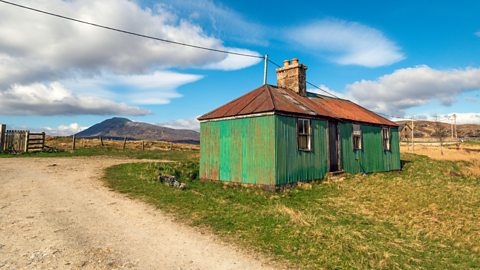 Image source, Tom Richardson Scotland / Alamy
Despite the hermit being the focus of the story, we learn very little about what he thinks or feels. We see him entirely from the perspective of the narrator, the ‘spokesperson’ for village opinion.
No dialogue is spoken by the hermit and we never hear how he reacts to the key three incidents.
We learn few facts, all about his appearance or actions - things that can be clearly observed: he is well built, always wears the same long, ragged coat, rides a bicycle and has constructed his own tin hut. He buys food at the village shop, fishes, does not seem to drink alcohol, walks on the moors and has no desire for human interaction.
In order to explain his strange lifestyle, the villagers invent stories about him: he is a disappointed lover, a scientist, a writer, a singer - all examples of what the villagers see as outlandish. They attempt to find out more, but are ignored by him. He simply does not need other people.
Having such little communication with the hermit, we might wonder why the village becomes so hostile towards him. The narrator tries to explain: the hermit is not a nuisance, but he is a disturbance. As the narrator says:
the very fact of his existence was a kind of insult to us all.
The villagers live in a community, where everyone knows and lives the same way as everyone else. The hermit lives alone: his very mode of existence is both a challenge and a temptation. By his existence, he makes the villagers question their predictable, conforming way of life. The only way they can make sense of him is through believing that he is hiding away from the world due to a broken heart. There is no evidence to believe this is true: it is just more comforting than trying to understand how he can prefer to live a life so different from their own.
Following the incidents, the hermit suddenly leaves. No one knows why: his disappearance is as mysterious as his arrival. One day there is no smoke coming from his chimney, and he is gone. The hut is left, with the door open, as if advertising his departure, and he is never seen again. The villagers are relieved, as if a malign presence has now gone.
And yet, what did he actually do wrong? The narrator concludes:
he ceased to be a challenge to us
This suggests the hermit had actively confronted them about their restrictive way of life. However, his challenge lay purely in the fact that he lived how he wanted, free and completely uninterested in their ‘rules’. They could not cope with that.
Image source, Tom Richardson Scotland / AlamyMen of the village
Three men in the village take extra notice of the hermit. They are:
- the old man
- the schoolmaster
- the bachelor
These three are not fully-rounded characters, but rather examples of the impact the hermit had on villagers. They feel compelled to examine their lives, in the light of his very different way of living.
The old man
The old man, after a lifetime of conforming to the village ways, suddenly becomes discontented.
He and his wife have lived a productive life, farming the land and bringing up children, the same as other members of the community. However, after the hermit moves in, the old man becomes restless for a life he never had. He shows "wistfulness" when watching the hermit cycle away, and stares at his hut for hours at a time.
This frustration is at first expressed through abusing his wife and then by leaving her to, he declares, become a hermit.
However, his attempt at rebellion does not last long. He stays in a barn with a leaking roof, tolerated by the owner. After his brief attempt at a hermit’s life, he is left, belittled, and still regarding the hermit with a mixture of "wonder and fear".
The schoolmaster
The schoolmaster thinks highly of his own intellect ("a very vain man") and enjoys expressing his opinions on a range of topics. The one thing he does not seem to be able to understand is the hermit and so this becomes a challenge for him.
He pronounces that no one can live as the hermit does, unless hiding a secret, and becomes obsessed with finding out what the secret is. Boasting that he does not fear a confrontation due to his wartime experience - which he exaggerates to make himself seem more heroic - he sets off to spy on the hermit. Finding the hermit just sitting there shocks the schoolmaster. He is
stunned by a vision of a world he did not know existed
His inability to understand suggests a limited imagination, despite his high opinion of his own intellect.
The bachelor
The bachelor is the villager most negatively affected by the hermit’s example.
Having been a sociable member of the community in his youth, at fifty he becomes dissatisfied with that life, retreats into himself and becomes reclusive. He neglects his appearance, cuts off social contact and stops helping with community tasks like peat cutting.
After a year of this isolation, he has a complete breakdown. He is seen throwing his furniture out of his house, screaming, taking off his clothes and repeating:
It is impossible to live like that
He is taken into care by medics (the narrator refers to "the asylum", which would have been the term used at the time for a psychiatric hospital).
Why do these three men become obsessed with the hermit?
It seems that something is lacking in their mundane lives. The hermit is dangerous because his presence makes the villagers examine their lives and find them unfulfilling. None of them can actually cope with the hermit’s life in reality:
- The old man cannot stand the physical discomfort.
- The schoolmaster cannot cope with something beyond his own limited comprehension.
- The bachelor can imitate the outward aspects of the hermit’s life but not the inner qualities that make it possible for him.
The narrator / 'the voice of the village'
Never identified, the narrator nonetheless provides an important perspective - the 'voice of the village' - through which we, the readers, ‘see’ and understand the events of the story.
The narrator is insightful and seems capable of observing and commenting objectively on the characters’. However, they identify very much with the opinions of the village, representing those very values that the hermit rejects.
The narrator is a typical villager who uses ‘we’ much of the time as they ‘speak for’ the village as a whole. They attempt (unsuccessfully) to find out information about the hermit and show judgemental attitudes, for example saying ‘Naturally he never went to church’. They view the hermit as competent and independent, but the very fact of his existence is a constant irritation for the community:
In the long winter nights, in the long summer days, we knew that he was there.
The three incidents are recounted largely in a non-reactive way, for example commenting only that it is ‘odd’ that the old man abuses his wife, who has been a consistently traditional good wife throughout their lives.
The narrator’s description of the schoolmaster as a "very vain man" is simple and understated, along with the explanation "none of us ever contradicted him since we all wanted to lead quiet lives".
However, the criticism, mildly expressed, is a lot more severe than it seems. For example
- "he had forgotten that after all he was only a schoolmaster in a very small school"
- "there were many people who were cleverer than him".
Clearly there is implied criticism in the description of the bachelor who went from "neat and elegant" to "ragged and dirty" with a "straggly beard" and a house that he "allowed… to go to rack and ruin".
The disappearance of the hermit is also described in neutral tones, but with a critical undertone:
door…,was wide open as if he was inviting people to see that he had gone
There is a suggestion that the hermit wants to send the village a message. They still can’t believe that the hermit is indifferent to the villagers: it’s much easier to believe that he is sending them a defiant message by leaving the door open than that he just doesn’t care.
We can also see that the narrator is not entirely honest, and is in fact an When a story is told from a first person perspective, the narrator can be fallible or unreliable in their reporting of events at points. At the end they say:
We succeeded in blotting him entirely out of our minds
Then, almost immediately, the narrator looks forward to a day when:
we won’t remember anything at all about him, thank God
Clearly, the hermit is haunting them still and they will struggle to forget his impact on them and the village.
Video - What is tone?
The tone of the narrator in The Existence of the Hermit is often judgemental and critical. Find out how writers create tone with this short revision video for Higher English.
What is tone? How is it created?
The attitude that a writer expresses towards a subject.
Tone always sends a message!
“What are you doing?”
A simple question, right? Adding a few extra words to this sentence can completely change the tone.
“What the hell do you think you’re doing?”
Whoever sent this message is not happy, and their tone gets this message across.
Everything we say or write has a tone. It’s shown in lots of different ways through word choice, imagery, sentence structure and even punctuation.
Tones can be driven by emotion. What we say and how we say it can change depending on whether we’re worried, excited, upset or affectionate.
But tone isn’t just about emotions. The situation is important too.
This can affect whether you choose a formal or informal tone.
“Dear student, It is with great pleasure that we offer you a place on your chosen university course…”
Though this is a very exciting letter to receive, it’s still written with a formal tone. The message you send your friend right after it might be a tad more informal, though:
“OMGGG!! I GOT INTO UNI! ”
Tone can say a lot in poetry.
In Liz Lochhead’s poem, My Rival’s House, she describes a simple scene of visiting her lover’s mother for tea.
“my rival thinks she means me well. But what squirms beneath her surface I can tell.”
Lochhead’s tone here is hostile and critical, as she feels her partner’s mother is trying to undermine her. The word “squirm” suggests discomfort.
“Deferential, daughterly, I sip and thank her nicely for each bitter cup.”
On the face of it, “deferential, daughterly” and “thank her nicely” all sound pleasant enough, but the word choice and imagery of "bitter cup” brings this surface tone into question.
It shows there is a poisonous attitude between the two women, as the speaker feels she is being forced to be submissive in the older woman’s presence.
Lochhead’s attitude is expressed clearly here through lots of different techniques!
The next time you’re at someone’s for tea, watch your tone!
Or you’ll no get yer puddin’!
What are the themes in The Existence of the Hermit?
The individual versus social conformity
Iain Crichton Smith often wrote about the tension between the urge to express one’s individuality - to be yourself - and the pressure to conform to the norms of society - to be what others expect you to be. In the village, conformity involves working on the land and being part of the community.
The hermit challenges these norms through his very lifestyle:
- he lives alone and independent
- he does not need social communication or the help of anyone (even building his own hut to live in)
- he actively avoids any interaction with the villagers
- he is not neat, clean and tidy
- he has few possessions or comforts in his hut, only one chair, a table, a stove
By disregarding the community, he makes himself free of its unwritten ‘rules’. His individual way of life both attracts and disturbs the villagers. Trying to be like him or to understand him damages the peace of mind of the old man and the schoolmaster; more disastrously, it has an enormous effect on the mental health of the bachelor.
The restrictive nature of village life
Crichton Smith lived for much of his life in a small rural community so he knew well the restrictions and pressures of village life. Here, he focuses on the way in which the villagers disapprove of an outsider; their tendency to gossip and judge; their repression of any feelings or behaviour that does not fit in.
The villagers seem contented, like the old man who seems to have a happy marriage. However, it takes only one person living a different sort of life to reveal the cracks in this apparently smooth facade. The old man wishes he had never been married; the bachelor gives up his conventional lifestyle; the schoolteacher becomes obsessed with the hermit’s ‘secret’.
Clearly, the conventions of village life are felt to be restrictive and unfulfilling by some villagers themselves, as soon as they are challenged by the presence of someone who refuses to live by them. The act of tearing down the hermit's hut and the narrator hoping the grass will grow over the shape that remains, shows how deep his lasting impact has been on the villagers while he appears to be entirely indifferent to them.
Rejection of difference
We see the villagers’ small-mindedness in their intolerance of someone who does absolutely nothing wrong, but just by his very existence is a constant irritant and provocation.
The villagers do not actually chase the hermit away, but it is clear that they are suspicious and critical of him. His rejection of any contact makes the mystery, and the disturbance, grow more powerful. It is not clear why he chooses to leave, but with the escalation in the incidents he is associated with and growing unease, it is possible that he might have left before any villagers tried to throw him out.
The hermit’s life choices create an implied criticism of them - or so they think. We never actually hear from the hermit what he thinks about any of what happens: we only know that he eventually removes himself from this place of judgemental and narrow-minded attitudes.
Comparisons with other short stories by Iain Crichton Smith
There are clear parallels in this story with Mother and Son, The Painter, and The Red Door. All four contain criticisms of the insular narrow-mindedness that Crichton Smith often associates with small village life. The expectations of the local community become oppressive and restricting. It also sets up a A direct contrast or division between two things that appear to be opposites in a lot of his work between the individual and the community they live in, where his characters feel unfulfilled or unable to be themselves.
Both The Painter and The Existence of The Hermit show what happens when the community takes against someone for being different. In the case of The Painter, it is the boy's talent and beauty that sets him apart, and his way to capture the truth of the village life, and in The Existence of The Hermit it is simply the hermit's unusual lifestyle, which makes the villagers question their own lives. Both are told from the point of view of unidentified narrators who identify so strongly with the community they use the plural pronouns "us" and "we" often. This shows that for some, the community is a positive thing to be part of. The cautionary tale comes when any of the apparent 'rules' about conforming are broken. In both of these stories, the non-conforming character has to leave, unable to be themselves in such an oppressive environment.
In The Red Door and Mother and Son, the protagonists are not outcast in the community (yet) and are instead living with the fear of what might happen if they, like William from The Painter, or the hermit, decide to live on their own terms. The readers of all four stories are left feeling that something must change; that this divide between individual happiness and expression and community rules and expectations is not leaving anyone with real happiness, but the hope is that each of the main characters finds a way to be themselves in the wider world.
At the end of The Existence of the Hermit, the narrator notes that
The door too was wide open as if he was inviting people to see that he had gone.
The image of the open or opening door can also be found at the end of The Red Door, where Murdo knocks purposefully on Mary's door, and Mother and Son, where John opens the door to listen to the rain. In each of these stories, the open door is a new beginning, or the hope of one.
Revise The Existence of the Hermit by Iain Crichton Smith
Revise The Existence of the Hermit and other poems by Iain Crichton Smith with interactive quizzes and flashcards for Higher English.
Quizzes - Iain Crichton Smith quiz
Test your understanding of Iain Crichton Smith short stories with a series of interactive quizzes for Higher English.

More on Iain Crichton Smith
Find out more by working through a topic
- count2 of 5
- count3 of 5
- count4 of 5
- count5 of 5