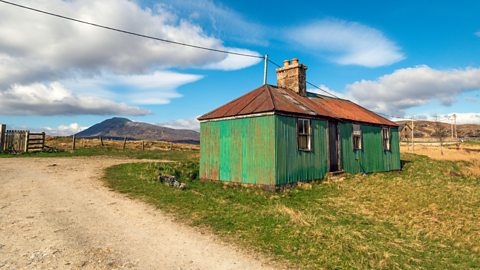
Overview of Mother and Son by Iain Crichton Smith
- Mother and Son by Iain Crichton Smith is a bitter, caustic story which examines the suffocating relationship between an infirm, aged, bedridden woman and her son.
- We meet John and his mother, who live together. She is confined to bed while John works the croft.
- John is trapped in a destructive relationship with his mother, who constantly goads and belittles him.
- The story ends with John turning his back on his mother and her insults. He stands in the doorway listening to the rain.
This short story contains themes of:
- restrictive village life
- the destructive nature of some family relationships
What is the plot of Mother and Son?
Mother and Son opens at the end of a day in which the son, John, has been out in the rain, working the land.
His clothes were dripping as he came in. The water was streaming down his cheeks, a little reddened by the wind and rain.
The bleakness from these opening lines is a sign of things to come. Instead of coming home to a warm welcome, he returns home to attend to his mother, in a home that is described as "in partial darkness, for, though the evening was not dark, the daylight was hooded by thick yellow curtains which were drawn across the width of the window".
This hints at the oppressive, dark nature of the home and the atmosphere between John and his mother. The colours yellow and green, often associated with sickness, are referenced several times in the descriptions of the home.
From the outset, the strain in the relationship between the two characters is clear. We are told that this not a one-off argument but rather, this is how their relationship is:
At these times her little bitter barbs passed over him or through him to come out on the other side. Most often however they stung him and he stood quivering in his flesh, and he would say something angrily with the reflex of the wound.
His mother is confined to her bed, and has been for a decade and so John has never been able to leave home and get a job like the other boys in the village. He says:
'You know well enough', he shouted, 'why I haven't my day's work'. It's because you've been in bed there for ten years now.
He feels compelled to look after his mother and work to keep their croft. His mother, however, far from being grateful to him perpetually goads and mocks him, saying "Why, you'd be no good in a job. The manager would always be coming to show you what you had done wrong, and you'd get confused with all those strange faces and they'd laugh at you."
As he prepares her tea, the criticisms continue relentlessly. She tells him how she regrets naming him after her father stating:
My father was never like you. He was a man who knew his business.
She implies that he has inherited some kind of hereditary predisposition to mental illness from his father’s side of the family and will be admitted to an asylum. Despite the callousness of such comments, John doesn’t retaliate though admits that they continue to hurt him.
Over the course of the story, a transformation takes place. A bus rattles past the croft and John thinks it is the other boys from the village:
That would be the boys going to the town to enjoy themselves. He shivered in his loneliness and then rage took hold of him again.
John experiences a moment of clarity and realisation. We begin to think that John may finally stand up to his mother and there is the possibility that this could end violently - he mentions wanting to "smash the teacup, smash the furniture, smash the house" and he considers that he might "avenge her insults with his unintelligent hands".
However, instead of using his hands to retaliate, the narrative takes an unexpected turn and ends not with him harming his mother, but turning away from her and opening the door to listen to the rain. The hope is that John can step outside the "dark cave" and live his life.
Who are the main characters in Mother and Son?
John
John elicits a sympathetic response from the reader (a technique known as A plea or argument designed to evoke an emotional response.) but he is not without flaws.
Though Crichton Smith depicts him as an attractive young man, with a "handsome" and "good looking face", he also emphasises that "there was something childish about it" with a "petulant mouth" and eyes that were "as dangerous and irresponsible as a child’s".
We realise that John is emotionally immature and therefore ill-equipped to deal with his mother’s constant berating - but it also reminds us that he is the child in this relationship, even though he is now an adult.
His unhappiness stems not only from her perpetual hectoring, but also from a feeling he is not making progress with his own life. Instead, he is resigned to a kind of purgatorial existence on the croft with his mother.
As each of the other boys in the village begins to break away, taking jobs and having nights out, John is unable to escape from the cycle of abuse. A sense of duty compels him to look after his mother and their land. In doing so, his own dreams and ambitions remain unfulfilled.
Life in this rural village is bleak. Crichton Smith emphasises the hardship of such an existence in the opening paragraphs. John comes home with his clothes "dripping" and with water "streaming down his cheeks… reddened by the wind and the rain". The relentless bleak weather is a metaphor for the relationship at the heart of the story - it does not change and remains "cold, dismal" throughout. As John comes home, he leaves one inhospitable climate for another in the cottage. This is a home entirely bereft of any sense of warmth or comfort and the room is dominated by the "four poster bed with soiled covers", just as his life is dominated by his mother.
John is overwhelmed by a sense of impotence and frustration at the way he is treated by his mother. As he tries to light the fire, he curses "vindictively and helplessly". This emphasises his exasperation and dissatisfaction with his situation. Yet he feels unable to do anything about it.
John's relationship with his mother subverts our usual expectations of the mother and son bond. It has a deeply corrosive effect of his. The impact upon his psyche is severe and is revealed in feelings of intense bitterness coupled with a desire to tune out of her criticisms.
At times he can "halt and watch her out of a clear cold mind" to try to numb himself from the pain of her jibes. Despite this, he admits just how hurtful he still finds her remarks. While occasionally "her bitter barbs passed over him… Most often however they stung him and stood quivering in his flesh", John is no match for the psychological war waged by his mother and feels increasingly embittered and emasculated.
There are hints that even in spite of her relentless cruelty, he still seeks some sense of approval from her. He becomes deferential to her at times as if he were asking for her pity. Here Crichton Smith highlights the particularly complex nature of the mother and child relationship. John’s relationship with his mother is toxic and dysfunctional but he still seems to be bound to her and want her blessing.
As the story continues, John eventually does reach his limit as the relentlessness of her attacks finally peaks.
A "terrible weariness" takes hold of him till he "felt himself in a dark cave", trying to protect himself from her rage "burrowing" into him and he experiences a moment of clarity:
Everything was clearing up… She’s breaking me up so that even when she dies I won’t be any good for anyone.
This realisation finally seems to bring a sense of peace to John.
His sense of loneliness closed round him, just as his house was on limitless moorland. There was a calm unspeaking silence, while the rain beat like a benediction on the roof.
As he observes the "bitter, bitter smile upon her face", highlighted through Repeating a word or phrase in a sentence can emphasise a point, or help to make sure it is fully understood., his mind is once more in a "turmoil of hate". However, instead of lashing out at her with his clenched fists, John turns away, opens the door and listens to the rain.
In the end then, John finds release from her cruelty not through lashing out, but in withdrawing. The open door represents possibility, and symbolises that finally he may find the strength and maturity to leave.
The mother
Unlike John, the mother is depicted in an entirely unsympathetic and negative light, with absolutely no redeeming qualities. She is utterly self-obsessed. Whatever condition has forced her to be bedridden has made her bitter and insular, with no shred of compassion, love, empathy or kindness.
Although the narrative is told from John’s perspective, it is the stinging contempt of the mother’s words that are most memorable. She continually humiliates and emasculates her son, even suggesting that he has some kind of mental illness.
Her comment that this is a condition that is "in your family but not in ours" is incredibly revealing. She feels such a lack of affection and disconnection to John that she seems to consider that he is not even related to her. This is especially shocking given the way society idealises the relationship between a mother and her child.
Although her anger and bitterness are palpable and relentless, we never really find out the root of her unhappiness. We can deduce from the comments about John’s father that she treated him with similar contempt. The fact she has been bed ridden for a decade would have an impact on her psyche.
However her particular hatred of her son, who looks after her and upon whom she is utterly dependent, can only be guessed at. Ultimately, her relentless abuse and destruction of his self esteem makes it impossible to see anything positive in this character.
In his descriptions of her, Crichton Smith emphasises her physical fragility and feebleness: she has a "frail white body" and a "scraggy neck" and is often compared to a bird, "pecking at the bed with a sharp beak" and her head "rising like a hen’s out of her plain white nightgown".
Despite her lack of physical strength, Crichton Smith shows us that she is capable of inflicting terrible damage psychologically.
This is a woman who could never be satisfied or pleased; she knows her condition prevents her son taking a job elsewhere but then she paradoxically mocks and belittles him for not doing so. Ultimately though, John’s epiphany renders her powerless and at last he seems he may be able to finally liberate himself from her.
Video - What is a simile?
Crichton Smith often compares the mother to a bird:
rising like a hen’s out of her plain white nightgown
This is an example of a simile and helps emphasise her fragile state.
Learn more about how and why writers uses similes in their writing with this short revision video.
What is a simile? How and why would you use one?
Simile!
A way to compare two things by using the words “like” or “as”
"Using a simile is like painting a picture with words.”
Their food was tough as old boots.
Imagine chowing down on an old shoe?!
This simile suggests that the food was leathery, dry and impossible to chew.
No thank you!
Be careful you don’t get similes mixed up with metaphors.
Metaphors compare two things by saying one is the other.
Similes always use “like” or “as”.
In her poem “George Square” Jackie Kay uses a simile to describe a protest:
“the banners waved at each other like old friends”
As well as suggesting how the banners move and wave together, this simile hints that the atmosphere at the protest was familiar, united and sociable.
Similes don’t always describe something clear, they can be much more complex.
In the novel The Cone Gatherers, Robin Jenkins compares the character Duror to a tree:
“He was like a tree still straight, still showing green leaves; but underground death was creeping along the roots”
Here, Duror is compared to a tree that seems healthy, but is dying on the inside.
This powerful simile tells us that although Duror may appear healthy and well on the outside
Inside, he is being slowly consumed by his hatred.
Using similes is a fun and effective way to explain something complex without using a long list of adjectives.
You can get as creative AS you LIKE!
What are the themes in Mother and Son?
Destructive family relationships
In Mother and Son, the destructive relationship that gives the story its title, also highlights the cost to the individual of maintaining a harmful relationship and of being dutiful. The relationship between John and his mother is memorable because it is so entirely lacking in any sense of maternal affection. Instead, the mother is a spiteful, hateful woman whose main pleasure seems to be derived from constantly humiliating and emasculating her son.
This is not an autobiographical account, but there are some interesting parallels in Crichton Smith’s own life. Like John, he was raised in a rural highland community by a widowed mother and their relationship was uneasy. Despite this, it was he who looked after her in her old age and he didn’t marry until after her death.
In this story, Crichton Smith forces us to acknowledge the corrosive and harmful effects of some familial relationships. He emphasises that sometimes the only way to find real fulfilment and quality of life is to sever such ties. In John we see the detrimental effects of caring for his mother and fulfilling the role of dutiful son. He is denied the friendships available to the other boys in the village and is effectively isolated from the local community.
Despite his physical attractiveness, there is also little prospect of any romantic relationship. The poverty of his existence is evident. In fulfilling his duty as a son, John has sacrificed any hope of personal happiness. The cost of duty is too high.
At the end though, there is a sense of hope that finally John will free himself from duty and find the courage to leave to address his own needs, dreams and desires.
The restrictive nature of village life
The restrictiveness of rural life is a recurring motif in many Crichton Smith stories and Mother and Son is no exception. The conditions are hard, the lifestyle is bleak and the landscape is suffocating in its dullness. There are also firm expectations in small communities about what is expected of people, and this would include caring for an elderly and infirm relative, whatever the personal cost.
However, although the expectations of the community are no doubt partly what keeps John looking after his mother, the world of Mother and Son is even more negative and claustrophobic than a restricted village. The two main characters in one room, with all the resentment and dislike between them is stifling. The open door at the end therefore symbolises an escape into the wider world and society. It hints at the promise of a much more fulfilling and enriching way of life.
Comparisons with other short stories by Iain Crichton Smith
There are clear parallels in this story with The Red Door, The Painter, and The Existence of the Hermit.
All four contain criticisms of the insular narrow-mindedness that Crichton Smith often associates with small village life. The expectations of the local community become oppressive and restricting. There is a A direct contrast or division between two things that appear to be opposites in these stories between the individual and the community they live in, where his characters feel unfulfilled or unable to be themselves.
In The Red Door, Murdo feels repressed and ponders "there were times he felt that there was more to life". There has to be more to life than the croft and his mother's anger for John in Mother and Son, and the reader hopes that the open door for John at the end of the story is a parallel with Murdo's decision in The Red Door to knock on Mary's door. These doors hopefully mean new beginnings for both of these unhappy The chief character in a literary work.. The hermit's open door at the end of The Existence of the Hermit after he has left the village, shows how little that character cares for village opinion and it is that quality that both Murdo and John could do with developing themselves.
While dealing with similar themes, Mother and son differs from the other stories in that it focuses on the relationship between two characters, rather than centring on situations that set an individual against a wider community. As a result, the atmosphere of Mother and son seems even more restrictive and claustrophobic. Village life, which demands a dull conformity in the other stories, seems like a possible escape for John. Trapped in the croft with his mother, he longs to find a job, or take the bus into town like the other boys.
The Painter and The Existence of The Hermit show what happens when the community takes against someone for being different - in the case of The Painter, it is the boy's talent that sets him apart, and in The Existence of The Hermit it is simply the hermit's unusual lifestyle. These stories show what John in Mother and Son is truly afraid of - the judgment of his neighbours and community if he lives his own life and severs ties with his mother. Both William in The Painter and the Hermit end up having to leave their respective villages, and again, the reader hopes that John might, too, at the end of this story.
All four stories focus on men living a dulled existence. They seem aware of the limits they must live within but seem so worn down or timid or comfortable that they put up with it. In their own ways, each story suggests escape from their repressive settings; whether it is John looking out the doorway and listening to the rain, Murdo knocking on Mary's door, the painter leaving the village, or the hermit leading his entirely separate life.
Revise 'Mother and Son' by Iain Crichton Smith
Revise Mother and Son and other short stories by Iain Crichton Smith with interactive quizzes and flashcards for Higher English.
Quizzes - Iain Crichton Smith quiz
Test your understanding of Iain Crichton Smith short stories with a series of interactive quizzes for Higher English.

More on Iain Crichton Smith
Find out more by working through a topic
- count3 of 5
- count4 of 5
- count5 of 5

- count1 of 5