Overview of Love by Edwin Morgan
- The poem Love by Edwin Morgan explores different, often contrasting, aspects of love.
- Love is described as a powerful force (sometimes for good, sometimes for bad) and finally it is powerful enough to leave this world and explore new, undiscovered, places.
- The poem is ultimately a celebration of the power of love and the reader is encouraged to experience it for themselves, in all its forms and let it take them where it will.
You can read Love by Edwin Morgan on the Scottish Poetry Library website.
The version of the poem published on the Scottish Poetry Library website is the form of the poem that will be used for the National 5 exam. The poem appears differently elsewhere.
Looking for some quick revision? Try an interactive quiz for National 5 English.
Form and structure of Love by Edwin Morgan
The poem Love by Edwin Morgan is unusual in both form and structure.
For the purposes of this article, we will refer only to the Scottish Poetry Library website version of the text as this is the version that may appear in the National 5 exam. You can see the poem as it was originally intended to be laid out on the Edwin Morgan Trust website. (You do have to scroll down to find it.)
In the version being used in the exam, the poem has sixteen lines. However, in many versions of the poem, these appear as long single lines which have to be continued over on to a new line, as they don't fit the width of a standard page.
There are other structural techniques used within the poem as well:
- listing
- repetition
- the Using three adjectives or descriptive phrases in a row to describe something or action., or tricolon
- When words, phrases, clauses, or sentences are arranged in ascending order of importance.
- A sentence that uses parallel structures of approximately the same length and importance to create balance.
These techniques demonstrate that these apparently free thought are actually very structured and precise.
The repeated rhyme of "-ate" sounds through the poem creates a structure on which all the assorted thoughts about love hang from. There are two shorter rhyming lines, forming a A pair of successive lines that rhyme, usually but not always of the same length("With love you send a probe/So far from the globe") This indicates a turn in the poem, where the scope widens and the poet starts to discuss not just what love is, but where it can take you.
Video - How to identify form
Poems come in all kinds of shapes and sizes. As described, the poem Love by Edwin Morgan has quite an unusual form and structure.
When we look closely at a poem, its form and structure can give us clarity on the message and meaning of the poem. Learn more with this short revision video.
Find out how to identify form in poetry.
Lines one to four
Love is the title of the poem. It is also the first word and is repeated throughout. There can be no doubt about what the theme of this poem is.
Line one
Morgan begins with the Using three adjectives or descriptive phrases in a row to describe something or action. and short sentences for emphasis:
Love rules. Love laughs. Love marches.
The words used are positive and strong verbs. They are also human actions so this is Personification is when a writer gives human characteristics to something that isn’t human. , perhaps to remind us that love tends to be a human emotion and to make the reader feel more connected to the idea.
This is followed by a shift in tone, and a longer description:
Love is the wolf that guards the gate.
This description extends the idea of strength with the ‘wolf’ and the The repetition of the same sounds or consonants in two more words nearby each other. ‘guards the gate’.
The ‘wolf that guards the gate’ is a tonal shift in these early lines, and could also be interpreted as a reference to Norse mythology. In Norse myth, the wolf Garmr guards the entrance to Hel (the underworld).
Click Show more to find out more about allusion to Garmr.
Garmr is a menacing wolf-like creature, and sometimes part of Norse mythology is that Garmr breaks free from his chains, joining the battle against the Gods and bringing destruction during an apocalyptic event, called Ragnarök.
Morgan often uses reference to myth and legend throughout his poetry. There are sentinel ‘hound’ figures in different mythological traditions, which makes this a widely understood symbol and image for Morgan to employ here.
The meaning of this in reference to this poem could be that love can be many things - protective, watchful, but also dangerous and potentially destructive.
Line three
In line three, the arts are listed indicating love is associated with creativity and ‘food’:
Love is the food of music, art, poetry.
Morgan suggests that without love, the arts would starve. Love is essential, and it is love which keeps these forms going. This phrase is an A quick reference - often to an image, character or place - from a work of literature or music or mythology. to, and a reversal of, Shakespeare’s famous line which opens Twelfth Night: ‘If music be the food of love, play on’
Line four
Morgan uses the rule of three again to expand on the idea of feeding the arts and A sound feature; the repetition of the same sounds (mainly consonants) usually at the beginning of words. for emphasis:
It fills us and fuels us and fires us to create.
The three verbs increase in intensity building to a When words, phrases, clauses, or sentences are arranged in ascending order of importance. from just putting something in us, to powering us, to inspiring us to make art.
Video - What is repetition?
The word ‘love’ is repeated throughout the poem for emphasis.
Brush up on your understanding of repetition with this short National 5 English revision video.
What is repetition? How and why would you use it?
Repetition, repetition, repetition!
Repeating words or phrases can really, really help make an idea more memorable. Really!
“The soup was stirred and stirred until it thickened”
If we say “the soup was stirred until it thickened”, it just gives us the facts.
Adding some repetition tells us more. Repeating the word ‘stirred’ suggests just how much time and effort has gone into the cooking.
In his most famous speech, Martin Luther King repeats “I have a dream”
“I have a dream that my four little children will one day live in a nation where they will not be judged by the color of their skin but by the content of their character. I have a dream today… I have a dream that one day every hill and mountain shall be made low”
Every repetition of this line builds on the one that has come before, reinforcing his passion and emphasising each point he makes.
Repetition can also be effective in poetry.
In his poem Visiting Hour, Norman MacCaig writes about going to see his sick wife in hospital. As he walks through the corridor he writes:
“I will not feel, I will not feel, until I have to.”
MacCaig is determined not to let his feelings overcome him. The repetition helps tell us how hard he is trying to remain numb.
Why not try adding repetition to your writing?
If you like it, you can use it again, and again, and again.
Lines five to eight
Line five
Line five begins with the first purely negative description of love:
Love is terror.
This short sentence is abruptly placed at the start of a line, creating a strong contrast to the previous description of love and arts. The reader wonders why the speaker would be so fearful of love (as suggested by "terror"). Morgan suggests that when in love, we can feel vulnerable and exposed, frightened perhaps to give ourselves to another. Again, as with the shift in tone earlier to the "wolf who guards the gate" Morgan is emphasising how love can also be something terrifying or fraught with danger.
It should be remembered as well that for much of the poet’s life homosexuality was against the law so to love another of the same sex could genuinely induce fear of being discovered.
The use of the word "sweat" is ambiguous at first. It could refer to the fear mentioned before, or suggest that love can be hard work. Given how the poem goes on, it is likely to also hint at the physical aspect of love.
Line six
The following reference to bedding continues this idea:
Love is bashed/ pillow, crumpled sheet, unenviable fate.
This suggests that passion can be messy ("crumpled") and physical, as "bashed" is a word that has connotations of damage, and even potentially violence. Again, Morgan is highlighting that love has its dark sides, dangers and threats.
The phrase "unenviable fate" is important due to the placing of "fate" at the end of the line as the rhyming word. Both words have negative connotations and this ominous tone could be linked to the earlier word "terror", as well as to the previous mythological reference. As homosexuality was illegal for most of Morgan’s life and therefore relationships had to be kept secret, even if the relationship is successful and there is no loss, the "fate" is going to be "unenviable" as it can’t be celebrated publicly.
Lines seven and eight
The words in line seven are, again, very powerful:
Love is the honour that kills and saves
"Honour" suggests a moral purity, which seems to go against the rebelliousness of the previous line. "Kills" and "saves" are opposites and this continues the To place two or more ideas/images close together to create further meaning for an audience. ideas described throughout the poem. Again, these are strong words and these descriptions suggest love has great power, perhaps even over life and death.
Line eight directly addresses the contrasts discussed throughout the poem thus far - Morgan suggests there will always be mixed feelings about love and contradictions within love itself.
Lines nine to eleven
Line nine introduces an Metaphors are a way of describing something by directly comparing it to something else. An extended metaphor takes this comparison and builds it over several paragraphs or poems, so it becomes a theme of the piece of writing. of a drink being poured. It begins with ice in a glass, which is ‘crushed’, perhaps suggesting the state of an individual before they are touched by love – cold and broken.
Love is the crushed ice that tingles and shivers / and clinks
The metaphor continues with another list of three which describes how a potential lover is excited by love, just as the ice is ready for the drink to be poured.
The Personification is when a writer gives human characteristics to something that isn’t human. of ‘tingles’ and ‘shivers’ is sensual and suggests anticipation while the When a word sounds like the word it is describing. For example, ‘buzz’ or ‘hiss’.‘clinks’ suggests movement and brings us back to the extended metaphor of the drink.
The care taken over the language here is noticeable as there is:
- The repetition of vowel sounds in a series of two or more words. in the repeated ‘I’ sound
- The repeated use of the ‘s’ sound in the beginning, middle or end of nearby words. with the repeated ‘s’
- repetition of ‘and’ - lending rhythm and a fluidity to this line to stress how natural this is.
The Scots dictionary definition of ‘fidgin-fain’ is ‘restlessly or excitedly eager’ which matches what has come before and has the added value of The repetition of the same sounds or consonants in two more words nearby each other. . The use of Ordinary, everyday language and dialect. Scots here reminds us that while there is beauty in love, it is also natural and down to earth and belongs to us all.
Morgan continues the extended metaphor of the drink being poured:
absinth to fall on it and alter its state.
Absinthe is a very strong spirit and this ties in with the power of love described in the poem thus far. It has been chosen here, not only as a drink that Morgan himself enjoyed, and associated with poets and artists in general, but due to its transformative (some say hallucinogenic) qualities. This fits the poem perfectly as it suggests how intoxicating, transformative and perhaps addictive, love can be.
The way absinthe is prepared as a drink alludes both to the crushed ice earlier in this line and to the sugar as it can be made like a ‘slushy’ with crushed ice; or water is dripped over an ice cube on a teaspoon and the sugar-water falls into the absinth below, causing its strong green colour to change into a cloudy white liquid.
In an author's note to the poem, Morgan says:
And I use the image of absinth (a drink I am fond of) swirling round the ice-cubes in a glass to evoke the desired quickening, which we are fidgin-fain (physically eager) to produce.
This metaphor works on various levels as love changes a person as the liquid changes and the effect is strong as love is powerful, and finally this effect of the drink, or love, may be ‘ambiguous’ or it may ‘kill’ or ‘save’ so may be positive or negative.
Lines twelve to sixteen
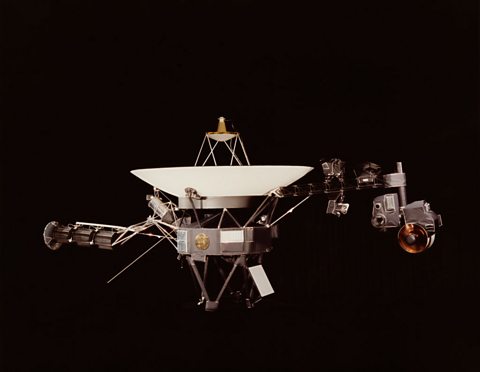 Image source, Getty Images
In line twelve, the poem changes in structure to two much shorter lines. This suggests a new direction for the poem, as does the new rhyme of the final word, ‘probe’. This word is scientific and makes us think of space, which is continued in the following lines, and the idea of exploration, which is also a common motif in Morgan's poetry. He uses this to show the vastness of the universe and what we have not yet encountered.
Over-the-top exaggeration for effect. is then used to suggest that love is so transcendental, so transformative, that it has taken us beyond our world entirely:
So far from the globe
‘Globe’ is here to rhyme with ‘probe’ but is another pseudo-scientific term. The qualifier ‘so’ is added to suggest that not only are we coming away from our planet, we are going a long distance away - such is the power of love. These short lines accentuate this power and emphasise that something important is happening, perhaps the poem is approaching the finale or A gradual build-up, increase in intensity.
The last lines of the poem continues these ideas. Love can take us so far from our world that a new love can feel like discovery, or uncharted territory. One of the most striking things here is the lack of punctuation.
No one can name the shoals the voids the belts the / zones the drags the flares
Typically, a list like this should have commas and Morgan’s punctuation thus far has been very controlled. This is a clear choice and the effect is that everything is happening at once and there is a lot of it. It’s new and exciting - otherworldly - and full of contrasts, just as the whole poem has been. There are references to the sea and to space throughout, mixing these images of journey and discovery. Love is all of these things, all at once.
- ‘Shoals’ suggest a lot of things together, like fish, but also references underwater ridges or sandbanks. This links to the idea of the journey of the probe, as they are obstacles that bring danger and need to be navigated around.
- ‘voids’ are the opposite as these are full of nothingness, another reference to space
- ‘drags’ suggest a downward motion or negativity, like an anchor being dropped and holding a boat back-‘flares’ are bright and upward. It could suggest solar flares in space, although flares at sea are a signal so the placing of this last in the list takes us into the idea that this new world is beckoning everyone to explore and find their way through all this.
- "it signals all to/leave all and to navigate" This is a reference to space probes, which travel away from Earth to explore far off areas of the solar system and send back information but are destined never to return. The message here is that we should explore love, in all its ups and downs and different experiences. There is no doubt that the poet embraces love in its entirety and is encouraging his reader to do the same.
Image source, Getty ImagesWhat are the themes in Love by Edwin Morgan?
The obvious theme is the title of the poem: Love. The poem explores various aspects of love which often contradict each other but what comes through everything is that love is a powerful force. As the poem progresses, so do the ideas around love as the Metaphors are a way of describing something by directly comparing it to something else. An extended metaphor takes this comparison and builds it over several paragraphs or poems, so it becomes a theme of the piece of writing. of pouring absinthe suggest love has the power to transform a person, much as the water changes the colour of the drink and the drink itself has the power to change a person.
The final section of the poem suggests that love is an exploration of the unknown and that it can take us far beyond our own world – the metaphor is of a probe going into space – and that the very act of this exploration, of falling in love, can be frightening but also exhilarating which reminds us again of the start of the poem when these ideas are stated more simply.
Other themes can be related to love and its power, such as the human condition, relationships, strong feelings, contrasts and change.
Comparing Love to other Edwin Morgan poems
The most direct comparison in the Morgan list is to Strawberries as it is also centred around the theme of love and, while Strawberries focuses more on a single memory and Love is more philosophical, conveying more general ideas about what love is, the poems are both clearly personal to the poet.
If we open out the theme of love a bit we can compare Love to others on the list. Love is an aspect of what we call the ‘human condition’ which really is about human experience, what it is to be alive, and we see other aspects of this in Morgan’s poetry such as:
- death and compassion in Death in Duke Street
- suffering and compassion in In the Snack Bar
- hardship in In the Snack Bar and Glasgow Sonnet (I)
- connection to humanity in Trio, In the Snack Bar and Death in Duke Street
In terms of form, the only other poem which adheres to such a strict form and structure is Glasgow Sonnet (I).
Revise 'Love' by Edwin Morgan
Revise Love and other poems by Edwin Morgan with interactive quizzes for National 5 English.
Quizzes - Edwin Morgan. quiz
Test your knowledge of the set texts by Edwin Morgan with interactive quizzes for National 5 English.

More on Edwin Morgan
Find out more by working through a topic
- count5 of 7

- count6 of 7
- count7 of 7

- count1 of 7