Overview of Death in Duke Street by Edwin Morgan
Death in Duke Street by Edwin Morgan is one of his A phrase coined by Edwin Morgan to describe poems which capture an event like a snapshot. .
In this poem a man has fallen ill on Duke Street (a prominent street in Glasgow) and is comforted as he dies by two passers-by:
- a young man
- a mother who has a child with her.
Others have gathered around the incident, and cars drive past. What Morgan is interested in as this scene unfolds is:
- how random life and death are
- how everyone around this incident is there by sheer chance
The last lines focus on the man dying with these strangers by his side and how no one is there to properly mourn him.
This poem explores themes of social responsibility, social isolation, and death.
You can read Death in Duke Street by Edwin Morgan on the Scottish Poetry Library website.
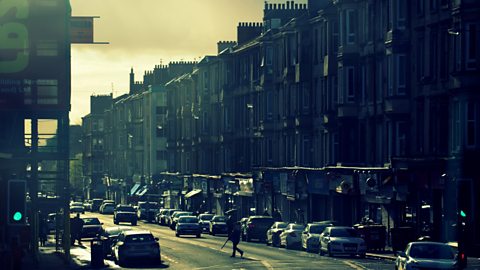 Image source, Gerard Ferry / Alamy
Looking for some quick revision? Try an interactive quiz for National 5 English.
Form and structure of Death in Duke Street
Death in Duke Street is what Morgan calls an A phrase coined by Edwin Morgan to describe poems which capture an event like a snapshot. . He describes this practice in his collection of reflections, Nothing Not Giving Messages:
I began a while ago by writing short poems which were directly about events which I had either read about or seen in newspapers or on television. So it's a poetry which is very closely related to real life in that sense, but I gave myself the kind of restriction that the poem must be presented in such a way as to give a visual picture of this event, whatever it was, as if somebody had been there with an Instamatic camera and had just very quickly snapped it…"
As it is an 'instamatic poem', the focus is on describing the event as quickly as possible, to give the reader a picture of what is going on. The lines are broken up with punctuation and the line-breaks themselves fragment things further so the reader pieces together the picture as though quickly looking from one thing to another.
- There is no strict A repeated pattern of rhymes, usually written with letters ABAB would mean lines 1 and 3 rhyme; and lines 2 and 4 rhyme also rhyme but differently. or rhythm to the poem.
- It has twenty-nine lines in total.
- Twenty-seven lines are contained in one long verse.
- The final two lines stand alone as a separate couplet.
The last section of the main verse slows things down as the man slips away and then there is one final verse, a A pair of lines in a poem, usually rhyming and of the same length., which provides the comment that, after this moment has passed, no one there will really mourn the man who has died.
Section I: lines one to eight
The poem opens with "A huddle", suggesting something of interest to at least a few people, that there is something going on here. This piques the reader's interest as well, especially given the dramatic title, and we want to read on.
Morgan attempts, in his 'instamatic' style, to record the scene. The word choice of "greasy" suggests the street is distasteful or dirty, which can be taken literally or When a writer uses figurative language they do not simply state the facts, they use words or expressions with a meaning that is different from the literal interpretation. For example, they might use exaggeration to make a point, as in 'I have a ton of homework'. - we are looking at the street as a setting for this scene to play out. The phrase ‘greasy street’ is highlighted through two sound features: the The repetition of vowel sounds in a series of two or more words. of the repeated ‘ee’ sound and the repetition of the ‘s’ within the words - known as The repeated use of the ‘s’ sound in the beginning, middle or end of nearby words..
cars stop, nose past, withdraw -
The information about the cars here is in Adding extra information using brackets (), commas , or dashes - -., emphasised with the dashes placed at the end of lines, and we have a three parallel words, phrases or clauses used in succession with equal length and/or rhythm. An example of the rule of three. , or rule of three describing the actions. However, the drivers are not mentioned here, instead the cars are Personification is when a writer gives human characteristics to something that isn’t human. .The most powerful action, "withdraw", is highlighted by coming last in the tricolon, and by enjambment. The drivers don’t want to get involved, and perhaps the protection of the vehicle allows them this anonymity - whereas, as we will see, the pedestrians do the opposite and get closer to the event. The actions of the cars are discreet, quiet and almost sly.
dull glint on soles of tackety boots,/frayed rough blue trousers, nondescript coat
These next lines of the poem describe an ordinary man - we are given details like his "tackety boots", "blue trousers", "nondescript coat" - who is also perhaps down on his luck - "dull glint", "frayed", "rough" - and who is lying on the pavement as we can see the soles of his boots. "Glint" suggests light, but "dull" contrasts with it – creating an A pairing of two words that seem to be opposites or contradictory. when two contrasting words are put next to each other, so we get the sense that something is not right.
stretching back, head supported/in strangers’ arms, a crowd collecting –
But then we see the man is in a bad way, helpless, reliant on being "supported" by "strangers" which makes the reader sympathetic towards him, we can see he is very vulnerable. The "huddle" has grown as emphasised by the A sound feature; the repetition of the same sounds usually at the beginning of words. of "crowd collecting". The 'instamatic' nature of this poem sees events unfolding in real time, and is more vivid and immediate as a result.
‘Whit’s wrang?’ ‘Can ye see’m?’/ ‘An auld fella, he’s had it.’
The dialogue adds to the realism, especially as it is in Scots, and is colloquial which fits the ordinary street setting. The multiple questions on one line are answered in the next and it feels as though there is a lot of chatter at once, which adds to the impression of a commotion on the street.
Section II: Lines nine to nineteen
The poem now turns its focus to the passers-by who are helping. The details in the description such as "headscarf" makes the poem more vivid as we see the scene before us very clearly. The young mother is "kneeling to comfort him" is almost reverent, even though it is clearly a distressing and difficult scene. Her son's confusion ("stands puzzled") adds to the scene and the realism. He is used to being the centre of his mum’s attention and now he is a bystander.
A woman drops her bag suddenly to help the man. This adds to the sense of events happening quickly
her shopping bag / spills its packages
This image suggests something hurried and sudden. The Personification is when a writer gives human characteristics to something that isn’t human. of "spills its packages" hints that even the shopping bag is upset at the man’s state. This sentence ends with a thinly veiled criticism of the nosy onlookers who are just watching, not helping at all - made clear by the repetition of the word "look" and the emphatic "everything". The onlookers take in all parts of the scene with equal interest; they are as detached from the man as a person as they are from the objects round him.
"On the other side" turns the reader's attention to another part of this scene. Again in the instamatic style, we are shown everything that is happening in this freeze-frame. There is a wide representation of humanity here now with the old man, a young mother, her child and now a youth, as well as the presumably mixed crowd that has gathered. It is important that young people have stopped to help as this suggests optimism and hope. We are told that the young man is "nervous" which adds to the emotion of the scene. This idea is immediately followed by "awkwardly" which reinforces the idea of this inexperience and anxiety, and "now" suggests he leapt to help without thinking.
a youth, nervous, awkwardly now / at the centre of attention as he shifts his arm / on the old man’s shoulders, wondering / what to say to him, glancing up at the crowd.
Morgan uses A poetic device where a sentence continues beyond the end of the line or verse. here to shift our focus back and forth between the youth and the dying man:
- The youth "shifting his arm" makes him the centre of attention and suggests his discomfort.
- Attention moves to the old man as we learn the youth's arm is holding the man, literally supporting him.
- The word "wondering" is then placed at the end of a line to take the focus back to the youth and to make us ask what he is wondering about.
- The second half of this clause ("wondering / what to say to him") is on a new line and answers our question from before. The young person is wondering what to say to the old man.
- Finally we are reminded of the crowd as the youth looks to them as though asking for help.
These were next to him when he fell, / and must support him into death.
Lines 18 and 19 are a shift in the poem, coming away from the overall picture and description and becoming more philosophical, revealing something of the speaker's own thoughts, thinking about what all this means. The woman and the youth are witnessing this scene by chance, as they just happened to be "next to him", but the word "must" is an interesting word choice as it shows how they have no option, they are compelled by their humanity to help him, even just by being there in his final moments. The word "support" has double meaning here; they are physically holding him but also trying to comfort him.
Video - What is personification?
Morgan uses personification when he describes the shopping bag "spill[ing] its packages", suggesting that even the shopping bag is upset by the man’s condition.
Find out more about personification, and why writers use it, with this National 5 English revision video.
What is personification? How and why would you use it? Bitesize explains with examples from ‘Home’ by Iain Crichton Smith.
Personification
Giving an inanimate object human feelings or actions.
“The thirsty flowers seemed to reach out and beg for water.”
The flowers can’t actually move or beg, but by personifying them, their need is made more human and understandable.
As well as actions, like moving or speaking, personification can also attribute a human feeling to an object.
“The apple sat, proud as punch, at the top of the fruit bowl”
The personification of the ‘proud’ apple, and its prominent position in the fruit bowl makes it seem more appealing.
Without the personification, this would just be a description of a lifeless scene.
Describing objects as if they are people is a way to make sentences more exciting.
In Iain Crichton Smith’s short story ‘Home’, he uses personification to describe how a street has changed:
“Instead of small shops, supermarkets were springing up, flexing their huge muscles”
The personification here tells us that the supermarkets are an intimidating addition to the town.
Their “huge muscles” represent their wealth and the power that these big businesses have over smaller rivals, and the fact they are “flexing” tells us they are flaunting this power, or showing off.
The personification paints a striking image, and means the writer can avoid a long explanation of business economics.
Why don’t you try bringing your writing to life with personification?
It can really make it sing!
Section III: Lines twenty to twenty-nine
The last ten lines of the poem bring our focus away from those helping the man and back to the man himself. It begins with a straight observation that the man "seems not to be in pain", which is a small comfort for the crowd, the speaker and ultimately the reader who is now invested in this scene. Now we are reassured he is not in pain, the next description is keenly observed by the reader as this man is on the point of death:
he is speaking slowly and quietly / but he does not look at any of them,
The words "slowly and quietly" suggest calm and slow down the pace of the poem. "he does not look at any of them" suggests a separation.
We learn that "his eyes are fixed on the sky". This could be because he is lying on the ground and it is more comfortable to look up. It could also suggest that the man is praying; the sky can often symbolise God and heaven. However, the word "fixed" also suggests a determination - the man is on a journey. As if to confirm this, we are told:
already he is moving out / beyond everything belonging.
The short lines are helpful for this section as we need time to process each stage of this, each aspect of what we are witnessing. The line "beyond everything belonging" - is the most important line in this section of his slipping away and it is emphasised by the use of The repetition of the same sounds or consonants in two more words nearby each other. . He is going far from us - the reader, the crowd, this world, life - and we can’t follow. He is separating from us as he moves from life to death. "As if he still belonged" indicates quite clearly he does not, he has gone, he has died, but the crowd, or at least the young mother and the youth, want to be sure that he's comforted in his last moments, or do not want to accept this immediately, so they "hold him very tight".
All of this poem has happened at once, in one long verse. This is because Morgan's A phrase coined by Edwin Morgan to describe poems which capture an event like a snapshot. are a snapshot of life and we ‘see’ the whole picture all at once. Here there is a break, though, and it is perhaps to signify the end for the man, or it is time for the reader to pause and reflect about what they have just ‘seen’, or it is a pause for the poet before he delivers his final thought.
Only the hungry ambulance/howls for him through the staring squares.
Starting the last couplet with "Only" reminds us that despite the helpful bystanders on Duke Street, this man has died essentially alone. The bystanders didn’t know him and they won’t really grieve for him which is what this last couplet is about. It is ‘only’ an inanimate object - the ambulance - which will mourn him.
At first, the ambulance is A type of imagery in which non-human objects, animals or ideas are given human characteristics. as "hungry", which is quite sinister as it suggests the ambulance is desperate for more people to fill it, suggesting that this is just one death of many. The man is put into the ambulance as if feeding it.
The sirens are personified with "howls", which likens the ambulance to a wild animal and adds to the sinister tone of these final lines. The "howl[ing]" is also an example of When a word sounds like the word it is describing. For example, ‘buzz’ or ‘hiss’. for the sound it makes and it is a strong word suggesting the grief for this man should be extreme.
The "staring squares" could be a reference to the grids of Glasgow streets through which the ambulance travels, full of people who stare at ambulances as they go past (much as the ‘huddle’ looked at everything going on earlier in the poem), or the windows which stare down at the ambulance from the buildings on these streets. The alliteration and assonance of this phrase right at the end of the poem is like a full stop - makes the end feel final, like the death of the man.
What are the themes in Death in Duke Street?
Social responsibility
Perhaps the main theme of this poem is social responsibility – the idea that we are all connected and responsible for each other to some extent. This is tested, and shown, in the response to this man’s death in public, as the passers-by that happen to be there are morally required to help as much as they can:
These were next to him when he fell, / and must support him into death.
A "huddle" and then a "crowd" gathers and they "look at everything" which is one aspect of human nature, with another exemplified by the cars which "nose past" and then "withdraw" but the man is supported by two individuals – the young mother and the youth – who do what they can in spite of inconvenience or discomfort. This is what Morgan wants us to focus on in the poem as it is this which gives us optimism and hope that our fellow human will help us if we need it, and that community spirit prevails – "they hold him very tight".
Social isolation
Morgan examines social isolation in Death in Duke Street, particularly by looking at how people react to the incident.
The crowd, the cars, the "staring squares" remain detached and take in what is happening without relating to the man or others involved as people. The use of the word "withdraw" in the second line highlights that passers-by don’t want to get involved.
While the young woman and youth do help the man; it is likely they will forget about him and won't grieve. The youth feels "nervous" and "awkward", which suggests showing this kindness to a stranger is uncomfortable and unnatural.
These reactions reflect a wider point that members of society have become too isolated from one another.
Death
From the title to the final image of the "hungry ambulance", death is present throughout this poem. It is a reminder to the readers that it comes to us all and we don’t know when or where. The man is described as very ordinary – "tackety boots", "nondescript coat" – and where he falls is just as ordinary – "greasy street".
The people who help him are equally everyday, as depicted by the use of very colloquial language in their conversation and details such as "headscarf" and "shopping bag". But these "strangers" help the man as best they can and "support him into death" which is hopeful as there are people with him. The final message is clear, however, that when we die we are ultimately separated from those around us which is made clear as "he does not look at any of them" as he is "moving out".
Comparing Death in Duke Street to other Edwin Morgan poems
In terms of social responsibility, kindness and helping others, In the Snack-bar is the most direct comparison as the speaker of the poem helps the man when he needs it, just as the passers-by on Duke Street help the dying man the best they can. Human frailty is evident in both of these poems, too, and vulnerability. These themes are also apparent in Glasgow Sonnet (I) which depicts people living in poverty.
It could be said that human connection is the link between these three poems and the other three on the list as well –
- In Trio the strength of the human connection is what moves the speaker of the poem
- In Love and Strawberries, Morgan writes about that most powerful of human connections – love. Love is one of the universal themes of the human condition – what it is to be alive – and that is also true of death, discussed in this poem.
Both Love and Death in Duke Street feature the imagery of a journey away from the Earth into space and the unknown: one through the power of love, the other through the process of dying.
Revise Death in Duke Street by Edwin Morgan
Revise Death in Duke Street and other poems by Edwin Morgan with interactive quizzes for National 5 English.
Quizzes - Edwin Morgan. quiz
Test your knowledge of the set texts by Edwin Morgan with interactive quizzes for National 5 English.

More on Edwin Morgan
Find out more by working through a topic
- count2 of 7
- count3 of 7
- count4 of 7

- count5 of 7