Overview of Glasgow Sonnet (I) by Edwin Morgan
Glasgow Sonnet (I) is a poem by Edwin Morgan about the experiences of people living in a tenement block in Glasgow.
The poem starts by giving a description of the exterior of the building before entering inside to concentrate on the poor life of a man. He is shown to be disappointed, ill and abandoned by a society which does not seem to care.
This poem deals with themes of:
- urban decay and poverty
- the contrasting images of beauty and squalor
You can read Glasgow Sonnet (I) on the Scottish Poetry Library website.
Looking for some quick revision? Try an interactive quiz for National 5 English.
Context
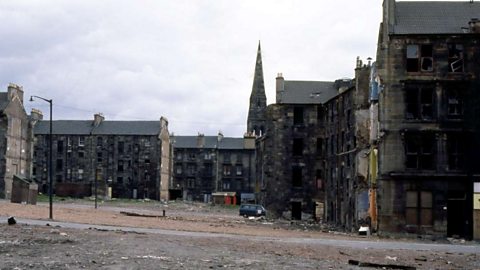
Glasgow Sonnet (I) is the first in a series of sonnets Edwin Morgan wrote about Glasgow and Scotland.
Edwin Morgan was always intrigued about the outside world and internationalist in his outlook. He was also deeply committed to his home city and the issues which affected it. This is the first in a sequence of Glasgow A fourteen-line poem traditionally on the subject of love. written in 1972. Morgan later also published a collection of sonnets devoted to Scotland.
The early seventies was a time of failing industry and rising unemployment in the UK and Morgan explores the human costs of these factors in this poem. It is an unflinching description of a derelict Glasgow housing block – the filth, debris and poverty that abound there and the people that populate this neglected place.
Form and structure of Glasgow Sonnet (I) by Edwin Morgan
Edwin Morgan makes the unusual choice of selecting the Used by the Italian poet Petrarch it's a 14-line poem split in two parts: the first 8 lines (octave) use the rhyme scheme ABBAABBA and show a problem or idea. The last 6 lines (sestet) often use CDECDE or CDCDCD and give a response. form for his poem.
What is a Petrarchan sonnet?
- Like all sonnets, it has fourteen lines.
- It is divided into an octave (eight line) section and a sestet (six line) section.
- The octave generally rhymes ABBAABBA and sets up a problem or situation.
- The sestet usually has a CDCDCD rhyme scheme and provides a resolution.
The sonnet form is tightly structured and rigid. Morgan uses this form to draw a forensic picture of the dilapidated building:
- The octave describes the exterior of the building
- The sestet describes the interior, focusing on one flat.
What makes this choice seem especially unusual is that this particular sonnet form is associated closely with love and romantic poetry, and the subject matter here seems, on first reading, to be completely the opposite.
Yet, Morgan is surely using the form to show his love for his city in all its discarded ugliness. He seems to be using the form ironically, to call into question why parts of Glasgow and its people have been allowed to become so unloved and uncared for. The classic romantic form throws the city’s abandonment by the authorities into sharp relief.
The setting here is urban and conventionally unattractive. This is also unusual for the sonnet form which is more normally concerned with beauty, reflection and love.
Morgan brings to life the experiences of the people in this landscape by using imagery and emotive language: "Play fortresses/of brick and bric-a-brac spill out some ash…" The images are shocking - home comforts, toys To place two or more ideas/images close together to create further meaning for an audience. with rats and squalor.
The octave - Exterior
Morgan begins by describing the harshness of the weather and the rubbish strewn around the tenement block.
A mean wind wanders through the backcourt trash.
The wind is described using the word "mean". This word choice suggests cruelty, as if the weather is threatening violence. It also makes us think of how bleak the weather is but also the hardened attitudes of the people who have to live here. This is an excellent example of When the mood of one of characters is reflected through the weather or inanimate objects – also when a writer gives human feelings or qualities to things in nature, for example by referring to the ‘sullen sea’ or the ‘bitter wind’.
"A" suggests this could be any wind and "wanders" suggests that it is aimless in its direction. Paired with mean, the wind is described like a thug circling, ready to indiscriminately lash out at anyone.
Video - What is pathetic fallacy?
Morgan uses pathetic fallacy at the opening of Glasgow Sonnet (I) with the words "A mean wind…"
Learn more about pathetic fallacy and why writers use it with this short revision video for National 5 English.
What is pathetic fallacy? Bitesize explains with examples from ‘The Bargain’ by Liz Lochhead.
Pathetic fallacy
The giving of human feelings to non-human objects.
Be careful not to get pathetic fallacy mixed up with personification.
Personification can give any human attribute to a non-human; pathetic fallacy is always about human feelings.
Pathetic fallacy is often used to make the environment, especially the weather or the seasons, reflect how a narrator or character feels. Like this:
"The raindrops wept around him as he trudged home, head down.”
Trudging with his head down suggests how sad this character is.
The weather reinforces how he feels.
Raindrops can’t literally weep, but the pathetic fallacy reflects the boy’s mood by implying that they too are sad.
Using pathetic fallacy can make inanimate objects or non-human life seem more familiar and relatable.
"A friendly sun shone down brightly on the party guests as they arrived in the garden.”
Here, the friendliness of the sun creates a feeling of fun and excitement.
Even though the guests aren’t described, the pathetic fallacy suggests they are happy and ready for a good time.
The way a scene is described can often reveal a character’s state of mind.
In the poem ‘The Bargain’, Liz Lochhead describes a day trip to the Barras market with her partner:
“Oh I know it’s cold”
It’s January in Glasgow - of course the weather’s cold! But this line refers to more than just the temperature.
It reflects problems in the speaker’s relationship.
The pathetic fallacy suggests that warm, loving emotions have died away, leaving a cold emptiness between them, without it having to be explicitly said.
Why don’t you try using pathetic fallacy?
It can really brighten up your writing!
Hackles on puddles rise, old mattresses/ puff briefly and subside.
Morgan's language brings inanimate objects to life, as if they were animals surviving in this bleak environment. "Hackles" is an effective word choice - it describes the ripples the wind makes on the surface of the water, while suggesting a cat or dog raising the hairs on its back to look bigger in response to a threat.
When the mattresses "puff", again the poet describes what is actually happening, as the wind inflates them, and suggests an animal puffing itself up to appear intimidating. However, the fact this is only done "briefly" implies that there is little strength or effort, as if these are creatures that are fading or have almost given up.
Although the poem is tightly structured and sticks to the Petrarchan sonnet form, Morgan uses A poetic device where a sentence continues beyond the end of the line or verse. to create unexpected turns. This is more in tune with the building itself - the structure is still almost in place but there is disorder and chaos
There is a sense of affection amongst the decay. The "puff" of abandoned mattresses could suggest sails and the ruins have thrown up "Play-fortresses" for the children to make their entertainment from. However, the word choice undercuts this playfulness: "subside" suggests decline and the harsh sound of the colloquial "bric-a-brac" returns us to the idea that this is a landscape made of broken pieces that have been thrown away. The hard sounds suggest that it is a hard place for hard people.
"Fortresses" is also a metaphor which suggests that the residents have barricaded themselves against the outside world. They have developed a siege mentality and are cut off from those with more privileged lives. There is the idea here too, of violence, that deprivation has led to a mentality of conflict.
Four storeys have no windows left to smash
Morgan continues the idea of a building under threat. Not only have the windows been smashed, "left to smash" implies an ongoing threat, that someone is still looking to lash out and destroy.
but in the fifth a chipped sill buttresses/ mother and daughter the last mistresses…
There is a dark humour in the idea of the "mother and daughter the last mistresses" of this falling down building. The use of "buttresses" suggests supportive and defensive structures. However, a "chipped sill" is obviously not up to this job. "Mistress" would normally suggest the owner of a grand house or castle. Morgan uses the term ironically, giving these last residents a status that the building does not really give them. They live there and may own or rent their own flat but they are mistresses of nothing worth having.
Morgan confirms this when he describes the building as "condemned" - not to fall but to remain in place. It would be better for all if the authorities reduced the residents’ misery by demolishing the whole thing and starting again.
The sestet - Interior
Around them the cracks deepen, the rats crawl.
Having set the scene outside, Morgan goes inside to see the effects of this decay upon the residents. "The cracks deepen" refers to the structure of the walls and ceilings breaking down. It also acts as a Describing something by saying it is something else. While a simile compares things using 'like' or 'as', a metaphor creates a direct comparison for a society that is falling apart when it allows its people to live in this way. The "rats" suggest abandoned and diseased conditions.
The kettle whimpers on a crazy hob.
A man is shown living in terrible depredation. Morgan uses Personification is when a writer gives human characteristics to something that isn’t human. to link the man's situation with his surroundings. "Kettle whimpers" describes the weak noise of the simmering kettle and also the sad cry of despair of the man himself. The "crazy hob" suggests his flat is run down and in need of repair. This is an example of When an adjective usually used to describe one thing is transferred to another. as it suggests the impact of these living conditions on the man's mental health.
Video - Transferred epithet
The "crazy hob" is an example of transferred epithet. The adjective "crazy" reflects the man's mental health but it is transferred on to the "hob".
Brush up on your knowledge of transferred epithet with this National 5 English revision video.
Revise transferred epithet and why writers use it.
Transferred epithet
An epithet is a word or phrase which describes the main quality of someone or something.
For example: a happy person.
Epithets are usually adjectives, like “happy”, that describe a noun, like “person”.
Transferred epithet is when this adjective is transferred to a different noun.
For example, happy birthday.
The builders were working at a dizzy height.
Heights can’t literally be dizzy - they have no feelings! The transferred epithet intensifies the idea of the height.
How high up would you need to be to feel dizzy?
'Dizzy heights', even 'sleepless nights’ are examples of transferred epithet used in everyday life.
But transferred epithet can be more complex too.
In ‘Dulce et Decorum Est’, Wilfred Owen explores the horrors of World War One.
“An ecstasy of fumbling,
Fitting the clumsy helmets just on time”
The transferred epithet here is the word ‘clumsy’.
‘Clumsy helmets’ suggests the helmets themselves are struggling to stay calm during a gas attack.
This gives the reader the idea that both the soldiers, and the environment itself, are in a state of panic and chaos.
Why don’t you try using transferred epithet in your writing?
You can leave your readers in wide-eyed amazement.
There is a striking contrast in the next line when Morgan talks of "roses of mould". The rose is a traditional symbol of love and courtship - the sort of token that would often feature in the love poetry of a conventional Petrarchan sonnet. Here, it denotes something else, growing in the man’s flat. Dampness has led to a soft green or grey growth which is spreading from the ceiling to the walls. The attractive image suggested by a rose creates a contrast that highlights the sickly decay of what is actually happening here.
The man lies late since he has lost his job
Depression has gripped the man. He "lies late" as he no longer has employment. There is nothing to get up for. He cannot even find the motivation to rise while he smokes a cigarette.
letting his coughs fall/ thinly into an air too poor to rob.
He seems ill. The fact that his "coughs fall thinly" suggest weakness or possibly a chest infection. He has nothing left and little to live for. Morgan finishes with another When an adjective usually used to describe one thing is transferred to another. by stating that the air is "too poor to rob", suggesting that this is also true of the man and the other inhabitants of the building. This links back to the previous image of a "fortress" in which the inhabitants and their belongings are protected. However, there is nothing worth attacking the fortress for.
There is the idea of people living in a landscape that has been reduced to criminal activity in order to survive, but that the people have had so much taken from them, and been so worn down that there is no longer anything left to steal.
What are the themes in Glasgow Sonnet (I)?
Urban decay and poverty
The people in the poem have very little. The man sits with his apartment crumbling about him; two women live on the top floor – the only one which is still habitable in the crumbling block. Meanwhile outside, the debris from the building is constructed into the playthings of children who we assume cannot afford other kinds of toys.
There is an underlying sense of rage from the poet that this has been allowed to happen in his city. "Mean", "hackles", and "crazy" all suggest his anger at the madness of these living conditions for human beings. "Condemned" is a form of A literary technique where the different meanings of a word (usually a verb) link together different parts of a phrase. - referring to the state of the building but also suggests the attitude of a society too quick to write off those that need help and the offering of some kind of hope.
The idea of decay is central to the poem. The building itself stands for the shattered lives of its inhabitants. They have been discarded, allowed to diminish just as if they were the rubbish that blows across the backcourt in the first line.
Beauty and squalor
Morgan clearly sympathises with the subjects of this poem. It is both a documentary picture of an ugly, decaying Glasgow and a sort of love sonnet, to a people and city he is crying out to see saved.
Using the Petrarchan sonnet form sets up the contrast between the expectation of a love poem and the apparent reality - but while there is clear bleakness, there is also fondness in the poem, as Morgan romanticises the scene.
This is done through the word choices like "Play fortresses", and "mistresses", where the images are of castles and grand houses. The image "roses of mould" again romanticise the situation, but also serves to highlight the contrast between beauty and squalor.
Comparing Glasgow Sonnet (I) with other Edwin Morgan poems
Like other poems by Edwin Morgan, Glasgow Sonnet (I) has a speaker detached and noting their observations of a scene, like a journalist.
- Trio has the speaker eventually reflect on the power of the happiness exuding from the people.
- In the snack-bar sees the speaker end with a reflection on how the blind man must rely on the kindness of strangers.
- In Death in Duke Street, the young woman and youth help the dying man, but the crowd is distant and the city and life carry on detached from the man's death.
There is no such revelation or resolution at the end of Glasgow Sonnet (I). The situation is entirely bleak. The people in this building are isolated: from society; from the rest of the city; and from one another. The wider problem of the devastation of poverty and societal neglect has not been fixed.
The use of the sonnet form and the romantic images ("roses", "mistresses") highlights this in stark contrast - usually the sestet of a Petrarchan sonnet resolves something set up in the octave of the poem. But here, the final image is without any kind of release: even the air is "too poor to rob". The way in which the poem is constructed has much in common with many of Morgan's Glasgow poems - a cinematic eye highlighting certain images within a wider scene. However, he often opts to write these in free verse, whereas the sonnet is a deliberate choice here to use that form for something unexpected.
Glasgow Sonnet (I) is not, of course, a typical love poem. It raises points about the human condition generally, as Strawberries and Love do, but does this through the image of one desolate building. Rather, it is a poem written about the realities of life and how people endure them, and the speaker finds what beauty they can in these surroundings. It is a testament to the city Morgan loves, but it is also a cry for help. In this respect, the sheer anguish at the end of In the Snack-bar is closest to the sense of despair felt in this poem.
Revise 'Glasgow Sonnet (I)' by Edwin Morgan
Check your understanding of the poem Glasgow Sonnet (I) by Edwin Morgan with this interactive quiz for National 5 English.
Quizzes - Edwin Morgan. quiz
Test your knowledge of the set texts by Edwin Morgan with interactive quizzes for National 5 English.

More on Edwin Morgan
Find out more by working through a topic
- count3 of 7
- count4 of 7

- count5 of 7

- count6 of 7