Overview of Trio by Edwin Morgan
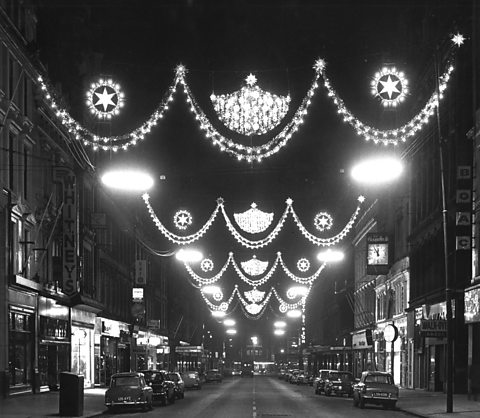
In Trio, Edwin Morgan describes a scene on a city centre street in Glasgow on an evening around Christmas time. A trio of people (each carrying an object) are used to examine joy and goodwill.
- The happy group and the items they carry symbolises happiness and hope.
- Contrast is created between the cold weather and the inviting, seductive warmth of the trio’s friendship.
- The poet uses positive images to describe the group and the items.
- The poem ends with a description of the lasting impression left by the group.
The poem deals with the themes of the power of humanity and the conflict between happiness and despair.
You can read Trio by Edwin Morgan on the Scottish Poetry Library website.
Looking for some quick revision? Try an interactive quiz for National 5 English.
Form and structure of Trio by Edwin Morgan
- Trio is written in a single, unrhymed poem of 27 lines, with no stanza breaks.
- Morgan instead uses The use of run on sentences with no punctuation at the end of lines or across stanzas., A pause that breaks up a line of verse by using punctuation, particularly a full stop. and line breaks to give the impression of a spontaneous set of observations in the moment.
- The poem is written in Free verse is a poem with no set rhyme or rhythm.. This adds to this sense of free-form thoughts, occurring to the speaker in real time as they witness the scene.
Morgan often writes with a very visual and observant perspective, where the reader can feel like we are watching events from the speaker's point of view, place and time. In places, this can even feel like:
- a film, as we zoom out and capture more of a scene than previously revealed, or zoom in and focus on an individual detail
- a journalistic report, as the speaker can feel like a detached observer rather than part of the action unfolding
Lines 1-14
The opening lines of Trio establish the setting in a well-known street in Glasgow:
Coming up Buchanan Street, quickly, on a sharp winter evening
The atmosphere sounds harsh - "sharp" suggests danger and pain, "winter" can symbolise death or endings, "evening" tells us it is dark.
The speaker describes in detail:
- the cold evening
- the time of year
- the setting (a specific city street)
- the trio of people.
A comparison is invited between the trio and the three wise men, who travelled together and brought gifts to celebrate and honour the birth of Jesus. We are told it is "winter" and that the trio are walking "under the Christmas lights" to make this comparison directly. Their position under the lights brings to mind presents under the lights on a Christmas tree. Perhaps this happy group is a present in itself.
These three also carry precious items with them:
- The new guitar brings the promise of music and enjoyment (also suggested by the poem's title, Trio. It represents the gift of giving that we so associate with Christmas.
- The baby represents Jesus and suggests life, new beginnings and hope.
- The chihuahua is a tiny, Mexican dog, so it suggests both something delicate and exotic. It could An allusion is when you refer to a person, place, event or idea that other people will know. For example to a famous story or piece of literature. to the animals present at the birth of Christ.
Extending this A comparison often used to explain or clarify something, often the comparison is made to something different but familiar to the reader. to the three wise men, the Christmas lights referred to could symbolise the star followed by The three wise men from the East who are said to have brought presents to the baby Jesus. to illuminate their destination.
The next five lines offer a description of the items the trio carry. The chihuahua is wrapped in a "tartan coat", the baby in a "white shawl" and the guitar in a "milky plastic cover". All three are wrapped up which suggests they are gifts, but also tells us these fragile objects are being protected. This idea is strengthened by the "brisk sprig of mistletoe" tied to the guitar. In folklore, mistletoe was believed to ward off evil spirits. It fits well with the Christmas setting, suggesting kissing under the mistletoe, and ideas of love, fertility and life.
Morgan uses a metaphor as he describes the trio, revealing that:
their breath rises/in a cloud of happiness.
Their breath becomes a cloud of joy and delight. This is particularly effective at establishing the positive mood of the poem. The breath of the group joins together, and seems to envelop and protect them. The excited optimism of the trio seems to be almost infectious and the speaker delights in their exuberance.
The voice of the young man is heard in the Ordinary, everyday language and dialect. exclamation:
Wait till he sees this but!
The use of the Glaswegian dialect word “but” (meaning something similar to "though" in Standard English) at the end of the sentence adds dialogue and energy to the poem, and reveals how eager he is to see the reaction of the gift's recipient. It also reinforces clearly the specific setting of the piece in Glasgow.
This mood is continued in the description of the chihuahua which is wrapped in:
a tiny Royal Stewart tartan coat like a teapot-holder.
This A simile is a word or phrase used to make a comparison for dramatic effect, using 'like' or 'as'. is light-hearted and compliments the hopeful mood established earlier in the poem.
The brightly-coloured coat becomes something whimsical and slightly ridiculous in a good-natured way. Like the chihuahua, the guitar and baby are also covered and protected in some way, revealing how precious and well cared for they are.
The young baby is also described with a simile:
bright eyes and mouth like/favours in a fresh sweet cake
This A simile is a word or phrase used to make a comparison for dramatic effect, using 'like' or 'as'. is effective because it compares the baby’s features to favours or treats in a celebration cake - something that it is good luck to find. This could be a Christmas cake, suggesting a party or get together. It could be a wedding cake, linking the baby to ideas of love and hope.
The baby is both "fresh" and "sweet", and so has positive connotations of enjoyment. The white shawl the baby is wrapped in suggests white icing, linking the baby and cake visually as well as thematically.
Video - What is a simile?
Morgan uses similes when to describe the chihuahua's coat "like a teapot-holder." and the baby's facial features "like/favours in a fresh sweet cake".
Learn more about similes and why writers use them with this short revision video for National 5 English.
What is a simile? How and why would you use one?
Simile!
A way to compare two things by using the words “like” or “as”
"Using a simile is like painting a picture with words.”
Their food was tough as old boots.
Imagine chowing down on an old shoe?!
This simile suggests that the food was leathery, dry and impossible to chew.
No thank you!
Be careful you don’t get similes mixed up with metaphors.
Metaphors compare two things by saying one is the other.
Similes always use “like” or “as”.
In her poem “George Square” Jackie Kay uses a simile to describe a protest:
“the banners waved at each other like old friends”
As well as suggesting how the banners move and wave together, this simile hints that the atmosphere at the protest was familiar, united and sociable.
Similes don’t always describe something clear, they can be much more complex.
In the novel The Cone Gatherers, Robin Jenkins compares the character Duror to a tree:
“He was like a tree still straight, still showing green leaves; but underground death was creeping along the roots”
Here, Duror is compared to a tree that seems healthy, but is dying on the inside.
This powerful simile tells us that although Duror may appear healthy and well on the outside
Inside, he is being slowly consumed by his hatred.
Using similes is a fun and effective way to explain something complex without using a long list of adjectives.
You can get as creative AS you LIKE!
During this section, Morgan’s word choice also contributes to the positive mood. The "milky" cover on the guitar (a white colour, like that of the baby’s shawl) symbolises innocence and purity.
The mistletoe becomes a "brisk sprig", brisk suggests vitality and liveliness. This adjective, used to describe the greenery, also conveys the energy, vigour and purposefulness in the trio's movements on this cold, crisp evening.
Lines 15-19
There is a change in pace from the longer, descriptive sentences in the first section of the poem by using a Three parallel words, phrases or sentences., three exclamations, in the depiction of the objects the trio carry:
Orphean sprig! Melting baby! Warm chihuahua!
The use of A pause that breaks up a line of verse by using punctuation, particularly a full stop. helps to focus our attention on each of the objects.
The use of the three adjectives is also significant:
- "Orphean" - according to Greek mythology, Orpheus had the power to charm animals, plants and even inanimate rocks with his music. In one story he travelled to the underworld to lead his dead wife back to the world of the living.
- "melting" and "warm" help to convey the joy and happiness emanating from the group
Despite the religious imagery presented earlier, and the Christmas setting, the speaker makes it clear that this is a Not connected with religious or spiritual matters poem in the line:
Whether Christ is born, or is not born
The idea presented is that religious faith is no more relevant or important than the feeling of goodwill and happiness that surrounds this trio. The qualities of generosity, compassion and kindness are not exclusive to religion but inherent in all of us regardless of faith or belief.
Now, though, the speaker moves on to a deeper meditation:
The vale of tears is powerless before you.
This suggests that when confronted with this trio, the sorrows and sadness of life, the "vale of tears" is effectively rendered "powerless". This expression is a biblical phrase; a metaphor for life’s problems and again alludes to religion. The idea implied is that the friendship and camaraderie of this group is just as fulfilling and enriching as any religious faith and equally able to offer protection from life’s hardships.
The speaker then moves on to explain how fate is no match for the joy and goodwill symbolised by the group. Fate is Personification is when a writer gives human characteristics to something that isn’t human. , becoming a foe which:
abdicates/under the Christmas lights
Fate, the perils and difficulties of life, is apparently forced into submission by the trio. We get the impression of the trio embodying happiness and enjoyment which counteracts and provides an antidote to the more difficult, negative aspects of life.
Lines 20-22
The power of the group is demonstrated again:
Monsters of the year / go blank, are scattered back,
Through word choice, the dark parts of life that have troubled us throughout the year are described as "monsters" becoming "blank". The fact that they are "scattered" suggests they have been forced to hurriedly retreat by the strength of group’s goodwill.
can’t bear this march of three
The Metaphors are a way of describing something by directly comparing it to something else. An extended metaphor takes this comparison and builds it over several paragraphs or poems, so it becomes a theme of the piece of writing. of an army in battle is used in the description of the group as a "march of three", with its clear A word used to describe the ideas or feelings that a word might suggest. For example, a skull conjures up thoughts of fear, mortality and death. of the military.
Lines 23-27
– And the three have passed, vanished in the crowd
This line starts with a dash, and ends a Adding extra information using brackets (), commas , or dashes - -. started at the end of line two. All this rich description of the trio and their gifts is contained in the parenthesis. This suggests how fleeting this moment has been as they march happily past the speaker.
The sentence structure of this line emphasises the lasting legacy of the group.
Though they have gone, their positive spirit remains. Morgan uses another parenthesis to reveal the depth of the positive impact of the trio. It shows that, despite their departure, the group have left an impression:
(yet not vanished, for in their arms they wind/the life of men and beasts, and music,/laughter ringing them round like a guard)
Perhaps like the wrapped up gifts carried by the trio, the feeling they have left with the speaker remains wrapped up and protected within him, just as these words are held within brackets.
The conflict between happiness and despair, touched on earlier in the poem, is continued in this final line. Morgan uses "laughter ringing round them like a guard", another simile, comparing the happy sounds of the group to a sentinel which protects against sadness. Joy becomes a protector, keeping negative feelings at bay. This is an optimistic message, suggesting that the trio of people and their items symbolise hope.
What are the themes in Trio?
The power of humanity
One of the important themes in Trio is the value and power of human warmth and togetherness, and the happiness and strength that others - even just those witnessing it, like the speaker and reader of the poem - can derive from this.
The group and their items represent the hopeful, joyful side of life. By evoking this particular scene, the speaker is hoping that the reader can experience the same uplifting feeling of contentment that he did.
The joy and goodwill emanating from the group is inspired by the tradition of gift giving at Christmas. Despite the religious imagery, this is a secular poem.
The speaker suggests that fraternity and generosity can provide as much fulfilment and protection from the negative aspects of life as any form of religion. In a society in which it is easy to become isolated, the speaker celebrates the positive attributes of humanity and the strength that we can draw from one another.
Conflict between happiness and despair
The poem does not simply deal with the joy and strength of humanity without acknowledging the other contrasting side.
The conflict between happiness and despair is touched upon throughout the poem. Morgan frequently compares the happiness of the group to images of cold, dark, suffering and even "monsters".
The joy of the trio becomes a protector ("laughter ringing them round like a guard") against negativity and challenges. This creates a wider message of optimism and hope against the challenges we all face as a society.
Comparing Trio to other Edwin Morgan poems
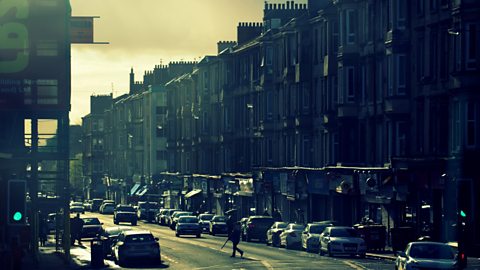
Trio, Glasgow Sonnet (I) and Death in Duke Street are all poems which depict Glasgow and its people. Morgan often wrote about his affection towards his home city but also about the issues affecting it.
Trio takes a very optimistic, joyful view of Glasgow. He describes a scene under the Christmas lights and the trio with "their breath ris[ing] / in a cloud of happiness".
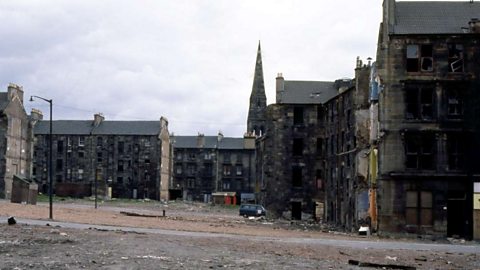
However, Glasgow Sonnet (I) describes a much darker version of the city and its people. It explores poverty, societal neglect and urban decay with words like "Mean", "hackles", and "crazy" all suggesting the chaotic living conditions in the tenement block.
Death in Duke Street is one of Morgan's instamatic poems, it captures a snapshot of a brief moment in time. In this poem a man has fallen ill on Duke Street (a prominent street in Glasgow) and like the other poems, it explores themes of social responsibility, kindness and helping others. Similarly, in Trio there is no act of recall - the speaker is recording what is happening - but the tiny details allow the reader to imagine those scenes incredibly clearly.
In the Snack-bar does not reference a specific Glasgow setting but it does explore the human condition. The happy group in Trio and the items they carry symbolise happiness and hope - what is good about society. In the Snack-bar is more complex in its portrayal of society and how we view each other. Unlike Trio, In the Snack-bar reveals the distasteful side of human nature that makes us so often reluctant to show compassion and kindness to those who may need it most.
This theme of social connection, present in a more positive way in Trio, is also present in both Love and Strawberries. In all three poems, this human connection is central. In Trio, the speaker observes the connection between the people and makes a wider comment about its significance. This love is not portrayed as romantic, but one of warmth and joy, whereas in Strawberries, the poet chooses to focus on one memory, where the connection between the couple is so intense that it is elemental, mirrored in the weather. In Love, the concept of love is represented in a variety of ways, exploring how this universal experience can have so many different aspects. It is clear that Morgan, for all of his poetic playfulness and layers of reference, values humanity first and foremost.
Revise Trio by Edwin Morgan
Revise Trio and other poems by Edwin Morgan with interactive quizzes for National 5 English.
Quizzes - Edwin Morgan. quiz
Test your knowledge of the set texts by Edwin Morgan with interactive quizzes for National 5 English.

More on Edwin Morgan
Find out more by working through a topic
- count7 of 7

- count1 of 7
- count2 of 7
- count3 of 7