Key points
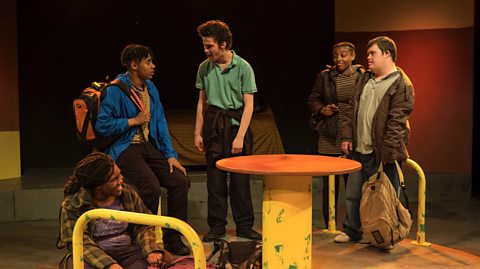
Refugee Boy is set in modern-day England, with flashback scenes set in Ethiopia and Eritrea.
Its context in both the UK and Africa reflects issues which are still relevant around the world today.
Benjamin Zephaniah may have been inspired by events in his own life when he wrote the novel Refugee Boy.
Similarly, Lemn Sissay may have wanted to adapt the novel into a play because of the similarities with his own experiences growing up in care.

Remember
In your essay on Refugee Boy, you need to link to the wider context of the play. You could:
write about relevant aspects of the author’s background and inspiration
link to wider issues in society when the play was written and now
explore possible messages for the audience.
Literary background
The story of Refugee Boy was first imagined by author and poet Benjamin Zephaniah. He wrote it as novel, which was published in 2001.
Lemn Sissay, the playwright and poet, adapted the story into a play which was first published in 2013. When discussing Refugee Boy in an interview, Sissay said “This is my story”, perhaps reflecting on his own Ethiopian background and time spent in foster care.
Benjamin Zephaniah
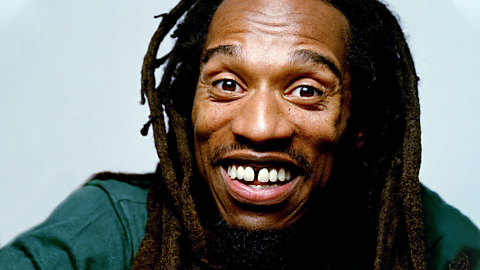
Zephaniah’s parents left the Caribbean and moved to England to find jobs as part of the The Windrush generation refers to the people who migrated from Caribbean countries to the United Kingdom between 1948 and 1971.. His father was a postman and his mother became a nurse.
Zephaniah was born and grew up in Birmingham and had a difficult childhood. He witnessed his mother experience racial prejudice and domestic abuse. He became involved in gang crime and violence, and he spent time in young offenders’ institutions and prison.
Zephaniah left school at 13 years old, partly due to his dyslexia, but was inspired to write poetry about his life experiences. His poems and novels are often political and seek to address injustices in modern society – all themes which are tackled both in his novel and Sissay’s adaptation.
Until his death in 2023, Zephaniah often wrote about identity, prejudice, and in defence of refugees.
Lemn Sissay
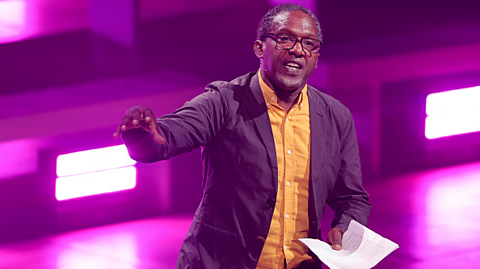
Sissay was born in Wigan, in Greater Manchester. Sissay's mother arrived in Britain from Ethiopia in 1966. This Ethiopian connection may partly explain Sissay’s interest in dramatising this novel.
At two months old, Sissay was put in long-term foster care with a white couple – against his mother’s wishes. When he was 12 years old, the couple returned him to the authorities.
Between the ages of 12 and 18, Sissay moved between different care homes in which he experienced serious racial, physical and emotional abuse.
Sissay started writing poetry "as soon as I moved into a children’s home" and has gone on to gain great success and recognition. Sissay has written poetry and novels that tackle themes ranging from love and peace, to issues such as slavery, social injustice and identity.
Mini quiz
Conflict in Ethiopia and Eritrea
In 1998, war broke out between Ethiopia and Eritrea – two neighbouring countries in Africa. The conflict centred around the town of Badme, where Alem says he was born.
Both countries wanted to claim Badme. As Alem explains: “Some people think this area is part of Ethiopia and some people think this area is part of Eritrea.” The war divided families and communities who lived on either side of the border.
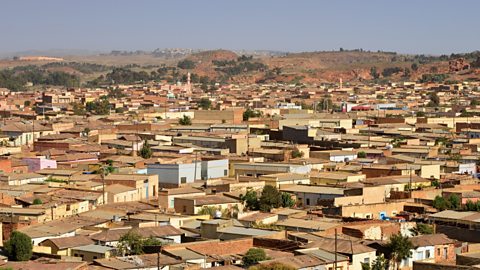
The war – often called ‘The Badme war’ – ended in the year 2000 and a peace agreement was signed.
In 2002 a ‘final and binding’ rule was made by the Eritrea-Ethiopia Boundary Commission granting Badme to Eritrea. Ethiopian troops refused to withdraw and violent outbreaks continued along the border.
As recently as 2020, Eritrean troops reoccupied Badme during fighting in the Tigray region of Ethiopia.
The sudden and Seemingly random or illogical. nature of becoming a refugee due to political events drives the narrative of the play. There is irony in the scenes in both Ethiopia and Eritrea when the soldiers victimise and reject the Kelo family for being both Ethiopian and Eritrean. Clearly the family are victims of circumstances outside of their control.
Question
How does Sissay dramatise the conflict on stage?
| Point | Evidence | Explanation |
|---|---|---|
| Sissay uses violent, noisy stage directions to help us imagine the conflict. | In Scene 5, the flashback begins with “Bang! Bang! Bang!” then later “The door splits the soldiers burst in”. | The noisy stage directions emphasise how this will be a loud, threatening scene to watch. “Bursts” also emphasizes how the actors playing the soldiers will almost invade the set, creating a suddenly threatening mood. |
| The soldiers verbally threaten and abuse the Kelo family in the dialogue. | In Scene 5, the soldier tells them “Leave Ethiopia or die!” | Verbal threats of violence make it clear to the audience that the Kelo family have no choice but to obey. |
| The soldiers physically threaten and abuse the Kelo family. | In Scene 5, this is shown through both stage directions (“The soldier raises the gun”) and the dialogue (“Blood sprays from her mouth”). | The soldiers’ dominance is asserted on stage through their physical actions. Mr Kelo narrates the blood spraying, reinforcing that this act of violence created a vivid, lasting memory for the family. |
Immigration and refugees
Sissay’s message

In the preface to the play, Sissay says in his first line that “immigration is as natural to us as breathing”. He argues that we have all been migrating from the moment we were born when we moved “from the womb into open air”. He says that if we accepted that immigration is natural to humans “there would be more peace in the world”.
Alem echoes Sissay’s positive views when he imagines a life where he and his friends would “travel anywhere in the world together, and "instead of demonstrating” they “would be celebrating”. Sissay encourages the audience to understand that people of all backgrounds and nations can be friends, and that it is normal and enriching for humans to travel and meet new people.
Zephaniah’s inspiration
Mr Kelo and Alem’s experiences as migrants and asylum seekers in the play reflect some of the difficulties people face in the real world. These portrayals of immigration may have been influenced by Zephaniah’s experiences with his parents as part of the Windrush generation, and Sissay’s own immigrant heritage.
Zephaniah explained that, when he wrote the novel, refugees were frequently in the media but often referred to “bogus refugees” or “fake refugees” or talked about through statistics. This is echoed in Sweeney’s comment that refugees are all “thieves and liars”. Zephaniah says he thought, “You know, behind all those statistics there's a human story.”

Did you know?
Zephaniah dedicated Refugee Boy to two teenage refugees he met, called Million and Dereje Hailemariam, who were being denied To seek asylum means to ask for protection, especially if you feel unsafe in your home country. in Britain.
Immigration court

In 1951, the UK and many other countries signed an agreement at a UN Refugee Convention. Amongst other things, those who signed agreed to not send refugees back to their home country if they faced serious threat to their life or freedom.
In Refugee Boy, many characters linked to enforcing immigration law are presented as uninformed and uncaring. As Alem tells his father: “The judge doesn’t know anything about Ethiopia or Eritrea”.
Even when Ruth, playing Alem’s social worker, tells the judge that Alem’s mother has been “brutally murdered”, the judge still refers to the war as a “skirmish”.
The audience is reminded not to make judgements about refugees without knowing the full facts, as the court officials in Alem's case do.
Mini quiz
Perceptions of the UK
Knife crime

Knife crime is often documented in the UK media and linked to ideas of gang culture, city-living and vulnerable young people. Much of the violence that Alem experiences when he is in the UK focuses around knives:
- firstly, Sweeney threatens him with a knife
- then Alem mirrors this by pulling out a knife when a youth tries to steal his bike
- finally, his father is stabbed and killed.
The murder of Mr Kelo warns of the logical conclusion of knife crime: death.
Alem and Sweeney do fit some of the stereotypes described above – they live in the city and are particularly vulnerable – but Sissay also shows how fear informs their decision to carry knives.
Sweeney had a violent upbringing and is perhaps mirroring what he has experienced growing up; Alem feels he needs to protect himself from people like Sweeney.
The audience see that violence leads to more violence and can corrupt even someone as innocent as Alem.
Dickens and Shakespeare
Throughout the play, both Alem and his father make references to the English writers Charles Dickens and William Shakespeare. Mr Kelo is well-educated and Alem loves learning. Mustapha teases him for this saying, “I saw you in class diggin’ on Charles Dickens.”
When Mr Kelo explains that he has applied for asylum and refugee status, he says:
We must ask this great country of Dickens and Shakespeare to let us stay and make a home for ourselves."
Sissay uses Dickens and Shakespeare to symbolise the opportunities the UK education system can offer. However, they also evoke unrealistic, mythologised images of an old-fashioned, idealistic England, which is a contrast with the England that Alem and his family actually encounter.
How does Dickens link to the themes in Refugee Boy?
Charles Dickens grew up in poverty, with his father serving time in prison for unpaid debts. Through his books, Dickens raised awareness of many of the inequalities in Victorian society. For example, Oliver Twist highlights the brutal treatment of orphaned children, whilst A Christmas Carol criticises uncaring rich people who exploit the poor.
By referencing Dickens throughout, Sissay may be:
Reminding us that the need to change our society remains an important issue
Emphasising Mr Kelo and Alem’s intelligence – they could make a positive contribution to society
Showing that ideas and stories can cross borders and unite people all over the world.
Foster care

In Refugee Boy, Sissay criticises some elements of the foster care system. One way he does this is through the violence Alem encounters in the care home which causes him to run away. Another way is through the character of Themba, who takes his own life.
Sissay grew up in foster care and suffered abuse during this time. His criticism could be seen to reflect his own negative experiences in the care system, and he could be trying to raise audience awareness about the challenges young people in care face. In an interview, he said:
It’s not our pity that they need. It’s our respect.”
The growth of the character of Mustapha is important. He starts the play with a confused and immature attitude but learns from his mistakes and goes on to speak powerfully at the rally arguing for the rights of disadvantaged young people.
Likewise, Sissay and Zephaniah overcame difficult childhoods and left school with few academic qualifications. However they went on to become well-known wordsmiths, outspoken on a range of social issues.
Quiz
Test your knowledge of the context of Refugee Boy by completing this multiple-choice quiz.
GCSE English literature revision podcasts. audio
Whether you're at home or on the go, listen to these podcasts by Bitesize and BBC Sounds to refresh your memory of key texts.

More on Refugee Boy
Find out more by working through a topic
- count1 of 5
- count2 of 5
- count3 of 5