Who are the key characters?
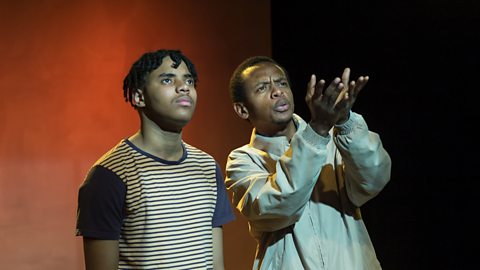
Refugee Boy tells the story of the Kelo family: Alem and his parents Mr and Mrs Kelo.
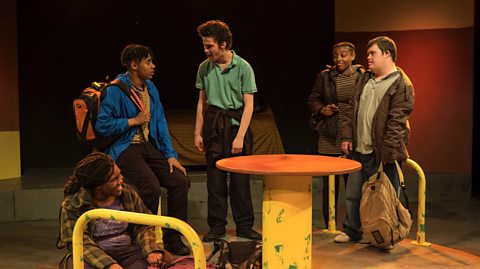
At the children’s home, Alem meets the likeable Mustapha and the unpredictable Sweeney.
Alem is fostered by Mr and Mrs Fitzgerald and their teenage daughter Ruth.
There are various secondary characters including:
Court officials whose lines are delivered by the actors who play the Fitzgeralds, as per the stage directions.
Soldiers who feature in Alem’s flashbacks of Ethiopia and Eritrea
Tewdros, a man from the Kelo family’s political past.

Remember
In your exam you will be asked to write about a character or a theme. If writing about a character, you should include:
Key moments for the character
If and how the character changes throughout the play.
Alem

Innocent
Optimistic
Determined
Alem begins the play as an innocent, gentle, curious young man with a love of learning. His father is from Eritrea and his mother is from Ethiopia. Throughout the play, Alem mostly speaks in English but also speaks in A language widely spoken in both Ethiopia and Eritrea. when he is distressed. For example, Scene 2 begins with “Abetan yet alleh / Where is my father?” Alem also says that he can speak A language spoken widely in Eritrea and the northern regions of Ethiopia..
Alem faces many challenges throughout the play such as being attacked by Sweeney in the children’s home, moving to a foster family, facing immigration court, getting used to a new school and experiencing an attempted mugging. He also experiences traumatic flashbacks to his time living in Ethiopia and Eritrea.
He tries to face these challenges bravely, but when he learns that his mother has been killed, he acts out by threatening the mugger with a knife. Alem mirrors the violence and prejudice that he has been subjected to, even copying Sweeney’s language by saying “I’ll cut you up”.
As the play progresses, Alem becomes increasingly mature. He says that he is “older” and “grown”, and challenges his father’s blind faith in the British justice system: “Our human rights, Dad. Sometimes these judges and Adjudicator people, they don’t listen.” Alem takes control of the situation when he and his father are denied asylum, organising the campaign and rally with his friends.
Despite his hardships, Alem keeps his humanity and hope for good in the world. He speaks maturely and Speaking in a fluent and persuasive way. at the rally in favour of refugee rights saying:
I would love to see the day when there are no more refugees in the world and the world can live in peace.

Did you know?
Alem means ‘world’. Benjamin Zephaniah may have chosen this name in the original novel to remind us of the Something shared by everyone. of Alem’s experience as a refugee.
Mini quiz
Mr Kelo
Moral
Educated
Protective
Mr Kelo is a cultured, educated man. He can speak six languages and has read English writers such as Shakespeare and Dickens. At the start of the play, he is a member of EAST – a political organisation fighting for peace and unity in Africa. When threatened by soldiers, he stays true to his morals and refuses to identify with either Ethiopia or Eritrea. He says: “I am African”.
He is forced into impossible choices by the hatred and An unfair and unreasonable opinion, normally held against groups of people. of others. For example, Mr Kelo tries to save Alem by temporarily leaving him in the UK. He is naïve about life in Britain and has blind faith in the immigration system. He continues to believe that the British justice system will accept their appeal, even until his death.
In flashbacks, Mr Kelo is seen defending his family against soldiers and preparing Alem for life alone in the UK. He is a devoted and loving father. When he asks Alem who loves him, Alem replies without question: “You do. And mother.” His approach to parenting is quite formal – he becomes upset when Alem calls him “Dad” rather than “Father” later on in the play.
Mini quiz
Mrs Kelo
Moral
Loving
Strong
Most of what the audience know about Mrs Kelo is learned through Alem or Mr Kelo’s words. She only appears on stage in the flashbacks where her family are being attacked by soldiers. Her only line is “Aggh” as a soldier hits her in the face with a gun.
Through Alem’s words, the audience learns that Mrs Kelo is educated and politically minded. Like Mr Kelo, she can speak six languages and campaigns with EAST for peace and unity in Africa.
She clearly loves her son and has made hard decisions to ensure his wellbeing and safety. Alem explains that they moved to Eritrea so that he could go to a good school. She was also involved in the decision to leave Alem in London: “Until the fighting stops and our persecution is over, your mother and I think it would be best if you stay in England”.
Mrs Kelo is “killed by some very evil people” and it is implied that her murder was politically motivated, to do with EAST. In his letter to Alem, Mr Kelo says “be as strong as your mother”. Alem says she “was a fighter and would not stay quiet”. He believes that she would want him and his father to continue the fight for justice.
Question
Which scenes does Mrs Kelo appear in?
Answers
Scene 5 when soldiers arrive at Alem’s home in Ethiopia. A soldier raises his gun at her, Mrs Kelo “flinches” and says “Aggh” as she is hit.
Scene 12 when soldiers arrive at their house in Eritrea. The soldier says “This woman is a traitor”.
Mustapha
Lonely
Troubled
Loyal
Alem meets Mustapha in the children’s home. He begins the play as a comedic character, concerned with girls and cars and often getting into trouble. Mustapha never explains his family situation. At first he says that his father was a mechanic, which is why he is so obsessed with cars, but later reveals that his father was “driven away” in a car. He seems to long for belonging and connection.
Initially, Mustapha joins Sweeney in bullying Alem because he is frightened of being bullied himself. He later apologises and they become friends. As the play progresses, Mustapha matures and speaks out passionately for Alem at the rally.
The character of Mustapha highlights the troubles of children in care. He says: “I know about fear. We know. Never really known who I was. Spent a life in different homes.” He could Stands for a much larger idea. hope that young people will create a more accepting society. In his speech at the rally, he asks: “Don’t we all need somewhere we can call home?”
Mini quiz
Sweeney
Unpredictable
Violent
Aggressive
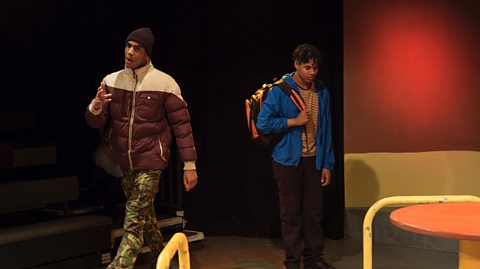
Sweeney is a violent, aggressive and insecure boy whom Alem meets in the children’s home. After Alem accidentally insults Sweeney’s family, he violently attacks Alem, subjects him to racist abuse and threatens him with a knife.
Later in the play, Alem mirrors these behaviours and pulls a knife during an attempted mugging. Sweeney arrives, sends away the mugger, and warns Alem away from a life of crime.
Sweeney is a product of his own abusive upbringing: he reveals that his father used to “beat” him. He warns Alem that violence is not the way forward: “You don’t want to be like us, Alem.”
Sweeney is a Characters who go through notable change in personality throughout a story. meaning that he changes and grows throughout the play. He shows that there is the potential for good inside everyone and that we all have the ability to change and abandon our prejudices.
Question
How are Sweeney and Alem similar?
Answer
As the play progresses and Alem is subjected to more prejudice and trauma, he starts to mirror some of Sweeney’s earlier behaviours. This is especially clear when he is mugged in scene 15.
| Sweeney (Scene 5) | Alem (Scene 15) |
|---|---|
| “You are a Refugee Boy. What are you?” | “Call me a Refugee Boy one more time. Yeah?” |
| “pulls out a knife” | “takes out a knife” |
| “Say one bad word about my family again and I’ll cut you up.” | “If you mess with me one more time, I’ll cut you up.” |
After Sweeney intervenes in the mugging he tells Alem about his violent father and warns him away from behaving like him and becoming “Messed with. Messed up”.
A parallel is drawn between the two characters: both are victims of violence and trauma, despite coming from different countries and having different upbringings.
Mr and Mrs Fitzgerald
Selfless
Welcoming
Moral
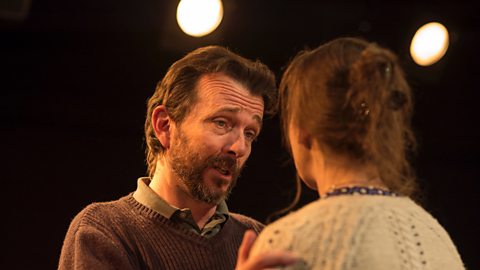
Mr and Mrs Fitzgerald are Alem’s welcoming and gentle foster parents. In Scene 14, Ruth says "We've had nine foster children here.”
The Fitzgeralds are Characters whose main qualities do not change throughout a story. who are presented as kind and well-meaning. When Mr Kelo arrives, the Fitzgeralds also welcome him and even offer him money, whilst keeping Alem's best interests in mind.
Throughout the play, we see the Fitzgeralds experience occasional doubts, make mistakes and argue with each other. These flaws help to make them seem even more human and realistic.
During the courtroom scenes, Mr and Mrs Fitzgerald play various courtroom officials.
Question
Why do the actors who play the Fitzgeralds also play the court officials?
Answer
The Fitzgeralds could be seen to symbolise decency and reflect the idea that most people are moral and welcoming. Their goodness is a contrast to the unwelcoming court and immigration enforcers, which is emphasised through the actors playing the Fitzgeralds also “speaking” the lines of the court officials in those scenes.
Ruth
Passionate
Loving
Mature
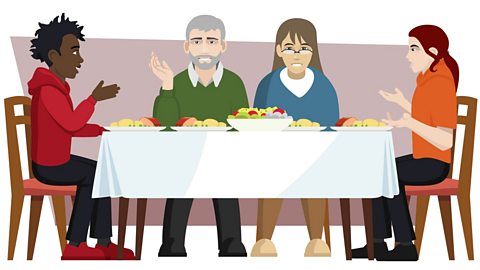
Ruth is the Fitzgerald’s teenage daughter. She initially struggles to bond with Alem and seems to struggle with jealousy and the disruption he brings to her life.
As Alem and Ruth’s relationship develops, she reveals that her unfriendliness was partly due to her falling in love with a previous foster child, called Themba, who “killed himself”. When Ruth comforts Alem after his mother’s murder, this shift in her character demonstrates her capacity to change.
Later, she helps to organise the rally to fight Alem’s deportation and eloquently speaks on behalf of the Kelo family. She symbolises the youth as the future due to her welcoming and moral nature, telling the audience: “It is time that the voice of the youth be heard on this matter”.
Did you know?
Ruth is a biblical name meaning ‘friend’, reflecting how she comforts and fights for Alem.
Mini quiz
Secondary characters
Soldiers
The soldiers are seen in the flashbacks in both Ethiopia and Eritrea. On both sides of the border they abuse the Kelo family.
Court officials
The court officials are played by the actors who play the Fitzgerald family, as per the stage directions. There is a social worker, a lawyer and an adjudicator. They are a A character who is an opposite to another, used to emphasise the contrast between their different qualities. to the kindness of the Fitzgeralds.
Both the soldiers and the court officials are nameless. The adjudicator often speaks as “the state”, which helps to separate him personally from the judgement he is making. He represents a legal system which views people as a collection of facts rather than human beings. The soldier are also anonymous, although Mr Kelo recognises one of them and says “I know you” and “I know your parents”. His is attempt at human connection is rejected.
Question
Why might Sissay have chosen to show the soldiers and court officials?
Answer
Both the soldiers and the court officials are used to create when the audience know something that a character(s) does not. in the play:
Through the soldiers we see the intense violence and impossibility of the Kelos family’s situation. No matter where they are, they are persecuted.
In contrast to this, the court officials dismiss the situation between Ethiopia and Eritrea as a “border dispute” and a “skirmish”. Even though Alem’s mother has been murdered there, the adjudicator merely offers their “condolences”.
Quiz
Test your knowledge of the characters of Refugee Boy by completing this multiple-choice quiz
GCSE English literature revision podcasts. audio
Whether you're at home or on the go, listen to these podcasts by Bitesize and BBC Sounds to refresh your memory of key texts.

More on Refugee Boy
Find out more by working through a topic
- count3 of 5
- count4 of 5
- count1 of 5