Key points
The key A theme is a big idea that can be found throughout the text. It is created by repeating images and ideas. in Refugee Boy are:
Youth
Home and family
Belonging and identity
Hope
Violence
Prejudice

Remember
Many of the themes explored in Refugee Boy are relevant to both Lemn Sissay and Benjamin Zephaniah's own lives.
These themes are used throughout the play and novel to communicate their key messages and ideas.
Youth

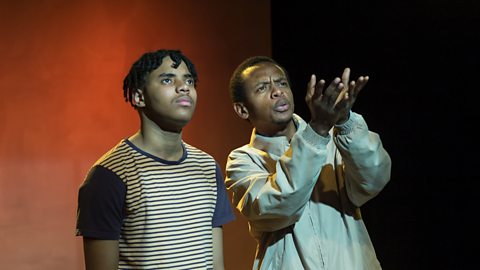
The characters of Ruth and Mustapha are relatable figures. They speak informally and act like stereotypical teenagers, making them accessible for the audience. For example, Ruth complains about her parents saying, “Nugh. Nobody tells me nothing”.
Despite their age, these two characters grow and change in a positive way throughout the play – they are Characters who go through notable change in personality throughout a story..
Unlike many of the adult figures, such as the soldiers or the court officials, who are more set in their beliefs, the teenagers learn to put aside their An unfair and unreasonable opinion, normally held against groups of people.. They unite, campaign and speak passionately for the Kelo family, offering a message of collective responsibility and hope.
At the end of the play, along with Alem, the teenagers act as a mouthpiece for Sissay’s own The author sharing their own opinions through characters or events in their work. – channelling his message about the future. For example, Ruth says:
It is time that the voice of the youth be heard.
Question
Sweeney is also a teenager. Is he a dynamic character too?
Yes. Even the character of Sweeney could represent hope and change, despite his behaviour at the start of the play.
Sweeney’s violent and unpredictable nature shows how young people can reflect their environment. He has had an abusive upbringing and, in turn, acts abusively.
In Scene 15, he acknowledges this and tries to break the cycle of violence. When Alem pulls out a knife, he warns him: “No, you stop it… You don’t want to be like us”. Sweeney’s character suggests that everyone has the capacity for change and empathy.
Home and family
The Kelo family
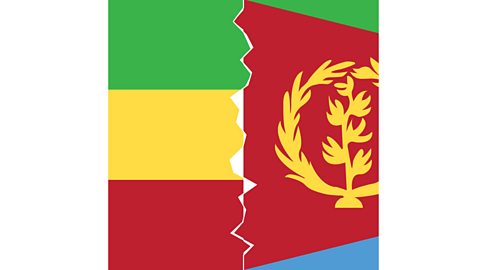
Due to the ongoing war around their hometown of Badme, the Kelo family cannot find a safe home in either Ethiopia or Eritrea. The impossibility of their situation is clear when Mr and Mrs Kelo make the difficult decision to leave Alem alone in London. Although heart-breaking, it is a selfless act that demonstrates the strength of their love for their son.
When Alem wakes up alone in the hotel in London, his use of Amharic shows his strong connection to his family and homeland:
Abaten yet alleh / where is my father?
Alem’s use of Amharic, and desperation for his father, emphasizes how connected he feels to his family in Africa: this connection endures throughout the play across many miles and borders.
Likewise, Mr Kelo refuses to be defined by man-made borders. He does not identify as Ethiopian or Eritrean, he tells the soldiers “I am African” and campaigns for unity.
Question
Which other characters are linked to the theme of home and family?
Mustapha
Initially, Mustapha lies about his father being an expert mechanic to impress Alem.
However, he later reveals the truth: “My dad didn’t know anything about cars” but “Every car I see I think it’s him driving his way back”.
Mustapha's constant talk about cars shows his longing for his father’s return.
Friends as family
Mustapha, Ruth, and Sweeney develop a protective attitude towards Alem.
Mustapha says that “Friends are like the family you make” and they form their own chosen ‘family’ towards the end of the play.
The Fitzgerald family
The Fitzgerald family are a modern, flexible family that welcome both Alem and his father, as well as nine previous foster children. Their kindness is clear from Mr Fitzgerald’s first lines: “You’ll be right at home here, boy.”
Mr Fitzgerald immediately welcomes Alem into their family. His use of the word “home” is especially powerful, implying not only can Alem stay as long as he needs, but that he is genuinely welcome and a part of their family.
Sweeney
Despite the abuse he suffered at the hands of his family, Sweeney is incredibly protective of them. In their altercation in Scene 4, Sweeney asks, “You talkin’ bad about my family?” before assaulting Alem and threatening him with a knife.
This erratic behaviour demonstrates not only how damaged Sweeney is due to his father’s abuse, but also the strength of feeling that can exist between family members, regardless of their situation.
Mini quiz
Identity
Fixed and fluid

In Refugee Boy, some aspects of the characters’ identities are fixed (unchanging) and others are fluid (changing).
In some ways, we see the best aspects of the characters remain fixed throughout the play. For example:
Mr Kelo never gives up his belief in the goodness of others
The Fitzgerald family continues to welcome new foster children.
The characters’ negative aspects are challenged and change as the plot develops and they learn from one another. For example:
Ruth learns to welcome Alem, rather than be hostile
Mustapha learns to say sorry and to stand up for his friends, rather than joining in with bullying
Sweeney protects Alem from being mugged, rather than attacking him himself.
The dynamic nature of the characters could symbolise immigration as a natural part of identity – they all learn from each other regardless of race or background.
These interactions echo Sissay’s preface to the play when he says: "Immigration is as natural to us as breathing" and "We are adapting all the time".
Question
Is Alem’s identity fixed or fluid?
Some aspects of Alem’s identity are fixed. For example, he keeps many of his positive habits and views, such as his love of reading and studying, and he learns from others around him. He particularly learns from Ruth and Mustapha who help him adapt to life in the UK.
However, his identity is also fluid and we are shown how negative environments can To have a bad influence on somebody, causing them to act worse. even the most innocent people. After being attacked by Sweeney and hearing of his mother’s death, Alem pulls a knife when ‘Hooded’ attempts to mug him. His violent threats echo the violence and bullying he has experienced: “You want some? You want to fight?”
Sissay might be using this dynamic part of Alem’s character to raise awareness of the suffering and danger people experience as refugees or in foster care. As a result of this suffering, the previously innocent and studious Alem is now acting in a reckless and violent way.
Code switching
Sissay uses Alem’s language to show his changing identity throughout the play.
The play begins with Alem speaking Ahmaric: “Abaten neh feligalloh / I want my father”. His identity is fixed and aligned with his family and country.
He then moves into speaking English, but it is formal and awkward, in contrast to his peers: “I have mathematics, English, sports and a timetable that instructs which lessons are where.”
Question
As Alem gets used to life in England, his language begins to change and he code switches, which means that he starts to speak more like his friends.
What are some examples to show this?
Answers
When Mustapha cannot believe Alem enjoys school, he responds “Yeah, it’s difficult but that’s how I learn. Man”. The full stop before “Man” emphasises the slightly awkward way Alem has added this slang word, showing that he is changing his speech to better fit in with his new friends and identity.
Later, Alem experiments with other slang phrases such as “Yo momma” which show a more fluid identity – he’s learning from the other students around him and developing a more irreverent humour.
Alem ends the play lovingly supported by Ruth and Mustapha, able to speak naturally and persuasively on stage: “I would love to see a day when there are no more refugees in the world and the world can live in peace”.
This code-switching helps the audience to track how Alem’s identity is slowly developing through his interactions with other characters.
Hope
Stars

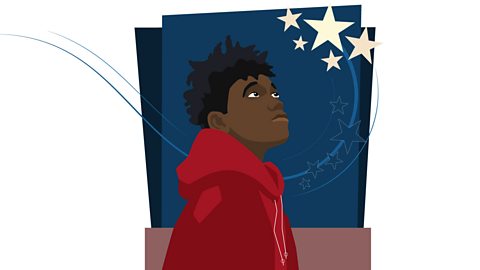
In Refugee Boy, hope is frequently symbolised by stars.
The play begins with Mr Kelo teaching Alem about the North star. Through a number of flashbacks, the stars link Alem to his father despite geographical distance.
Stars also have links to navigation, especially the North star, and Alem’s final lines “The North star decided he would always shine” may also suggest a hopeful ending to the play, with his father still guiding him from beyond the grave.
Stars are also used as a metaphor for love by the Fitzgeralds:
Count them and times by as many and you won’t get close to how much I love you.
Throughout the play, the Fitzgeralds symbolise how ordinary people offer hope for the world. They offer support to the most vulnerable, welcoming and supporting Alem and later his father despite their challenging circumstances.
The Repeated pattern, phrase or idea. of stars – including the first and last scenes, final speeches and even the preface to the play have a hopeful tone, celebrating all that is best in humanity.
Hope is fragile
However, hope is not certain to lead to positive outcomes. Mr and Mrs Kelo hope and campaign for peace and racial unity through the political organisation EAST. They go to great lengths to preserve their family but are both killed.
At the end of the play, Alem’s future is uncertain, and his final lines are a flashback to him pleading with his father: “Can I come? Please. Please. Can I? Can I?”. By finishing the play by returning to a younger, more vulnerable version of Alem, Sissay emphasises the danger and vulnerability of current Alem’s situation.
Question
Does Refugee Boy have a hopeful ending?
The answer to this question is Unclear, often deliberately so..
| Yes | Alem is surrounded by friends and family. At the rally, we assume the general public are there in support against his deportation. |
| No | Alem now has lost his birth family. The courts still plan to deport him. |
This ambiguous ending may reflect a key message from Sissay. Whilst there is great hope for society, we must all take immediate action to make the world a better place – especially those in power. Sissay writes in his preface:
Reach for the stars Alem because darkness surrounds you.
Mini quiz
Violence

The Kelo family’s home, Badme, is portrayed as a violent place. In flashbacks, the family are attacked whether they are in Ethiopia or Eritrea, and are forced to leave their home. Later, Alem’s mother is murdered in a political attack. The violence follows Mr Kelo to London, and he is also murdered by the same political organisation.
However, the UK also is shown to be a violent and unfair place through the character of Sweeney. He has experienced a violent upbringing, and in turn is racist and violent towards Alem. In self-defence, Alem takes on this violence, stealing and carrying a knife to protect himself.
Notably, Alem’s flashbacks are triggered by traumatic events taking place in the UK.
Sweeney’s attack on Alem leads into Scene 5, the flashback to soldiers attacking the Kelo family in Ethiopia.
Similarly, when Alem learns of his mother's death he believes he hears a banging at the Fitzgeralds’ door which leads into another flashback in Scene 12, where soldiers attack the Kelo family in Eritrea.
This helps the audience to better understand Alem’s mindset: he is on high-alert and these stress-induced flashbacks show how his memories of past violence are inescapable and spill over into his new life.
Prejudice
Sissay examines different forms of prejudice in Refugee Boy.
The Kelo family experience prejudice from the soldiers in the flashbacks because Mr and Mrs Kelo are from different countries and have married.
Alem also faces prejudice from Sweeney for being a refugee. Sweeney calls refugees “liars and thieves”. He tells Alem that “you’re all poison”. He doesn’t see Alem as an individual.
The UK courts are also prejudiced against the Kelo family. They are told that Mrs Kelo has been “hacked to death” but seem ill-informed, insensitive and refuse to see the war as anything more than a “border dispute”.
It could be argued that much of the prejudice in Refugee Boy is sparked by fear and ignorance: the soldiers, Sweeney and the court officials fear that refugees, like the Kelo family, could have a negative impact on their countries.
However, their racist insults and ignorance emphasise how dangerous prejudice can be. The Kelo family are dehumanised and not allowed basic human rights, like a home.
Question
There is repetition in the insults that the Kelos family face.
Sweeney: "you’re all poison."
Soldier (in Ethiopia): "A dirty poison, a A dog whose parents are of different breeds.."
Soldier (in Eritrea): "Dirty dog traitors."
What might this repetition suggest?
The repetition of similar insults across two different continents emphasises how people can be prejudiced all over the world. It also shows how people are similar all over the world – even in their hate.
Sissay draws similarities between these events to show how damaging prejudice can be and how we must challenge it whenever we encounter it.
Quiz
Test your knowledge of the themes of Refugee Boy by completing this multiple-choice quiz.
GCSE English literature revision podcasts. audio
Whether you're at home or on the go, listen to these podcasts by Bitesize and BBC Sounds to refresh your memory of key texts.

More on Refugee Boy
Find out more by working through a topic
- count4 of 5
- count1 of 5
- count2 of 5