Key points
- Deforming means changing the shape of a material by bending, stretching, or compressing it.
- Vacuum forming involves heating a sheet of plastic until soft and then stretching it over a mould using a vacuum to create a shaped object.
- Line bending heats a plastic sheet along a specific line, allowing it to be bent into a desired shape.
- Metal folding uses a machine to apply pressure and bend metal sheets into different shapes.
- Heat treatments involve controlled heating and cooling of metals to alter their properties, with processes like annealing, normalising, hardening, and tempering to achieve different effects.
Shaping materials is crucial in design and manufacturing, enabling us to transform raw resources into functional products and structures. Different materials respond uniquely to forces like bending, stretching, and compressing. Understanding these responses and employing techniques like vacuum forming, line bending, and heat treatment allows us to manipulate both plastics and metals precisely.
Accuracy, Tolerance and Quality Control
In a workshop, precision is important for making good-quality items. Accuracy, tolerance, and quality control help ensure every cut and measurement is correct. Using tools like saws, callipers, and micrometers, you can check that your work matches the required dimensions and tolerances, keeping everything consistent and excellent.
Accuracy refers to how close a measurement or dimension is to the intended or desired value. When using a saw to cut wood, accuracy means making sure the cut is exactly where you want it, matching the measurements on your plan.
Tolerance represents the range within which a dimension can vary while still being acceptable. If a part should be 100 mm in diameter with a tolerance of ±1 mm, it means the part can be between 99 mm and 101 mm and still be considered correct.
Use measuring tools like callipers or micrometers to check the dimensions of the workpiece after processing. Compare these dimensions to the required accuracy and tolerance to ensure the work meets the specifications.
Quality Control — regularly measure and inspect workpieces during and after processing to ensure that both accuracy and tolerance are maintained throughout the project.
Deforming
Deforming means changing the shape of a material by bending, stretching or compressing it. It's like moulding or shaping a material to fit a new form
Vacuum forming
Vacuum forming is a process where a sheet of plastic is heated until it's soft, then stretched over a mould. A vacuum is used to pull the plastic tightly against the mould, shaping it to fit. After it cools, the plastic holds the shape of the mould.
This video explains the processes involved with Vacuum Forming, the easiest way to make hollow plastic mouldings which can be used in a wide variety of RMT design/make projects.
Vacuum forming is used to make plastic housing or components for a wide range of items, from food packaging and masks to helmets and parts for aeroplanes.
Let's take a look at how it's done.
Before we get started here's what you'll need:
MDF or similar material to make your mould
Access to a vacuum former
Some sandpaper
A release agent or furniture polish
Goggles, apron and a dust mask.
And for finishing you'll need a mould cutter or jig saw, as well as a sanding board and wet and dry paper.
The first step is to make an MDF mould or pattern which will be used to shape the plastic.
Your mould will need a few features to work best.
Firstly, it should have a flat base so that it can sit on the platen of the vacuum former. There should be no undercuts so that it can be easily removed from the formed plastic.
Always make sure that any recesses or grooves have a pattern of small holes drilled around the edges. This ensures that the plastic is sucked into the mould rather than being draped across the surface.
Most importantly, the mould needs to have a draft angle, which is an angle or slope of typically 5 to 10 degrees. The draft angle ensures that the mould can be easily removed.
And finally, the surface of the mould needs to be sanded smooth to resist sticking. It can also help if you coat the surface with a release agent or furniture polish.
Now, you can place your finished mould onto the platen in the base of the vacuum former and lower the platen into the machine.
Clamp your thermoplastic sheet onto the seal.
Make sure that the sheet sits on the seal all the way around and that the clamp presses the plastic sheet evenly on to the seal.
Once that's in place, you can turn on the heaters and slide them over the plastic sheet.
At first the plastic will warp as it warms, then sag slightly and then pull tight as it reaches the right temperature and softness.
Now you can turn off the heaters and slide off the lid.
Next, raise the platen with the mould on top, which will press the mould into the soft plastic.
Activate the vacuum pump to evacuate the air, creating the atmospheric pressure which will form the plastic around your mould.
After 30 to 60 seconds, turn off the vacuum. If your machine has a reverse air-flow button, use it now as it will force air back into the mould and help to break the contact between the mould and your plastic component.
And now it's time to trim and finish your plastic item using a combination of a mould cutter, sand paper or sanding board, plastic scrapers, and wet and dry paper.
- Lower mould into vacuum former.
- Heat the plastic until soft.
- Bring the mould up into the plastic using the lever.
- Switch on the vacuum to suck out all the air.
- Switch off vacuum and remove the plastic.
- Remove moulds – cut away excess plastic.
Sometimes talc can be dusted on the A hollow container used to give shape to molten materials. to help it drop out with ease. A good vacuum-formed product will only be possible if a good mould has first been made. The mould must have a draft angle, so it doesn’t get stuck in the plastic. A draft angle is a slant that on each side of a vacuum moulded part. This helps with releasing the part from the mould.
Line bending
Line bending is a process where a plastic sheet is heated along a specific line until it becomes soft. Once soft, the plastic can be bent along the heated line to form a shape. After bending, the plastic cools and stays in the new shape
Line bending is a technique used to make precise folds in plastic components. The process is demonstrated using a strip heater and a hot wire line bender. Acrylic is used in this demonstration but the process can be used for a variety of thermoplastics.
Line bending is used to make straight, precise folds in plastic components. Items like mobile phone stands are made using this process.
Before we get started here's what you'll need:
A sheet of plastic, usually acrylic is best
Access to a hotwire heater or strip heater
And a right angle or adjustable jig.
Cut the plastic sheet to the size and shape you need for your design. If you are using a CAD/CAM method then use a laser cutter. But you can also use a jig saw or coping saw and sand and finish the edges.
There are a few different options for heating plastic to bending point.
For this example, we are using a hot wire heater, but the process is the same for a strip heater.
Set the hot wire heater to the correct temperature for the type and thickness of your plastic. Acrylic like this softens at 160 degrees Celsius, but high impact polystyrene would soften at 80 to 90 degrees.
Heat the plastic until it bends easily in your fingers.
If the plastic is over 6mm thick, it will require a cooler wire and a longer heating time and will need be turned during heating to ensure that it doesn't burn.
Using an appropriate angle or adjustable jig, hold the plastic at your desired angle until its cool.
Our 3mm thick sheet will need to be held in position for two minutes, but thicker plastics would need to be held for longer.
In general, you'll need about two minutes for every three millimetres of thickness.
Once it's cooled, then you're ready to finish your plastic product.
Check out the 'Explain This… Finishing plastic' in this series for more detail.
A line bender has a heated wire that provides heat, concentrated to just a few millimetres wide. The wire heats plastics along a line so they can be bent. Once the plastic softens, it can be bent easily into shape around a A solid shape that is often used to make a mould before being left to cool.
Metal folding
Metal folding is a process where metal sheets are bent into different shapes. A machine applies pressure to fold the metal along a specific line or angle. This is used to create parts or structures with precise angles and shapes.
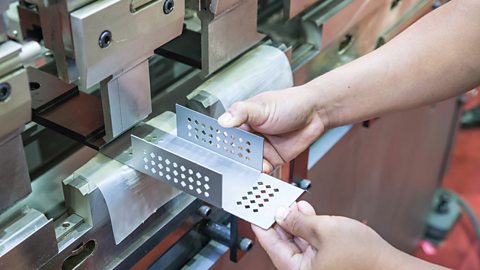
Sheet metal can be easily bent using a manual folding machine also known as a ‘Box Pan Folder’. The piece of sheet metal is first clamped into position. The user then pushes the handle upwards, and the sheet metal is shaped to the required angle.
Heat treatments
Heat treatment involves the controlled heating and cooling of metals to alter their physical and mechanical properties.
Annealing
Annealing is a heat treatment process that softens metals, improves Ductility is the ability of a material to be pulled into long thin fibres. and relieves internal stresses from machining. Metals are heated below melting point, held for a time then slowly cooled in a furnace or oven to enhance toughness and reduce the risk of metal cracking from work.
- HEAT
The metal is heated to a specific temperature, usually below its melting point. This allows the internal structure of the metal to change, relieving any internal stresses that were built up during processes like cutting or shaping. - HOLD
The metal is kept at this high temperature for a certain period. This step ensures that the heat penetrates all parts of the metal, promoting even changes throughout. - COOL
After holding it at the high temperature, the metal is slowly cooled down. This gradual cooling process helps the metal retain its new, softer properties.
- Relieves Stress: When metals are shaped or machined, they can develop internal stresses that make them more likely to crack or break. Annealing helps relieve these stresses.
- Improves Ductility: Annealed metals are more flexible and easier to shape without damaging them.
- Enhances Strength: While annealing softens the metal, it also improves its overall strength and durability.
Example:
When a plumber needs to bend or shape a pipe to fit it into a tight space, they might heat the pipe first. This heating process softens the pipe, making it easier to bend without breaking. The plumber can create smooth, strong bends in the pipes.
Normalising
Normalising is a heat treatment that strengthens and toughens metal, especially steel. The metal is heated until red-hot to change its structure, then cooled in air at room temperature. This cooling method refines the grain structure, making the metal tougher and easier to work with, without making it overly brittle.
- HEAT
The metal is heated until it is red-hot, changing its internal structure. - COOL
The heated metal is then cooled in the air at room temperature.
- To improve toughness and refine the metal's grain structure, making it easier to work with.
- It prevents the metal from becoming too brittle, allowing it to withstand stress better.
- This cooling method helps create a uniform grain structure, improving overall properties.
Example:
Metal is normalised during the production of steel beams used in construction. After the steel is forged and shaped, it undergoes normalising to improve its toughness and strength. This process helps refine the grain structure of the steel, making it less likely to crack or deform under heavy loads.
Hardening
Hardening is a heat treatment process used to increase the hardness and strength of a metal. The metal is heated to a high temperature, typically above its The critical temperature for hardening is the temperature at which a metal's chemical structure changes., allowing its internal structure to change. After reaching this temperature, the metal is rapidly cooled, usually by quenching it in water or oil. This fast cooling locks the new structure in place, making the metal harder.
Hardening can make the metal more brittle, so it is often followed by tempering to reduce brittleness while maintaining strength.
Hardened tool steel is used for making drill bits. The hardening process makes the drill bits durable and able to cut through hard materials.
HEAT
The metal is heated to a high temperature (usually red in colour indicates 800 degrees C)COOL
Rapidly cool, typically by quenching in water or oil.
- This process changes the metal's internal structure, making it harder by locking in the new arrangement of particles.
Example:
Hardening drill bits is a practical technique to enhance their durability and effectiveness for drilling tasks.
Tempering
Tempering is a heat treatment process used to reduce the brittleness of hardened metals while maintaining their strength. After hardening a metal can become very hard but also brittle which can lead to cracking.
In tempering the hardened metal is reheated to a lower temperature and is then held at this temperature for a specific period before being allowed to cool down gradually.
As a result of tempering the material is more ductile, has improved toughness and is relatively hard.
High carbon steel is used to make knives. After hardening the steel is tempered to reduce brittleness and make the knife tougher and less likely to snap during use.
REHEAT
The hardened metal is reheated to a specific temperature (usually lower than hardening)HOLD
Temperature is held for a set period of timeCOOL
Allowed to cool down gradually.
- The metal becomes more ductile and tough, reducing the risk of brittleness and cracking.
Example:
A tempered drill bit is strong yet flexible enough to withstand drilling forces.

The A pattern of letters, words, ideas or associations which help with memorising something.ANew Hard Tool can help you to learn the heat treatments
Annealing: heats and cools slowly to make metal soft and ductile.
Normalising: heats and cools in air to make metal tougher and stronger.
Hardening: heats and quenches rapidly to make metal very hard but brittle.
Tempering: reheats to reduce brittleness and improve toughness while retaining strength.
Annealing
CARE
C - Cooling: Controlled cooling is essential to the process.
A - Alloy: Often applied to various metals and alloys.
R - Relief: Relieves internal stresses in the metal.
E - Enhancement: Enhances ductility and overall mechanical properties.
Normalising
THAW
T - Toughness: Increases toughness in the metal.
H - Heat: Involves heating the metal to a high temperature.
A - Air Cooling: Cooled in air at room temperature.
W - Workability: Improves workability and refines the grain structure.
Hardening
HARD
H - High Temperature: The metal is heated to a high temperature.
A - Active Cooling: Rapidly cooled, usually by quenching in water or oil.
R - Resilience: Increases hardness and strength of the metal.
D - Definite Structure: Locks in the new internal structure for enhanced durability.
Tempering
TEMP
T -Temperature Adjustment: Reheated to lower temperature.
E - Enhanced Toughness: Reduces brittleness.
M - Maintain Strength: Keeps the hardness.
P - Period Hold: Held at temperature for a time.
Test yourself
More on Manufacturing - tools and processes
Find out more by working through a topic
- count6 of 7
- count7 of 7