Dividing decimals
Dividing is the opposite of multiplying. When you divide a decimal number by 10, 100 and 1000, the place value of the digits in the number decrease.
Place value is the position of a digit in a number. The same digit has a different value at a different position in a number.
You can use a place value chart to help see the value of each digit in a number.
Quiz: Divide decimals by 10, 100 and 1000
Why not see how much you know about this topic already? Then work through the page and see if you can beat your score.
Dividing decimals by 10
Let's look at the rule for dividing decimal numbers by 10.
To divide a decimal by 10, move the digits one place value column to the right.
The number then becomes 10 times smaller.
For example, let's divide 3.95 by 10.
39.5 ÷ 10
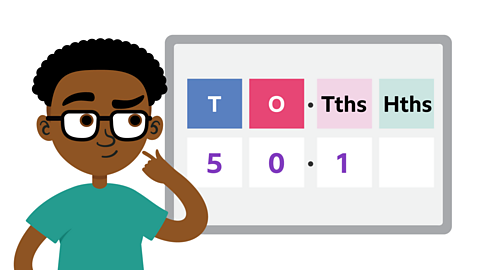
You can use a place value chart to help you.
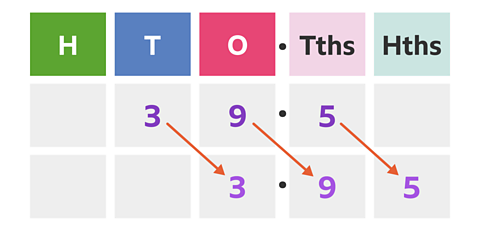
You can see that each digit in the number moves one place value column to the right. Therefore:
39.5 ÷ 10 = 3.95
Let's look at another example.
161.4 ÷ 10
Look at the slideshow to see how the place value of each digit changes when you divide by 10.
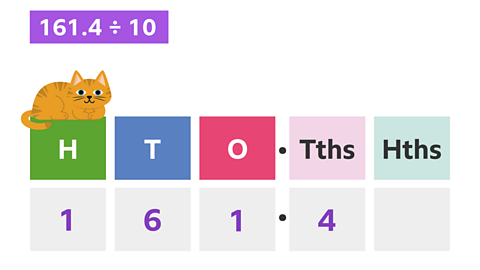
Image caption, The digits of 161.4 are shown in the hundreds, tens and one's column with one digit in the tenths column.
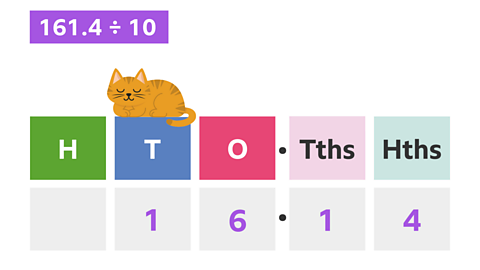
1 of 2
Dividing decimals by 100
Dividing decimals by 100 is the same as dividing by 10 and then dividing by 10 again.
Let's try an example:
312 ÷ 100
Look at the slideshow below to see how the place value of each digit changes when you divide by 100.
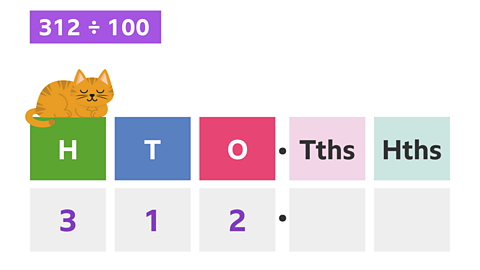
Image caption, To divide by 100, you move the digits two places to the right.
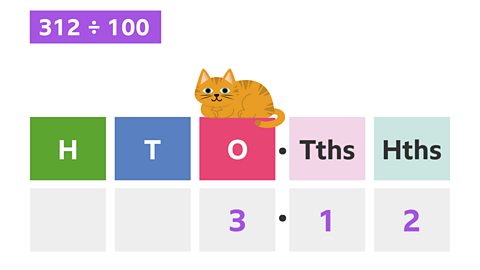
1 of 2
Dividing decimals by 1000
To divide by 1000, you move the digits three places to the right.
Let's look at an example:
40 ÷ 1000
Look at the slideshow below to see how the place value of each digit changes when you divide by 1000.
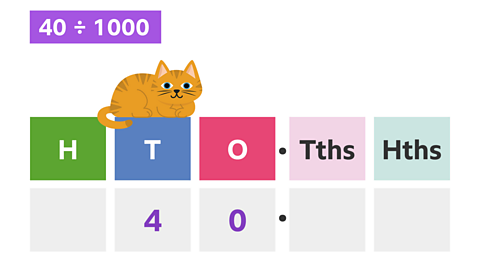
Image caption, A way to help you remember how many places the digits need to move is by looking at the zeros in 10, 100 and 1000. There are 3 zeros in 1000, so you need to move the digits 3 places to the right to divide by 1000.
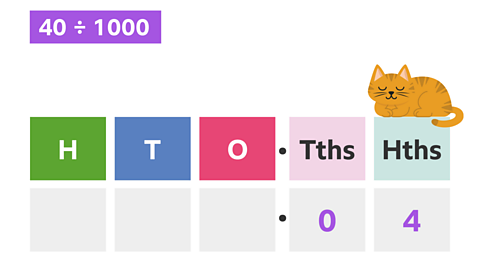
1 of 2
Example 1
Dividing decimals by 10, 100 or 1000 is useful in everyday life. It can be used to convert measures, such as centimetres to metres, grams to kilograms and millilitres to litres.
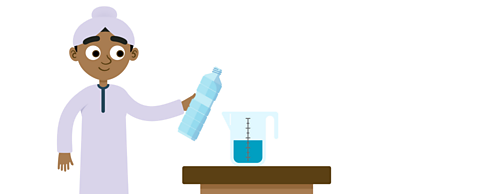
A bottle holds 3250 millilitres. What is this amount in litres?
✓ There are 1000ml in 1 litres. So you need to divide 3250 by 1000.
You can use a place value chart to help convert 3250ml to litres.
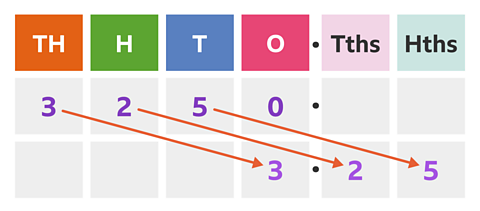
The digits move 3 place value columns to the the right.
3250 ÷ 1000 = 3.25
3250ml is the same as 3.25 litres.
Example 2
Anika has collected a mixture of pounds and pennies.
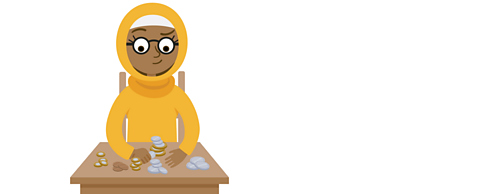
Anika has worked out that there is 723 pence altogether, but what is that amount in pounds?
✓ There are 100 pence in a pound, so the calculation is:
723 ÷ 100
Let's use a place value table to help show this.
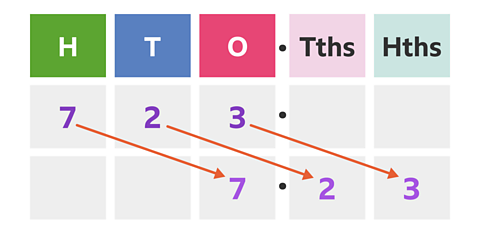
The digits move 2 places to the right.
723 ÷ 100 = 7.23
Therefore, Anika has collected £7.23
More on Multiplying and dividing
Find out more by working through a topic
- count29 of 32
- count30 of 32
- count31 of 32