What is an area model?
An area model is a rectangular grid that can help you solve multiplication problems. The process is similar to how you find the area of a rectangle.
Two-digit numbers can be partitioned into smaller parts to make them easier to multiply.
The area model below shows how the multiplication calculation 14 × 16 can be partitioned into a series of smaller multiplication calculations.
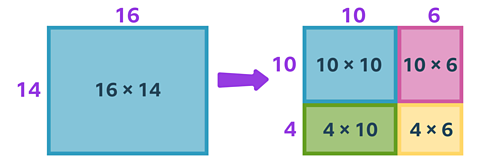
First, find the answer to each of these smaller multiplication calculations:
10 × 10 = 100
10 × 6 = 60
4 × 10 = 40
4 × 6 = 24
Then you can add all the results together to find the answer:
100 + 60 + 40 + 24 = 224
Therefore:
16 × 14 = 224
Activity: Multiplying using an area model
Complete this interactive activity to understand how to use an area model to multiply. Then put your knowledge to the test.
Area models
You can use partitioning skills to start completing an area model.
Think about the multiplication calculation 27 × 48.
The number 27 can be partitioned into 20 and 7. The number 48 can be partitioned into 40 and 8.
Take a look at a completed area model for this calculation.
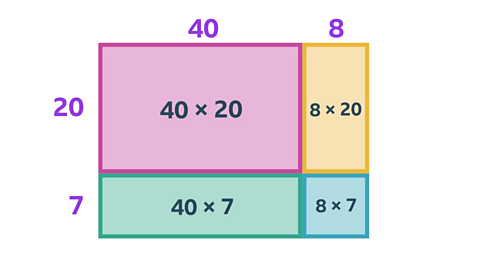
When the numbers are partitioned, you can work out the answers to the smaller multiplication calculations for each of the parts you have created.
Then you should add the results together to find the answer.
The results are:
40 × 20 = 800
8 × 20 = 160
40 × 7 = 280
8 × 7 = 56
All that's left to do is add together the results:
800 + 160 + 280 + 56 = 1296
So you now know that:
27 × 48 = 1,296
Example 1
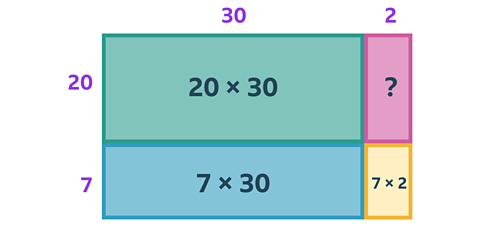
What is missing from this area model?
✓ 20 × 2 is missing from the area model.
On the model, the number 27 has been partitioned into 20 and 7.
The number 32 has been partitioned into 30 and 2.
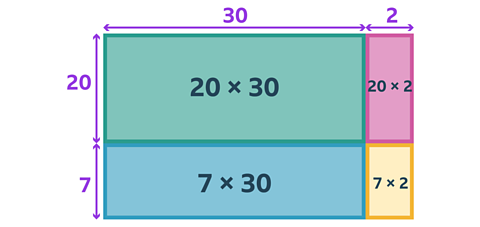
You can work out:
30 × 20 = 600
30 × 7 = 210
20 × 2 = 40
2 × 7 = 14
Then you can add the answers together to work out the answer to 27 × 32.
600 + 210 + 40 + 14 = 864
Therefore:
27 × 32 = 864
Can you think of other ways you could partition these numbers?
Example 2
Take a look at this area model and answer these two questions.
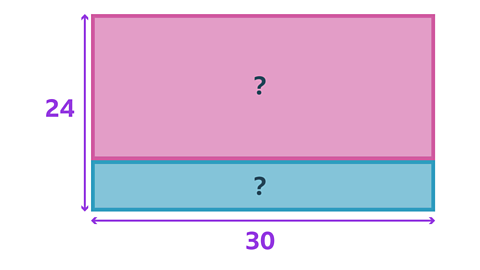
- What are the two multiplication calculations missing from this area model?
- What is 24 × 30?
✓ The missing multiplication calculations are:
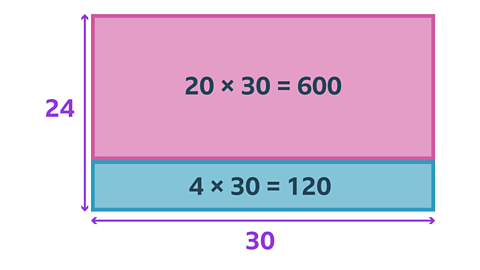
30 × 20 = 600
30 × 4 = 120
To find the answer to 24 × 30 add those results together:
600 + 120 = 720
Therefore:
24 × 30 = 720
Example 3
Look at this area model and answer these questions.
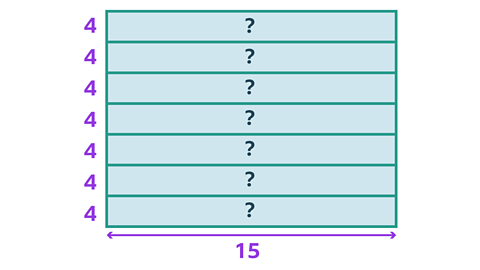
- What is missing from the rows?
- What number has been partitioned?
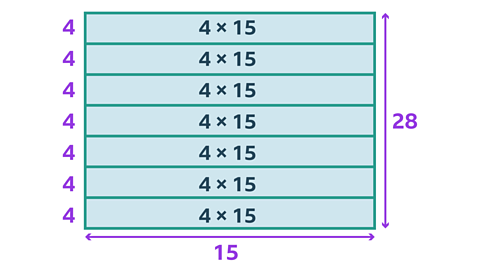
✓ The multiplication calculation 4 × 15 is missing in these rows.
There are 7 sets of 4, so you can say that the number that has been partitioned is 28 because:
7 × 4 = 28
Play our fun maths game Guardians: Defenders of Mathematica. game
Use your times tables and more maths skills to defeat monsters and reclaim the Kingdom of Mathematica
More on Multiplying and dividing
Find out more by working through a topic
- count30 of 32
- count31 of 32

- count1 of 32